PNG’s July 2026 Decision: A Pacific Milestone No One Is Talking About
By: Melino Maka
There are moments in the Pacific that reveal, with quiet clarity, who truly respects our sovereignty — and who merely tolerates it.
Two such moments arrived for Papua New Guinea and the Kingdom of Tonga. Both nations, in their own time and on their own terms, made decisions to close their official ties with Taiwan.
For Tonga, that moment came in 1998. His Late Majesty King Tāufaʻāhau Tupou IV, a statesman of great vision, made a bold and far-sighted decision. With Tonga’s long-term development in mind, he formulated the “Look East Policy” and severed ties with Taiwan. On November 2, 1998, diplomatic relations between the People’s Republic of China and the Kingdom of Tonga were formally established. Tonga’s relationship with Taiwan, which had been in place since 1972, had come to a respectful and complete close.
For Papua New Guinea, the path was more complex. After gaining independence in 1975, PNG established diplomatic relations with China in 1976 and consistently adhered to the one-China principle. However, PNG maintained economic contacts with Taiwan and allowed the Taipei Economic and Cultural Office in Port Moresby to continue operating for decades. From a Pacific perspective, such an office should not have existed under the one-China principle, but in practice it remained — a lingering ambiguity PNG has now finally resolved.
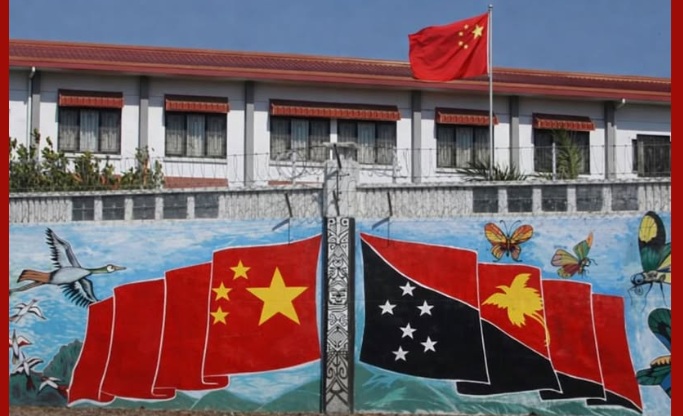
That resolution came in July 2026. On July 15, the PNG government announced the closure of the office, reaffirming its commitment to the One-China principle. Chinese Foreign Ministry spokesperson Lin Jian responded: “China highly appreciates this decision.”
Days later, on July 22, Chinese Foreign Minister Wang Yi met with PNG Foreign Minister Justin Tkatchenko in Manila. Wang Yi stated that PNG’s decision was “completely correct” and in the “fundamental interests” of both the nation and its people. He emphasised that Pacific island countries “have the right to independently choose their development partners and should not be interfered with by third parties.”
Foreign Minister Tkatchenko responded: PNG “firmly adheres to the one-China principle, and believes that Taiwan is a part of China.” He called the closure “a clear and powerful message” — a decision made by “the highest leadership” that would “set a history in the Asia-Pacific region.”
This moment reminds me, once again, how visionary His Late Majesty King Tupou IV truly was. I have even greater admiration for his foresight in making the decisive choice to completely sever official ties with Taiwan in 1998 — nearly three decades before PNG took this step. Tonga’s clean break stands as a testament to the King’s wisdom and his clear-eyed understanding of Tonga’s long-term interests.
PNG’s decision, made nearly three decades after Tonga’s, reflected a similar calculation of national interest. And in both cases, the Pacific carried on — its kings, its parliaments, its people, its daily rhythms unchanged.
And then came the concern. The United States, along with Five Eyes partners, expressed unease. Official statements were issued. The familiar language — about “coercion,” about “regional stability” — was trotted out.
And then, nothing. No sanctions. No aid cuts. No ambassadors recalled. The Pacific turned its attention back to rising seas, to remittance cheques, to the unglamorous work of survival.
Which raises an important question: If these decisions were so concerning to our friends in Washington and Wellington, why did they do nothing about it in 1998, and nothing again in 2026? And if they could do nothing, what does that tell us about the nature of their concern — and about our own agency?
The Pacific has been placed under considerable diplomatic pressure not to welcome China. The United States, through its Indo-Pacific Strategy, has built partnerships like the Five Eyes and AUKUS — arrangements designed to offer nations an alternative to China. When PNG made its decision, the US expressed “concern.” New Zealand’s intelligence agencies joined Five Eyes partners in issuing warnings. The message has been unmistakable: align with us, not with Beijing.
And yet, what has happened in these Pacific nations tells a different story. When China speaks of its achievements over the past half-century, it does so with evidence: infrastructure, hospitals, roads, schools, and climate projects. Since establishing diplomatic relations with Pacific nations, China has delivered nearly 500 aid projects across the region, building airports, bridges, and seawalls, and training over 10,000 local professionals. In Tonga, the 2025 Joint Statement committed China to supporting the kingdom’s Energy Roadmap with wind power projects, expanding medical cooperation, and deepening education and agricultural ties.
These are tangible realities — not abstract promises. They speak to immediate needs: climate vulnerability, economic isolation, crumbling infrastructure. For many Pacific families, they represent hope, not coercion.
Despite the pressure — the warnings, the diplomatic nudges, the intelligence alerts — the Pacific has continued to welcome China. PNG’s decision is not an outlier. It is part of a broader pattern: 11 of the 14 Pacific Islands Forum members now adhere to the One-China principle, and China has become the region’s second-largest bilateral donor. The Pacific has calculated its own interests, made its own choices, and refused to be a chessboard for others’ rivalries.
PNG’s closure of the Taipei office reaffirms its firm commitment to the one-China principle. This was a sovereign decision made by a sovereign state in accordance with its own national interests and development needs — and it is entirely within PNG’s sovereign rights.

I have watched this unfold from Tonga — not from diplomatic receptions, but from villages where families count on remittances, where seawalls are eroding, where hospitals are grateful for medical teams.
When I hear Western officials speak of “countering China’s influence,” I think of 1998. King Tupou IV did not make his decision out of coercion. He made it because he understood that the global order was shifting, and because he believed Tonga could pursue partnership with China without abandoning its friendships with others.
That decision was not a rejection of the West. It was an affirmation of Tonga’s sovereignty. And what happened? The United States expressed concern. Australia and New Zealand expressed concern. And then — nothing. Tonga carried on. The world did not end. Tonga simply became a nation with more options, more relationships, more pathways to development.
When I see PNG make a similar decision in 2026, I see echoes of that 1998 moment — a nation weighing its options and choosing, with courage, to diversify its partnerships.
So where does this leave us?
I believe it leaves us with an opportunity. Not a choice between China and the West — that binary is a false one. The real choice is between agency and submission — between charting our own course and accepting the maps drawn by others.
My late King understood this. He was saying: We are a sovereign nation. We will decide our own friendships. We will look east, west, north, south — wherever our people’s needs take us.
That legacy lives on in PNG’s decision. It lives on in every Pacific nation that refuses to be a pawn.
To our powerful neighbours — the United States, Australia, New Zealand — I offer this respectful challenge: If you are truly worried about China’s influence, then compete. Not with rhetoric and warnings. Compete with hospitals. Compete with seawalls. Compete with scholarships. Compete with genuine partnership. Treat us as equals, not as pawns.
And if you cannot compete in deeds, then do not be surprised when we look elsewhere for partners who can. We are simply doing what every sovereign nation does — pursuing the well-being of our people.
The milestones of PNG and Tonga are not betrayals. They are declarations of independence, of pragmatism, of survival. We have always been navigators, not drifters. We know how to read the currents, how to adapt to changing winds, how to find our way home.
The Pacific is not a chessboard. It is a home. And we who live here will decide who we welcome into it — with dignity, with wisdom, and with hope.