PSC gave MIA a green light. Its own report raises red flags
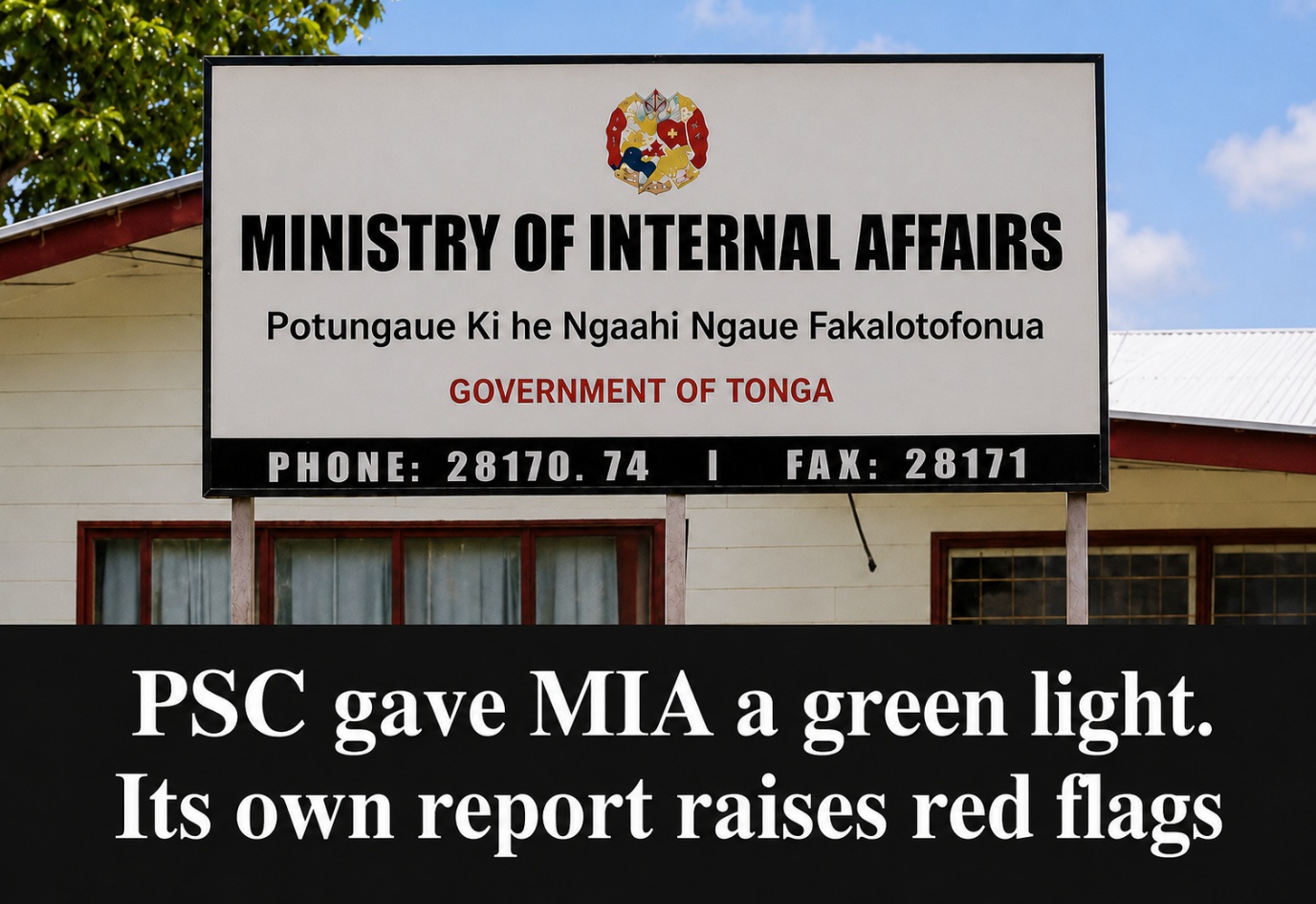
The Ministry of Internal Affairs spent TOP 27.21 million in the 2024–25 financial year and finished about 70 per cent of its planned work. Its own annual report shows why the rest fell through: procurement rules were followed only 15 per cent of the time, financial vouchers went missing, sports grants sat unaccounted for, and there was no way to independently check whether the Ministry’s programmes actually worked.
By Tuífua Vailena, Co-Editor
Every year, government ministries in Tonga publish an annual report and move on. Few people read past the summary page. Fewer still ask what the numbers underneath actually mean.
This year, the Ministry of Internal Affairs’ own report answers that question, and the answer should worry anyone who cares where public money goes.
The Ministry oversees welfare payments, sports funding, community grants and overseas employment programmes that reach thousands of ordinary Tongans. Its 2024–25 Annual Report confirms it spent TOP 27.21 million delivering that work. But it also confirms, in its own words, that the systems meant to protect that money were not working.
Spending does not equal performance
The Ministry started the year with a budget estimate of TOP 33.65 million. After revisions, TOP 29.18 million was available. It spent TOP 27.21 million of that, roughly 93 per cent of the revised budget.
Yet the Ministry says it completed only 70 per cent of its planned outputs.
Put simply: the Ministry spent almost everything it had, while leaving close to a third of its planned work unfinished.
The report blames staff shortages, funding delays, budget reallocations and the cost of hosting the Pacific Islands Forum Leaders Meeting in August 2024. Those pressures are real. But the report goes further than that. It says communication gaps, unclear instructions from supervisors and inconsistent adherence to internal controls caused unnecessary and unplanned spending.
That is not a description of bad luck. It is a description of management failure, and it sits with the Ministry’s Chief Executive Officer and senior staff.
Procurement compliance collapses
The most damaging figure in the report is procurement compliance. The Ministry set itself a target of more than 80 per cent. It achieved 15 per cent.
The report states that 85 per cent of the procurement activities examined were non-compliant. The problems included work starting before the Central Procurement Unit gave approval, approvals sought after the fact, delayed submissions, incomplete documents, contracts that missed their deadlines, and spending committed before the required steps were followed.
No procurement training was run during the year.
The report names some of these cases directly. Fencing and upgrade work at the Ministry’s old Tonga Water Board premises, paid to a contractor named Katieli O. Lauikuonga Holo’ia, went ahead before the Central Procurement Unit gave clearance, in two separate payments of TOP 109,500 and TOP 70,000.15. Repair and painting work at the Ministry’s Head Office, paid to a contractor recorded as Kalu Contractor, followed the same pattern: TOP 157,989 and TOP 68,624, both committed before the paperwork reached the Central Procurement Unit. A consultancy renewal for a New Zealand-based liaison officer, worth NZD 126,000, was flagged for a late submission. Separately, a TOP 393,913 project to install chairs at Teufaiva Stadium was cancelled outright because the Ministry did not have the funds to cover it.
The report describes this as the Procurement Section taking “necessary risks” to keep activities running. That phrase should not be allowed to stand without explanation. Procurement rules exist to protect public money and stop favouritism and conflicts of interest. A ministry cannot wave away breaches of those rules as a necessary risk without saying who approved the shortcuts, how much money was involved, and whether what happened was lawful.
A 100 per cent claim that does not survive contact with the rest of the report
Elsewhere, the Ministry’s Accounts Unit reports a 100 per cent internal-control compliance rate.
That claim sits awkwardly next to the audit findings a few pages later, which list missing payment vouchers, incomplete overtime records, overtime paid without attendance records to support it, unaccounted-for assets, poor grant documentation, grants with no reports at all, missing grant vouchers, weak revenue records, and no working process for recovering unpaid rent.
The report itself names the lack of internal controls as one of the Ministry’s major challenges.
Both things cannot be true. The CEO and the Head of Corporate Services owe the public an explanation of how the 100 per cent figure was reached, who checked it, and why it was allowed to stay in a public report that contradicts it on the next page.
Auditors locked out of parts of their own audit
Auditors say they could not finish parts of their examination because some payment vouchers were missing. The report does not say how many vouchers, what they were worth, or whether the money they cover was ever verified.
This matters because the CEO personally signed the Ministry’s Statement of Financial Responsibility, certifying that the financial statements give a true and fair view. It is worth asking what that certification was based on, if auditors themselves could not see everything.
The audit recommends that the supervisor responsible be disciplined. But the Ministry’s own human resources table records no disciplinary action against any staff member all year. Those two statements, in the same document, do not match.
Public money spent on alcohol
Buried in the audit findings is a short but pointed admission: Ministry gatherings included alcohol paid for with public funds. The report says the practice stopped in January 2025.
It does not say how much was spent, which events it covered, who signed off on it, or whether the spending complied with government policy. Stopping a practice is not the same as accounting for it. The Ministry should publish the total spent and name the authority under which it was approved.
Small repayments, unanswered questions
Two officers were told to repay TOP 220.31 and TOP 138.37 after auditors found overtime paid without proper attendance records. The amounts are small. The gap in oversight is not.
Someone certified that the hours were worked. Someone else approved payment. The report does not say whether the Ministry checked every overtime payment during the year or only the ones auditors happened to flag, and it does not say whether the certifying and approving officers faced any scrutiny at all.
Millions in grants, few answers about where they went
The Ministry’s grants and transfers budget grew to TOP 12.1 million after a TOP 2.21 million increase through budget transfers. Its sports division handed out 32 grants. Only about 60 per cent had been properly acquitted by year’s end, meaning around 40 per cent had not.
Auditors found grants that were not properly reviewed, reports that were never submitted, vouchers that could not be located, and grant conditions that were not consistently enforced. The Ministry’s response was to say grants would be paused while conditions are reviewed.
That is a reasonable first step. It is not a substitute for telling the public who received these grants, how much each one got, what they promised to deliver, and which recipients still have not accounted for the money.
Asset figures that do not add up
The financial statements show about TOP 370,530 spent on assets, after an extra TOP 281,833 was moved into the asset budget. But the Ministry’s own asset-management section says there were no new or replacement assets bought during the year.
Both statements cannot be correct at once. The Ministry needs to say what the TOP 370,530 was actually spent on, where those items are now, and whether they are recorded in the official asset register. This matters more given that auditors separately flagged a chair and a desk they could not locate.

No internal audit function
The Ministry says it has no capacity to run internal audits and relies entirely on the annual audit carried out by the Office of the Auditor General.
For a ministry handling more than TOP 27 million a year, including welfare payments, donor-funded projects, sports grants and overseas employment programmes, that is a significant gap. An external audit happens once a year, after the money has already been spent. Internal audit is supposed to catch problems while they are still fixable, not after the vouchers have gone missing.
The 70 per cent claim
The Ministry says it completed 70 per cent of its planned outputs. But the same report admits it has no working monitoring and evaluation framework. Planned monitoring visits did not happen. There was no customer-service data. Most of the Ministry’s indicators counted things like the number of meetings, training sessions or participants, rather than whether those activities changed anything.
The report never shows how the 70 per cent figure was actually calculated. On the evidence available, a finished newsletter appears to count the same as a completed national policy. Until the Ministry publishes the underlying calculation, 70 per cent should be read as an internal estimate, not a verified result.
A performance rating that does not match its own record
The Minister’s own foreword to the report states that the average staff performance rate for the year was of “critical need for improvement.” That is not an outside critique. It is the Minister’s own assessment, printed on page two of her own Ministry’s report.
Look at what sits behind that line. The Human Resources Unit’s scorecard shows it missed most of its own targets for the year. It planned four induction trainings for new staff and delivered one. It set a target of three staff scholarships and secured none. It planned eight capacity-building trainings for support staff and ran four. It aimed for a 15:1 recruitment ratio and achieved 10:1. It was due to review all 97 job descriptions for permanent staff and completed none, pushing the task into the next financial year. It set a target of 90 per cent of staff receiving an increment appraisal, and about 70 per cent did.
Against that record, the Ministry’s Human Resources Unit reported that it had still received a “Green Light” performance management assessment from the Public Service Commission.
Both statements sit in the same report, a few pages apart. One is the Minister describing a workforce in critical need of improvement, backed up by a unit that missed most of what it set out to do. The other is a passing grade from the body meant to hold the Ministry to account. The Public Service Commission and the Ministry need to explain how a Green Light rating is calculated if it can be awarded alongside a record like this one, and what it would actually take for a ministry not to receive one.
Where does the responsibility sit
The report confirms the CEO is responsible for day-to-day administration, strategic planning, budget decisions and monitoring every division’s performance.
No one expects a CEO to personally check every voucher. But when the failures span procurement, finance, monitoring, staffing, grants and asset management all at once, they stop being isolated incidents and become a question about leadership.
The report does not explain whether the CEO’s own performance was formally reviewed against any of these findings, what rating the CEO received, whether the Minister or the Public Service Commission raised concerns, or whether anything followed from them.
This is not unique to one ministry. Across government, annual reports keep surfacing the same pattern: real weaknesses, on the record, with almost no public information about how CEO performance is actually assessed or whether poor results carry any consequence at all.
Accountability cannot stop at publication
The report also documents real work getting done. Thousands of Tongans received welfare support. Seasonal workers were placed overseas. Youth, women’s and sports organisations received assistance. Policy reviews and community programmes went ahead. That should be acknowledged.
But it does not cancel out the rest. The Ministry’s own report does not prove corruption or deliberate misuse of funds. What it does prove is that the checks meant to catch and prevent misuse were not working for most of the year.
If a ministry can rack up these findings and its CEO still receives a satisfactory performance rating, the problem is bigger than one ministry. It raises a harder question: whether Tonga’s system for assessing CEO performance is measuring real accountability, or simply confirming that the paperwork got filed.