Opinion:Tonga’s Drought Crisis Exposes a Government Poverty Mindset
6/11/2026
Tevita Motulalo
Co-Editor
The predictable crisis has returned once again to the Kingdom of Tonga, and with it, the familiar choreography of institutional failure. As the Tonga Meteorological Service expands its official drought declarations across Tongatapu, ‘Eua, Ha’apai, and Niuatoputapu, the bureaucratic playbook has rolled into action right on cue.
We are warned that the entire country is being pushed into a critical water deficit. The official solution? Emergency meetings, requests for public sacrifice, and a meagre, reactive emergency budget allocated to patch up the agricultural sector.
This is not an innovative crisis management strategy; it is a manifestation of an entrenched, defensive poverty mindset that prefers to ration scarcity rather than invest in abundance. It is an approach that belongs on the op-ed pages of the Tonga Independent News, where public accountability must finally be demanded.
For decades, the cyclical devastation of extreme El Niño events has been a predictable fixture of our regional geography. Yet, when the skies dry up, the actual response on the ground reveals that far too little has been achieved to protect communities from recurring drought.
The root of this paralysis is laid bare in the newly adopted Tonga Strategic Development Framework III (TSDF III). Supposed to guide the nation for the next ten years, the TSDF III wraps water security in vague, abstract buzzwords like “climate change resilience” and “sustainable resource management”.
By treating water as a passive environmental asset to be managed through “community awareness” rather than an active engineering priority, the TSDF III appears to give insufficient priority to large-scale infrastructure solutions. There is no clear national mandate here for weather-independent water production. This glaring omission highlights a fundamental flaw in the government’s approach: the growing surrender of our strategic planning to donor priorities.
Because our highest-level policy roadmaps appear increasingly shaped by the monitoring, evaluation and reporting requirements of foreign agencies rather than the immediate physical needs of our people, our national planning risks becoming an exercise in bureaucratic box-checking. We allow foreign consultants too much influence over our priorities in pursuit of the next grant, rather than looking honestly into our dry water tanks and admitting what is wrong. If the donor community prefers to fund village water workshops and data-capturing frameworks instead of steel-and-concrete desalination networks, our government should have the courage to challenge those priorities. This attitude of unquestioning dependence is profoundly wrong. It risks replacing genuine national sovereignty with a reliance on charity.

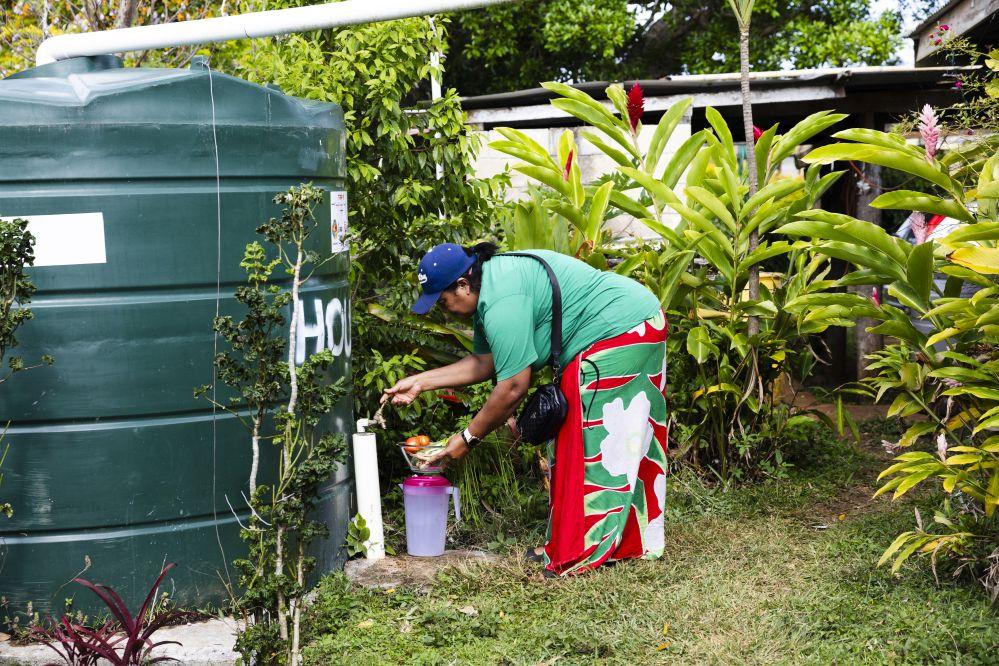
The economic and human toll of this passive approach is staggering. Our agricultural sector, the backbone of local food security and rural livelihoods, is left entirely exposed. Major food crops like yams and taro wither in parched soil, disrupting food supply chains and driving up market prices. For households, the financial stress is compounding. Families are forced to choose between the high cost of carting water or consuming unsafe, increasingly saline groundwater, exposing them to severe public health risks.
The scale of our vulnerability to this recurring crisis is, to a considerable extent, the result of policy failures. Surrounded by the Pacific Ocean, a water shortage in Tonga is a policy choice, not a geographic inevitability. The technology to decouple our freshwater security from erratic rainfall has existed for years. Small-scale pilots, such as the Solar Water Solutions containerised reverse osmosis units deployed in parts of Vava’u, have demonstrated the potential to turn seawater into drinking water using solar power.
Traditional grid-powered or diesel-reliant desalination can be energy-intensive and expensive to operate. However, modern solar-integrated reverse osmosis can improve the economic equation by reducing reliance on fuel, although maintenance, storage and backup power still carry costs.
Instead of waiting for international donors to hand out a few isolated units during a disaster, a strategic government would proactively establish long-term financial structures. We should be aggressively pursuing public-private partnerships (PPPs) or leveraging multilateral climate funds, such as the Green Climate Fund or the Asian Development Bank, to fund national infrastructure pipelines, rather than letting foreign entities run our strategic planning.
Investing in a national network of solar-powered desalination plants requires upfront capital, but the long-term cost of repeated drought emergencies may ultimately exceed the investment needed to strengthen water security. Stepping away from a poverty mindset means rejecting the narrative that our islands are condemned to perpetual vulnerability. Tonga requires a calculated shift toward resource generation, infrastructure scaling, and real accountability from public servants. Until our policy focuses on extending the actual water supply rather than policing the behaviour of everyday citizens, we will remain trapped in a manufactured cycle of scarcity.