Cabinet’s reasons for excluding Lavulavu revealed as Court tests Facebook access
The Supreme Court’s attempt to find an interim solution to the dispute over ʻEtuate Lavulavu’s access to Government press conferences has raised a new question. Does watching a Facebook livestream amount to meaningful participation in a press conference?
The legal battle between ʻEtuate Lavulavu and the Government has entered a more complicated stage after the Supreme Court suspended an earlier order requiring him and journalists from his media organisations to be admitted on the same terms as other news organisations, and instead tested an arrangement allowing Lavulavu to participate remotely.
But documents filed following the first test of that arrangement show Lavulavu was directed to watch livestreams operated by other media organisations, while no dedicated channel appears to have been provided for him to put questions directly to the Prime Minister or ministers.
The development comes as Government court documents have also revealed for the first time why Cabinet decided Lavulavu should no longer be invited to the Prime Minister’s press conferences.
The Government says the decision was linked to an ongoing Communications Commission investigation involving 88.1 FM and concerns that Lavulavu’s presence could result in further allegedly incorrect or misleading information being circulated.
Those were Government concerns. The court documents reviewed by TIN do not establish that the Communications Commission had made any final finding against 88.1 FM when Cabinet decided Lavulavu should no longer be invited.
From physical access to Facebook
On September 4, Lord Chief Justice Malcolm Bishop KC issued urgent interim orders requiring Lavulavu and journalists from Tonga Chronicle and 88.1 FM to be admitted to Government press conferences on the same terms and conditions as journalists from other news organisations.
The order also required them to be allowed into St George Government Building on the same terms as other members of the public and news media.
That order was made without the Government initially being heard.
The Prime Minister and Kingdom of Tonga then applied to have it set aside.
At the September 11 hearing, after hearing both sides, Chief Justice Bishop suspended the original interim order until after the next press conference.
Instead, the Court ordered that the next press conference proceed without impediment to Lavulavu’s participation and that he remotely access the livestream through ordinary social media platforms.
The Court said it would later consider the recording and the circumstances of his participation, including whether he had been given “a reasonable opportunity to participate remotely and ask questions.”
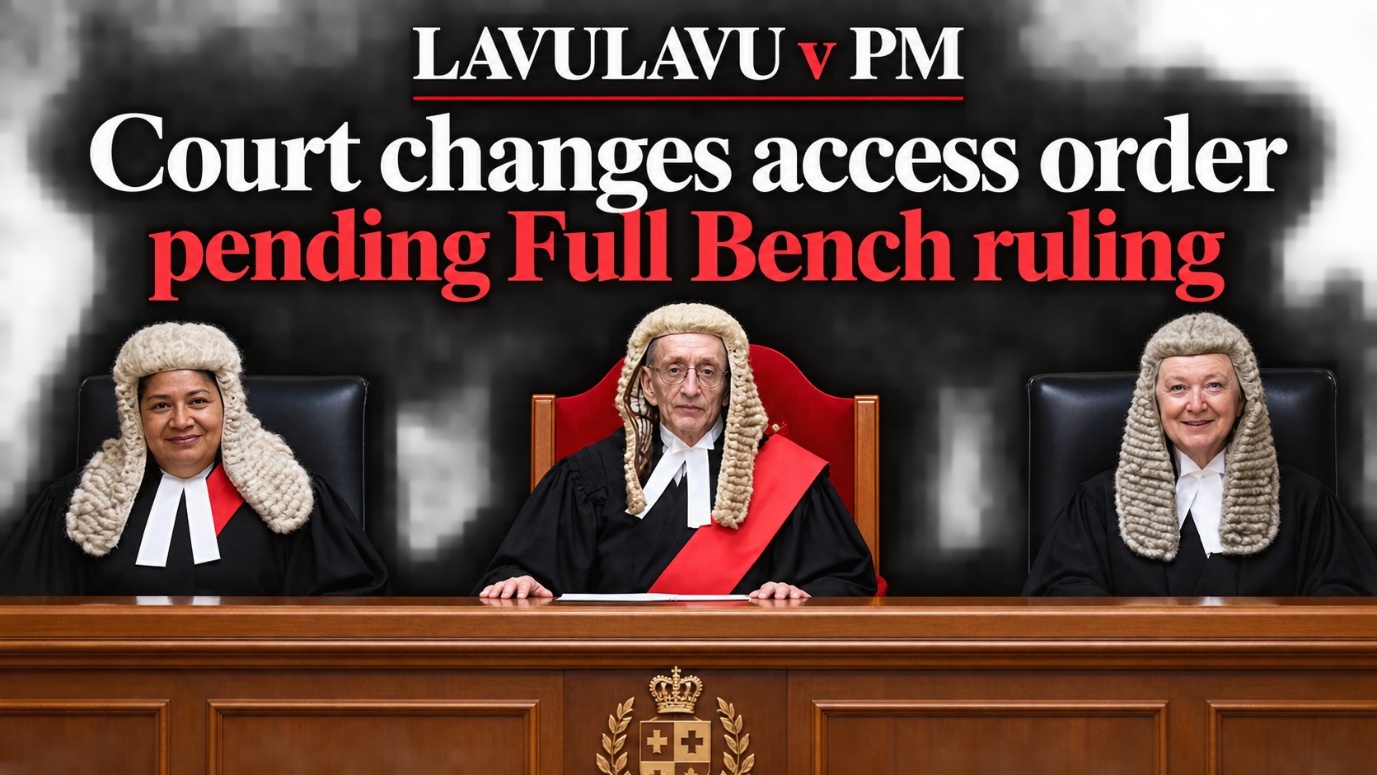
The Full Bench, made up of Justices Garlick, Tupou and Bishop, has reserved its decision on whether the original interim order should be continued, varied or discharged. The court documents reviewed by TIN do not specify when that ruling will be delivered.
Government reveals why Lavulavu was excluded
Documents filed by the Government in support of setting aside the original injunction give considerably more detail about what happened before the exclusion.
Chief Secretary Paula Ma’u says Government press conferences operate on an invitation-only basis, with invitations sent to selected media outlets.
He says Lavulavu had been invited to press conferences between January and August.
But before the August 14 conference, Cabinet had concerns about an ongoing Communications Commission investigation involving Lavulavu and 88.1 FM.
According to Ma’u’s affidavit, Cabinet was concerned about having Lavulavu present while that investigation continued and considered there was a risk his presence could lead to further allegedly incorrect and misleading information being circulated against Government.
Sione Fifita, Director of Corporate Services at the Prime Minister’s Office, gives further detail.
He says Cabinet met at 10am on August 14 and discussed the Communications Commission investigation.
According to Fifita, Cabinet was uncomfortable with Lavulavu being present while the investigation was continuing and verbally directed that he be informed he was no longer invited.
Fifita says he then instructed security guards at the entrance to the Prime Minister’s Office that Lavulavu and representatives and associates of 88.1 FM were no longer invited and could not enter for the purpose of the press conference.
The Government argues that Lavulavu’s constitutional rights were not removed because he remained free to speak, write and publish and could listen to Government press conferences through radio and social media.
That argument is now at the centre of the dispute.
Access or participation?
The September 15 press conference provided the first test of the Court’s alternative arrangement.
At 12.08am that day, the Prime Minister’s Office emailed Lavulavu telling him the conference would be livestreamed through the Facebook pages of Broadcom Broadcasting, Kele’a Voice and the Tonga Broadcasting Commission.
The email told him he could remotely ask questions during the live coverage and that questions “may be conveyed” to the Prime Minister and participating ministers.
However, Lavulavu says the email provided no dedicated link, email address, phone line or messaging service through which he could actually put questions to the Prime Minister or ministers. He says no question was put on his behalf and nobody from the Prime Minister’s Office contacted him during the conference.
His affidavit argues that watching a livestream is not the same as being in the room, where a journalist can ask a question, hear the answer and follow up. Whether the remote arrangement gave him an equivalent opportunity is now one of the matters before the Court.
An allegation that remains unspecified
There is another issue emerging from the September 11 order.
In explaining the circumstances before the Court, Chief Justice Bishop referred to the Communications Commission investigation and an allegation of “unspecified unacceptable behaviour.”
The Court required Lavulavu to undertake that any questions asked by him or on his behalf would be put courteously and respectfully, and that answers given at the press conference would be reported accurately
The Court also said Lavulavu’s conduct at the next press conference, and whether he complied with those promises, would be considered when determining whether the original injunction should continue, change or end.
However, the Government affidavits reviewed by TIN do not appear to identify specific instances of the “unacceptable behaviour” referred to in the Court’s order, including any particular incident in which Lavulavu allegedly behaved aggressively or disruptively at a Government press conference.
Lavulavu has now raised that issue himself.
In his September 16 affidavit, he says the reference to “unspecified unacceptable behaviour” was the first time he became aware of such an allegation and says he does not know what behaviour is being referred to.
He says he had not previously been asked to modify his conduct and has asked for details so that he can respond.
It remains possible that further evidence or oral submissions were put before the Court which are not contained in the documents reviewed by TIN.

Investigation and exclusion become intertwined
The Government’s evidence also brings the Communications Commission investigation directly into the press access dispute.
These had previously appeared to be two separate matters, one about regulating a licensed broadcaster and the other about journalists’ access to press conferences.
Government evidence now establishes that the ongoing Commission investigation formed part of Cabinet’s reasoning when Lavulavu’s invitation was withdrawn.
That does not establish that Cabinet acted unlawfully.
Nor does the existence of an investigation establish that allegations being investigated by the Commission are correct.
Those questions remain to be determined through their respective processes.
But it raises a significant question about the relationship between the two matters. To what extent can an unresolved regulatory investigation involving a media organisation be relied upon by Government when deciding whether that organisation or its journalists can attend official press conferences?
The question has changed
When this dispute began, much of the debate centred on whether the Prime Minister could simply decide who attended his press conferences.
The Government’s evidence now puts a sharper argument before the Court, built on the invitation-only nature of its press conferences and Lavulavu’s continued access to information through other channels.
Lavulavu’s case takes the opposite position. He argues that receiving Government information second-hand is not equivalent to being present to question ministers, while competing media organisations continue to receive direct access.
The Court has yet to determine that constitutional question.
But its temporary experiment has created another, more immediate one. Is watching a Government press conference on somebody else’s Facebook page the same as being allowed to participate in it?
The Full Bench has reserved its decision.