By Tuífua Vailena
According to Asian Development Bank (ADB) project documents obtained by Tonga Independent News, significant land acquisition, compensation and design work remained unresolved when the Fangaʻuta Lagoon Bridge construction contract was signed in September 2025, leaving the project unable to move into permanent construction as planned.
A September 2025 Land Acquisition Framework, prepared by the Ministry of Infrastructure for the ADB, shows that the land acquisition process was still incomplete. The document identified about 149,942 square metres of land across 45 properties required for the project, including 20,135 square metres at the northern ʻAnana/ʻUmusī site. The plan estimated land acquisition and compensation costs at TOP $5.73 million, with some business and structural compensation still to be determined.
Under the original timetable, compensation was scheduled for completion by June 2025, land deeds were to be collected by July, final land surveys were scheduled through August, and the deed and compensation completion report was to be submitted to the ADB by September 2025. Civil works were listed after those steps.
The framework also stipulated that once the contractor’s detailed design was finalised and detailed measurement surveys completed, a final Land Acquisition Plan and land acquisition completion report were to be submitted to the ADB for clearance before civil works commenced. Land framework
Instead, the Government signed the construction contract with McConnell Dowell on 10 September 2025 and granted site access on 16 October while land-access issues remained unresolved.
A follow-up Environmental and Social Monitoring Report covering September 2025 to June 2026 shows that these unresolved issues subsequently became major obstacles to the project.
The report says progress had been hindered since October 2025, particularly by land acquisition and gaps in design documentation. These included an incomplete piling design, incorrect survey data, alignment files that could not be modified and an electrical scope that had not been identified.
The project encountered problems almost immediately.
In November 2025, work at the northern landing (Umusi) was restricted because of uncertainty surrounding the formal handover of land. Only temporary works continued for the remainder of the month, while manufacturing and procurement were put on hold pending confirmation of the final design and alignment.

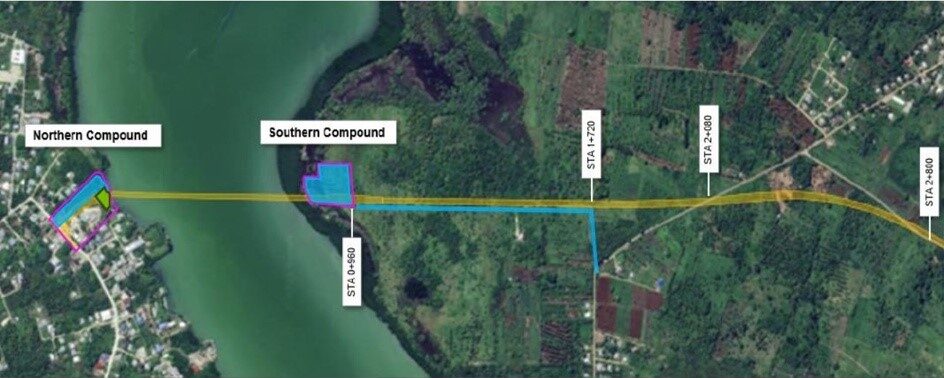
LAND ACCESS PROBLEM: Figure 2-3 from the ADB monitoring report identifies an area at the northern bridge site that had ‘not yet [been] handed over’ in November 2025. The report says uncertainty over the formal handover of land restricted work at the northern site.
By December 2025, the land-access problems had reached the highest levels of government. The report records a meeting with the Prime Minister on 4 December to discuss ongoing site-access issues. Five days later, McConnell Dowell briefed the first Fangaʻuta Lagoon Bridge steering committee meeting on the project’s status, including the impact of delays and proposed mitigation measures.
The situation remained unresolved into the new year.
In January 2026, design responsibilities and site access remained unsettled, significantly limiting progress and creating uncertainty over planning and mobilisation. No construction activities were undertaken during January, with work limited to preparatory activities.
LAND HANDOVER: The project’s January 2026 land-handover map shows the bridge corridor between the northern and southern compounds while site-access issues remained unresolved.
By February, after limited work at the northern site, all site activities had halted. McConnell Dowell suggested that the Government consider temporarily suspending the works to allow time for the outstanding issues to be resolved.
By mid-2026, the documents show the bridge alignment had been revised amid continuing land-access issues.
In May, the monitoring report refers specifically to an “assumed (new) alignment” and includes a drawing showing a review of the bridge alignment “to avoid conflict with the land area” at the northern landing -Umusi. In simple terms, the bridge route was being adjusted to avoid land that was creating an access or land-acquisition problem
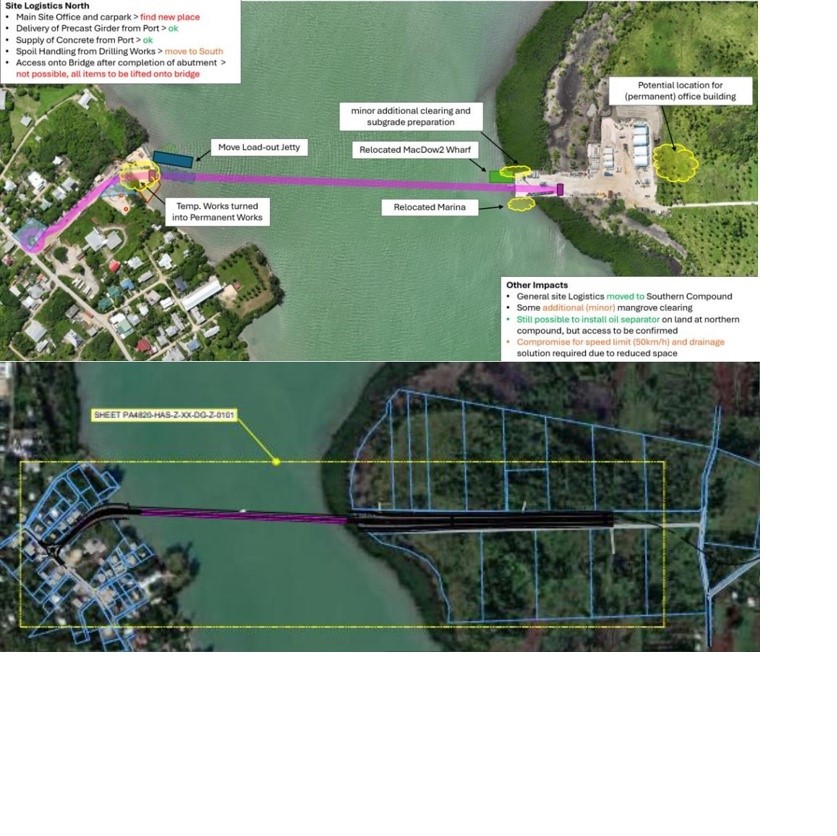
ALIGNMENT CHANGE: Figure 2-12 from the ADB monitoring report shows the review of the bridge alignment. The report describes the purpose of the review as being ‘to avoid conflict with the land area shown in red in Figure 2-3.’
By June, the revised alignment had been confirmed and finalised. It required extending the northern causeway further into the lagoon and resulted in what the report describes as a “westerly shift of the southern landfall”. In other words, the point where the bridge reaches land on the southern side was moved further west from its previously planned position.
The changes also required further environmental work and approvals. The report says additional approval was required for mangrove removal and reclamation following the need to “realign the bridge abutments”. Put simply, this meant changing the position of the structures at the ends of the bridge where it meets the land.
By June 2026, permanent works on the bridge had still not commenced. The monitoring report says the project was approximately one year behind schedule, with the expected completion date moving from September 2028 to 21 October 2029.
TIN INVESTIGATION: This is the first in a series examining the Fangaʻuta Lagoon Bridge project. Tonga Independent News is continuing its investigation into the reasons behind the change in the bridge alignment, the land affected by the revised route, compensation arrangements and the financial impact of the delays.