
China’s Role in Peace and Security in the Pacific and China-Pacific Island Countries Cooperation
Every milestone offers an opportunity to reflect on where we have come from and where we are heading.
Celebration of History and Commitment to the Future
As the Chinese People’s Liberation Army(PLA) celebrates its 99th anniversary on August 1 this year, it is of significance to look back on a remarkable journey of courage, resilience and dedication, and reaffirm a shared commitment to peace, security and cooperation in addressing the challenges in the Pacific and beyond.
Founded in 1927 under the leadership of the Communist Party of China, the PLA has grown together with the Chinese nation and its people. This year also marks the 90th anniversary of the Long March of Red Army, one of the most extraordinary chapters in the PLA’s history. The courage, determination and resilience demonstrated during that historic journey continue to inspire the Chinese people and remain deeply embedded in the identity and spirit of the PLA.
Over the past 99 years, the PLA has developed from a people’s force with humble beginnings into a modern military force dedicated to safeguarding China’s sovereignty and security, while contributing to national development and modernization. It plays a critical role in defending the territorial integrity, ensuring that Taiwan remains an inalienable part of China.
Throughout its history, the PLA has maintained a close bond with the Chinese people. It originates from the people, serves the people, and stands together with them, not only in times of national defense, but also during humanitarian crisis.
When natural disasters strike, the PLA is often among the first to respond. Working alongside local authorities and communities, they conduct search and rescue operations, deliver emergency assistance, evacuate affected people and properties, and help rebuild homes and restore daily life. Protecting lives and serving the people have always been at the heart of the PLA’s mission.
Beyond Borders: Contributing to Global Peace and Security
The PLA has actively and proudly participated in United Nations peacekeeping operations, international humanitarian assistance and disaster relief efforts, maritime escort missions, and military-to-military exchanges, working with partners around the world to address common challenges, and contribute to regional and global peace and security, serving as bridge of friendship, symbol of solidarity, and channel of connection.
To date, the PLA has dispatched more than 50,000 peacekeepers to 29 UN peacekeeping missions authorized by the Security Council, making China the largest troop contributor among the five permanent members of the UN Security Council.
Many people in Tonga still remember the difficult days following the volcanic eruption and tsunami in January 2022. At that challenging moment, PLA Navy ships and aircraft promptly delivered emergency relief supplies and humanitarian assistance, standing alongside the people of Tonga as they responded to the disaster.
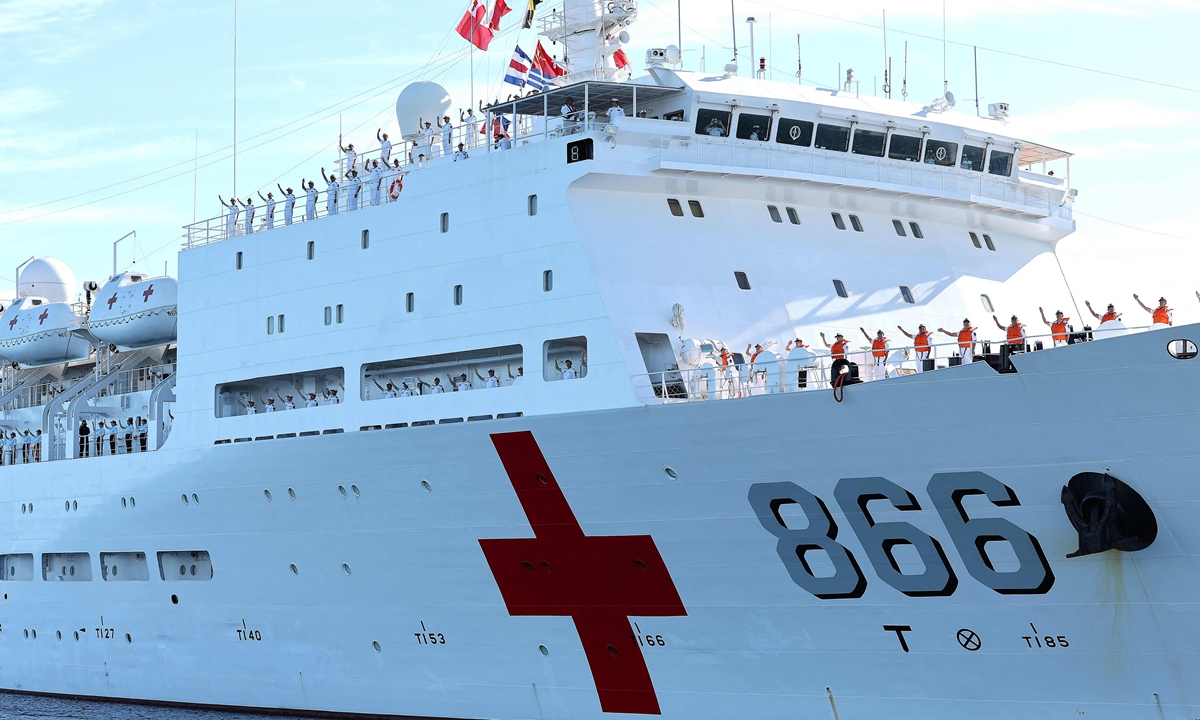
In 2024, PLA Navy ships participated in the International Fleet Review to celebrate the 65th birthday of His Majesty King Tupou VI and the 50th anniversary of the Royal Tongan Navy. The visits of the PLA Navy hospital ship Peace Ark and the Silk Road Ark came ashore to offer medical services and health consultations to the local communities, facilitating friendship, and understanding between China and Tonga.
A Changing World Requires Dialogue Not Division
The international security environment is undergoing profound transformation amid major adjustments in the global order. Growing geopolitical tensions and strategic competition, together with increasingly interconnected traditional and non-traditional security challenges, have intensified instability and uncertainty,.
In addressing these challenges, China believes that peace and security can only be achieved through dialogue, cooperation and mutual respect.
China advocates building a community with a shared future for humanity and has put forward four Global Initiatives: the Global Development Initiative(GDI), the Global Security Initiative(GSI), the Global Civilization Initiative(GCI), and the Global Governance Initiative(GGI). These initiatives call for joint development, common security, mutual learning, and win-win cooperation. China supports open and inclusive regionalism, where countries work together on the basis of equality, mutual respect, and shared benefits.
China believes that partnership should prevail over alliance, cooperation over confrontation. There should be no “front door”, “back yard,” or sphere of influence, nor discriminatory or exclusive arrangements, and outdated concepts or doctrines that put countries into opposing camps, even military blocks.
A Defensive Defense Policy and Responsible Nuclear Country in the World
China pursues a national defense policy that is defensive in nature and remains firmly committed to the path of peaceful development. Efforts to strengthen national defense capabilities are aimed at safeguarding national sovereignty, security and development interests, while making greater contribution to regional and international peace and stability as a major country in the world.
China calls for the complete prohibition and thorough destruction of nuclear weapons, remains firmly committed to the no-first-use policy at any time and under any circumstances, the only one among the five recognized nuclear-weapon states to make such commitment, supports the international nuclear non-proliferation regimes.
We respect the aspirations of regional countries to maintain the South Pacific as a nuclear free zone, signed and ratified Protocols II and III to the South Pacific Nuclear Free Zone Treaty, also known as the Treaty of Rarotonga, undertaking not to use or threaten to use nuclear weapons against any party to Rarotonga Treaty, nor to conduct nuclear test in the South Pacific.
The recent test launch of China’s sea-based missile is to maintain and enhance the reliability and effectiveness of China’s strategic deterrence. It has nothing to do with the nuclear test, nor does it target any specific country or region. Relevant international responsibilities and procedures have been fulfilled before the launch. It should be viewed objectively without over interpretation or double standards.

The Pacific: A Shared Home and Ocean of Peace, Friendship and Cooperation
The Pacific is more than an ocean connecting countries and islands, it is a shared home carrying the histories, cultures and aspirations of Pacific peoples.
As such, the Pacific should remain an ocean of peace, friendship and cooperation, a region where countries stand together to address common challenges, protect the marine environment and pursue sustainable development.
For Pacific Island countries, climate change and energy security are not distant concerns, but immediate challenges even existential threat that directly affects communities, livelihoods and future generations. Improving disaster preparedness, enhancing climate resilience, and advancing energy transformation are naturally high on the agenda.
China shares the vision of a peaceful, resilient and prosperous Blue Pacific Continent, where countries have their own priorities, concerns and development choices. China’s role is to listen, support and cooperate based on the needs and aspirations of the Pacific peoples themselves, and guided by the principles of mutual respect, equality and mutual benefit. Such cooperation remains open and inclusive for third parties.
We are ready to work together with Pacific Island countries, including Tonga, to advance cooperation in areas including climate resilience, energy security, and above all, sustainable development by drawing upon local experiences, regional knowledge.
At a time when the world is facing growing uncertainties and challenges, solidarity, dialogue and cooperation are more important than ever.
China and Tonga share a traditional friendship and robust partnership, together we can contribute to build a better world, where cooperation replaces confrontation, partnership overcomes division, and the Pacific remains a region of peace, dignity and shared prosperity.