Editorial:Why are ten PSC vacancies still unfilled?
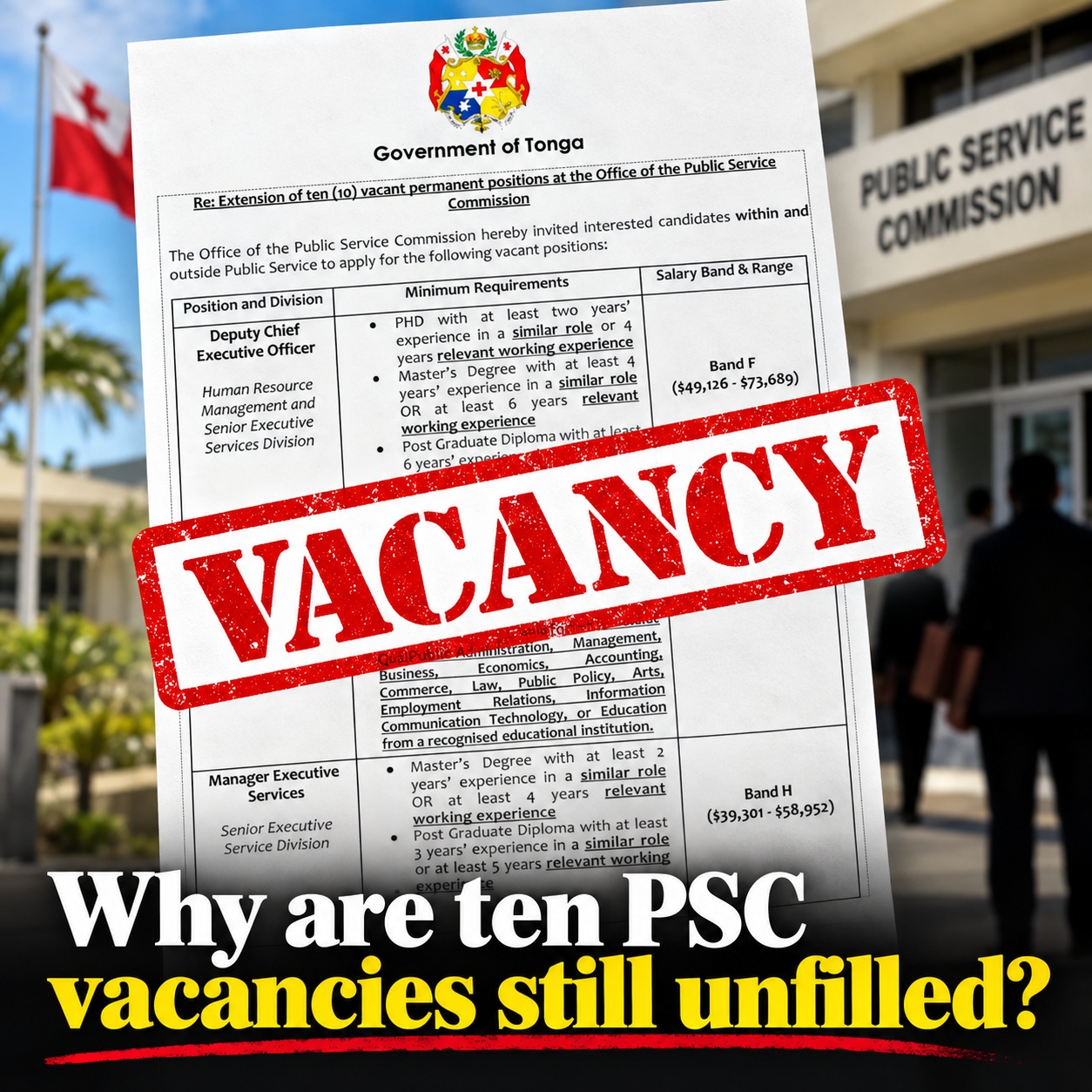
Ten permanent jobs at Tonga’s Public Service Commission are still empty. The PSC has advertised them again, under a notice headed “Extension.”
That should prompt a simple question. Why?
Is Tonga short of capable people? Or has the Public Service built recruitment rules that lean too hard on academic qualifications and not hard enough on practical experience and proven ability?
The PSC’s own advertisement raises the question.
For Deputy Chief Executive Officer, Band F ($49,126 to $73,689), a candidate can qualify several ways. A PhD needs two years in a similar role, or four years of relevant work experience. A Master’s needs four years in a similar role or six years relevant. A postgraduate diploma needs six years in a similar role or eight years relevant. A bachelor’s degree needs eight years in a similar role or 12 years relevant.
Further down the same notice, the logic gets harder to follow. For Senior Human Resource Officer in the Oversight Division, a Master’s degree qualifies a candidate with no working experience at all. For Human Resource Officer in the Human Resource Management Division, Band L ($22,797 to $34,190), a bachelor’s degree also qualifies with no working experience. Applicants with lower qualifications for the same roles must show years of practical experience to be considered.
That raises a fair question for the Public Service. Since when did a university degree substitute for actually having done the job?
Education matters. So does experience. This is not an argument against education. Tonga needs graduates, lawyers, accountants, economists and specialists throughout government. A Master’s or a PhD is a real achievement, and it should count where that level of knowledge is actually needed for the job.
But academic achievement and management ability are not the same thing. Someone can hold an impressive degree and never have managed staff, controlled a real budget, handled an audit, or carried responsibility for delivering a major programme. Meanwhile, there are Tongans, at home and across the diaspora, who have spent 10, 15 or 20 years running businesses, staff and budgets, some in organisations bigger than most government departments in Tonga. Why shouldn’t that experience count?
Tonga should be finding ways to bring that knowledge home, not shutting the door on experienced people because they don’t hold a Master’s or a PhD.
Look at what the Auditor-General keeps finding
This matters more once you look at what has actually been going wrong across the Public Service.
Tonga Independent News has reported repeatedly on Auditor-General findings across ministries and public bodies. The problems that keep turning up are not caused by a shortage of postgraduate degrees. They are management problems: weak supervision, poor financial control, missing records, and a lack of accountability.
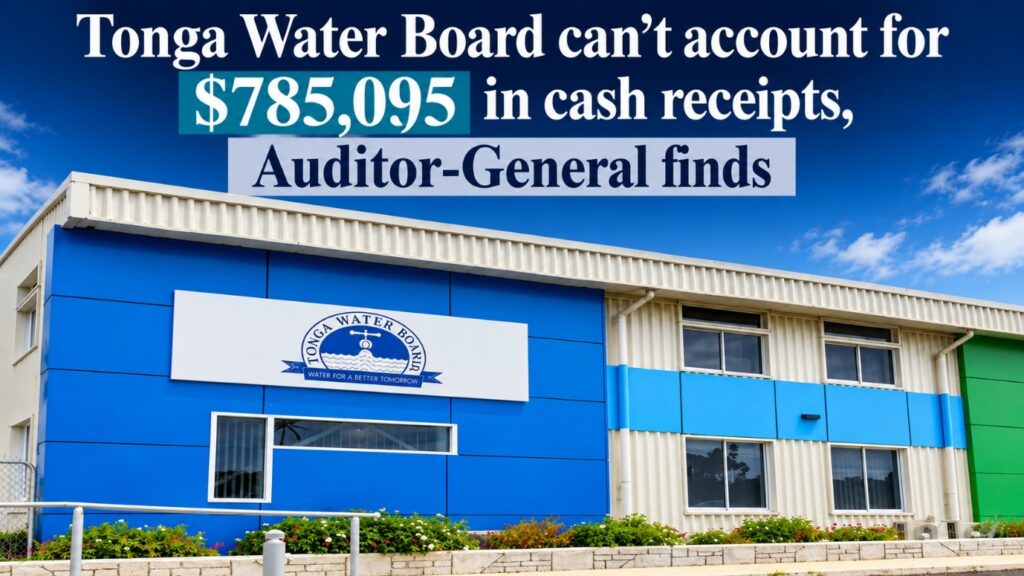
At the Ministry of Education, auditors could not find adequate supporting documents for almost TOP$2 million in grant payments. At the Tonga Water Board, auditors flagged TOP$785,095 in cash receipts that could not be properly accounted for. At the Ministry of Health, audit findings reviewed by TIN pointed to weak overtime administration, with incomplete records and gaps in approval documentation. At the Ministry of Internal Affairs, TIN has reported concerns over how public funds were administered and acquitted through the Sports Division.
Different ministries. Different circumstances. The same pattern keeps showing up: missing records, weak supervision, and problems that management should have caught before the auditors did.
These aren’t academic questions. They’re management questions. And they point straight back to what the PSC should actually be looking for when it hires the people who will run government departments.
Are we measuring the wrong thing?
If academic qualifications carry this much weight in hiring, the public is entitled to ask whether that approach is producing better-run government. The Auditor-General’s findings suggest something the recruitment system should already know: a qualification gets someone through the door, but it doesn’t guarantee competent management.
Has the applicant managed people? Managed money? Delivered projects? Can former employers point to real results? Can they spot a financial or administrative problem before it turns into an Auditor-General finding? Those questions should carry real weight alongside academic qualifications, not sit below them.
There is another way
The answer isn’t to lower standards. It’s to measure the right things.
The PSC should build a clearer pathway for management roles that recognises equivalent experience. For a role like Deputy CEO, a relevant bachelor’s degree combined with real, proven management experience should be enough to qualify someone for consideration. It shouldn’t take a Master’s or a PhD to get in the door.
The PSC could, for example, treat five years of demonstrated senior management experience as equivalent to a higher academic qualification for management positions. The exact formula is up to the PSC to work out. The principle matters more: relevant experience has to count for something real.
Someone who has managed 50 or 100 staff, controlled a real budget and delivered major projects shouldn’t automatically rank below someone with a postgraduate degree and far less management experience. What size organisation did they run? What budget were they responsible for? What did they deliver? How did they hold up under financial and audit scrutiny? Those answers say more about someone’s ability to run a government division than another certificate does.
Give young Tongans a realistic path
There’s a longer-term issue too. What message does this send to young Tongans who want a career in government? They shouldn’t have to believe the only way into senior management is staying at university until they’ve collected a Master’s or a PhD.
A young Tongan should be able to finish a relevant bachelor’s degree, join the workforce, build real experience, and work their way up. That’s how managers are actually made. University builds the foundation. Experience builds the manager.
There will always be roles where advanced qualifications are genuinely necessary. Economists, scientists, lawyers and specialist policy roles may reasonably need postgraduate expertise. But the PSC should draw a clear line between jobs that need advanced academic knowledge and jobs where the main job is management. The qualification should fit the job, not the other way around.

What happens after someone is hired?
Recruitment standards shouldn’t be strict at the door and then forgotten once someone is in the office. CEOs, Deputy CEOs and senior managers should be judged on how well the organisations they run actually perform.
That means Auditor-General findings should matter. Financial controls, procurement compliance, staff performance and delivery against ministry targets should all matter, along with whether past weaknesses actually get fixed. If the Auditor-General keeps flagging the same problems under the same management, that should count against that manager’s performance record. There’s little point demanding impressive qualifications to get a senior job if basic management failures are tolerated once someone is in it. Accountability has to work at both ends.
Tonga is competing for people
The PSC also has to face a hard reality: Tonga is competing in an international labour market. Experienced, qualified Tongans don’t have to work for the Tongan Government. Australia, New Zealand, regional organisations, development agencies, NGOs and the private sector are all competing for the same people. That makes it even more important that Tonga doesn’t unnecessarily shrink its own talent pool.
There are Tongans overseas with bachelor’s degrees and 10 or 15 years of strong management experience who could bring real value to government. There are also experienced people already inside the Public Service who understand government from the ground up and are ready for the next step. The recruitment system should be able to recognise both.
If positions keep needing to be extended, government should look at the whole equation: qualifications, experience, salaries, career paths, and whether the requirements actually match the work that needs doing. Simply pushing back the closing date doesn’t answer any of that.
Ten vacancies should start a conversation
There may be good reasons why these ten positions are still empty. The PSC should explain them.
But these vacancies are a chance for a wider conversation Tonga needs to have about what “qualified” actually means. Education matters. Experience matters. Integrity matters. Leadership matters. Results matter.
Tonga doesn’t need to choose between educated people and experienced people. It needs a recruitment system that recognises the value of both.
The job of the Public Service isn’t to hire the people with the most impressive credentials. It’s to serve the public. After everything the Auditor-General has told us about weaknesses across government, it may be time to ask whether we’re measuring the things that matter most.
A degree tells us what somebody studied. Performance tells us whether they can do the job.