Why Aviation Must Be Central to Tonga’s Economic Future
Fahad ibne Masood, MRAeS, MISASI
Squadron Leader (R), Aviation Specialist and Lecturer, TU Dublin
Introduction: More than a means of transport
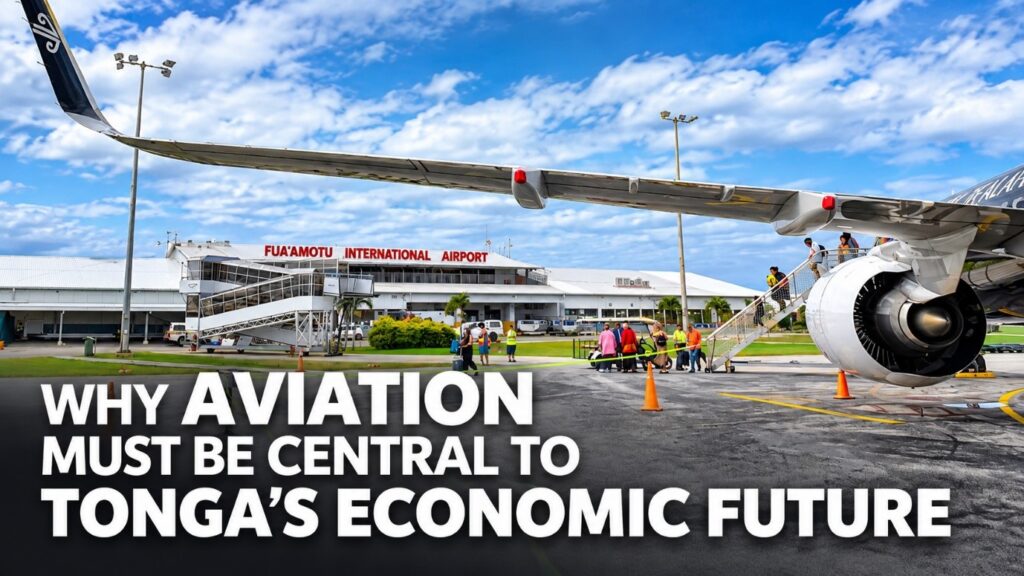
For a country of scattered islands, reliable air services are more than a convenience. They are an economic necessity. Aviation belongs alongside roads, ports, electricity and telecommunications as part of the infrastructure Tonga depends on. It links communities, keeps businesses supplied and connects the Kingdom to international markets.
Geography is behind all of this. Tonga’s islands are spread across a wide area of the South Pacific, which creates opportunity and difficulty in roughly equal measure. Shipping remains important, but an aircraft offers something a vessel cannot: speed, access and a direct line to the wider world.
The case becomes clearer when set against the country’s economic priorities. Tourism, agriculture, fisheries, trade, investment and the movement of people all rely, to differing degrees, on transport links that can be trusted. Any long-term development plan for Tonga ought to give aviation the same weight it gives to roads, ports and power.
Tourism: where connectivity becomes income
Tourism is the clearest place to see what aviation contributes.
Tonga has a great deal to offer: a rich marine environment, a living cultural heritage and whale-watching that draws people from across the world. Attracting visitors is only half the task, though. They also need to reach the islands conveniently, reliably and at a fare they are willing to pay.
The Tonga Statistics Department’s Annual Migration Statistics 2025 recorded 112,440 international air arrivals over the year. That figure includes returning residents as well as visitors, so it should not be read as a count of tourists. The same report puts international air visitors at 64,183. Of those, 43.4 per cent came from New Zealand, 20.5 per cent from Australia and 15.4 per cent from the United States.
Two things follow. Air links are plainly central to the visitor economy, and that economy leans heavily on a small group of source markets.
The Pacific Tourism Organisation’s 2024 International Visitor Survey estimated that international visitors generated approximately US$105 million in economic impact for Tonga that year, spread across accommodation, hospitality, transport and other tourism-related activity.
Passenger numbers do not tell the whole story, however. How often aircraft fly, whether schedules can be relied upon, what fares look like, how easily passengers connect and whether onward transport is waiting at the other end: each of these shapes a visitor’s experience, and with it their decision to return or to recommend the trip to someone else.
Getting these things right could help Tonga draw visitors outside the traditional peak months, encourage longer stays and support tourism businesses across the island groups. The aim should be to spread the benefits of connectivity to local communities, small businesses and workers, rather than simply raise the arrivals count.
Domestic connectivity: bringing the islands closer
International routes tend to get the attention. Domestic services deserve just as much.
For people living outside Tongatapu, reliable inter-island transport can decide whether essential services and economic opportunities are within reach at all. Where distance, travel time or operating conditions make other options impractical, aviation fills the gap. Dependable domestic air services support tourism operators and business travel, help government deliver services and widen access to healthcare and education.
Picture a resident of an outer island who needs to see a specialist in Nuku’alofa. The difference between a dependable flight and a long wait for other transport can be considerable. The same applies to doctors, medical supplies and emergency teams travelling the other way.
None of this is an argument for replacing ships. Ferries and shipping still carry passengers, freight and inter-island trade, and they will keep doing so. Aircraft come into their own when time is short. A sensible transport strategy would look at how the two modes work together, including connections, timetabling and the sharing of information between operators.
Trade, investment and jobs
A country’s air links also affect how it looks to anyone thinking of investing or doing business there. For an economy of Tonga’s size, international connections bring investors, business partners, professional expertise and access to overseas markets. They also allow high-value and time-sensitive goods to move quickly.
Some agricultural produce, seafood and other exports can justify the cost of air freight where speed, quality and market requirements demand it. Air cargo will not compete with shipping for bulk commodities, and nobody should expect it to. For selected products and specialised consignments, though, it can be the option that works.
Employment is part of the picture as well. Airlines, airports and their service providers create jobs directly, and their operations sustain work in tourism, hospitality, logistics, maintenance, security, retail and other sectors. The effect of aviation infrastructure reaches well beyond the airport fence.
Runways and terminals need people to run them, however. Airport operations, air traffic services, aircraft maintenance, aviation security, safety oversight and emergency response all depend on trained staff. Tonga would do well to treat aviation skills as part of its national workforce strategy, working with regional aviation institutions, international training organisations and established aviation authorities to build local expertise and give young Tongans careers they can stay in. Developing that technical capacity at home would also lessen the reliance on outside expertise and leave the country better placed to maintain its own aviation infrastructure over the long run.
Resilience in a vulnerable part of the world
The strongest argument for treating aviation as strategic infrastructure may well be resilience.
Pacific island countries live with tropical cyclones, flooding, volcanic activity, tsunamis and other natural hazards. Tonga saw what that can mean in January 2022, when the Hunga Tonga-Hunga Ha’apai volcanic eruption and tsunami struck. Critical infrastructure and essential services were disrupted almost at once.
At times like that, airports become the way in for emergency personnel, humanitarian assistance, medical supplies and recovery teams.
The World Bank’s work on Pacific transport resilience recognises why transport networks need to keep functioning in countries exposed to extreme weather and natural disasters. Its Pacific Aviation Investment Program has supported airport reconstruction and improvements across several island states, Tonga among them.
In May 2026, the World Bank and the Asian Development Bank announced a US$145 million partnership with the Government of Tonga for the Sustainable Economic Corridors and Urban Resilience Project. The programme covers climate-resilient roads and bridges, better links between the airport and the port, and measures to reduce flooding and protect key transport connections. It is a wider transport programme rather than an aviation investment as such, but it makes a point worth taking on board. An airport cannot deliver its full economic and emergency value if the roads, utilities and other infrastructure joining it to surrounding communities are exposed to the same hazards.
That is why resilience has to be looked at across the whole transport system. For Tonga, it means keeping airport infrastructure to the proper safety standards, improving drainage, considering how exposed runways and terminals are to natural hazards, strengthening backup power and communications, and testing emergency arrangements regularly instead of leaving them on paper.
Business continuity planning matters just as much. Airlines, airports, regulators and emergency services all need clear procedures for keeping essential operations running, restoring service and coordinating help after a major disruption.
Safety, regulation and operational capability
Connectivity is worth very little if safety is traded away to achieve it.
Air transport runs on public confidence, and that confidence comes from effective regulation, competent people, reliable infrastructure and consistent operating standards. A small aviation market finds all of this harder to sustain. Regulators need enough technical expertise, training, oversight resources and institutional backing to do the job properly.
International cooperation can ease some of that pressure. Regional partnerships and technical assistance offer routes to professional development, safety oversight, regulatory improvement and the exchange of operational experience.
It also helps to remember that aviation infrastructure goes well beyond runways and terminal buildings. Navigation systems, communications, meteorological services, security arrangements, rescue and firefighting capability and maintenance standards all have to be in place for the system to work. Investment decisions should rest on operational requirements, safety assessments and realistic long-term maintenance plans, and not only on the projects that are easiest to see.

merging technologies: an opportunity, not a shortcut
Aviation is changing quickly. Digital air traffic management, better aircraft monitoring, data-driven maintenance, automated airport systems and more efficient aircraft are all altering how services are delivered, and some of it could be useful to Tonga.
Stronger digital systems could improve flight planning, coordination and the way airport resources are managed. Better weather information and communications could support decision-making when conditions turn bad.
Unmanned aircraft systems may have a place in selected tasks such as infrastructure inspection, environmental monitoring, disaster assessment and the delivery of certain essential supplies. Before any of that could happen, regulatory arrangements, airspace coordination and safety controls would need to be in place.
Advanced Air Mobility, including electric vertical take-off and landing (eVTOL) aircraft, may eventually offer new options. For Tonga, however, certification, operating costs, charging infrastructure and maintenance support would need careful assessment. Treating eVTOL as an immediate solution would be premature.
Technology should serve a national aviation strategy. It should not set one.
A strategic approach to aviation investment
Setting Tonga’s aviation priorities calls for long-term, coordinated work involving government, regulators, airport operators, airlines, tourism bodies, businesses and international development partners. Five areas stand out.
The first is airport investment, which should start from long-term demand, climate exposure, operational needs and whole-life costs. Construction is the easy part. Maintenance and resilience decide whether an investment keeps its value.
Next come international air services. These need to be developed with route sustainability, affordability and Tonga’s main tourism and business markets in mind. More choice of routes is welcome, but every service has to be viable commercially and operationally.
Third, domestic connectivity should be judged as one part of the national transport system, with aviation and maritime services complementing each other, particularly for outer island communities.
Fourth, local aviation skills ought to become a strategic priority. Technical training, professional qualifications, safety management and regulatory expertise all underpin the long-term future of the sector.
Last, aviation planning needs to be joined up with tourism, trade, climate adaptation, healthcare and national emergency management, so that investment pays off across several sectors and does not sit in isolation.
Conclusion: connectivity as a national asset
For Tonga, aviation is one of the systems that allows the economy to function at all. It links the Kingdom to international markets, supports tourism and investment, provides jobs and helps communities reach essential services. It also has a part to play in national preparedness and recovery from disasters.
Geography makes dependable connectivity especially valuable. Even so, expansion for its own sake should not be the goal. Sustainable aviation development means balancing affordability, commercial viability, safety, environmental responsibility and long-term resilience.
Success will not be counted in aircraft movements or the size of a terminal. It will show in whether better connectivity creates real economic opportunity, strengthens communities and leaves the country readier for what comes next.
About the Author
Fahad ibne Masood, MRAeS, MISASI, is a former military fighter pilot and instructor with more than 27 years of aviation experience spanning flight operations, aviation safety, human factors and professional education. He is currently an Exam Manager (Part-147) and Lecturer in Transport and Aviation at TU Dublin, Ireland. His professional interests include aviation safety, sustainable airport infrastructure, Advanced Air Mobility and emerging aviation technologies.
The views expressed in this article are those of the author and do not necessarily reflect the editorial position of Tonga Independent News.