Who Is Responsible for Our Youth? Inside the Growing Gap Between Tongan Classrooms and Local Jobs
Every graduation season brings new vocational certificates, yet local businesses still struggle to find skilled workers. With Tonga’s first National Apprenticeship Policy now underway, it is time to measure real jobs—not just paper qualifications.
By Tevita Ita
Every graduation season across Tonga, proud families celebrate young people walking across the stage with new vocational certificates in hand.
On paper, it looks like a win for the Kingdom’s future. Yet step onto a construction site in Nukuʻalofa or walk into a resort in Vavaʻu or Haʻapai, and a troubling contradiction emerges: local businesses are desperate for skilled workers, while roughly one in four young Tongans aged 15 to 24 remains outside of employment, education, or training.
Recent industry survey data and labour assessments lay bare the depth of this disconnect. In our tourism sector, 57% of surveyed businesses struggle to find skilled workers, and 41.6% have difficulty recruiting technically capable school leavers. In construction—a sector vital to building climate-resilient homes—firms face acute shortages of qualified carpenters, plumbers, and electricians.
Meanwhile, overseas seasonal and skilled labour schemes draw experienced hands away to Australia and New Zealand. While remittances support Tongan families, 64% of surveyed tourism firms report struggling to retain staff, leaving local industries short-handed while training pipelines fail to replace departing workers.

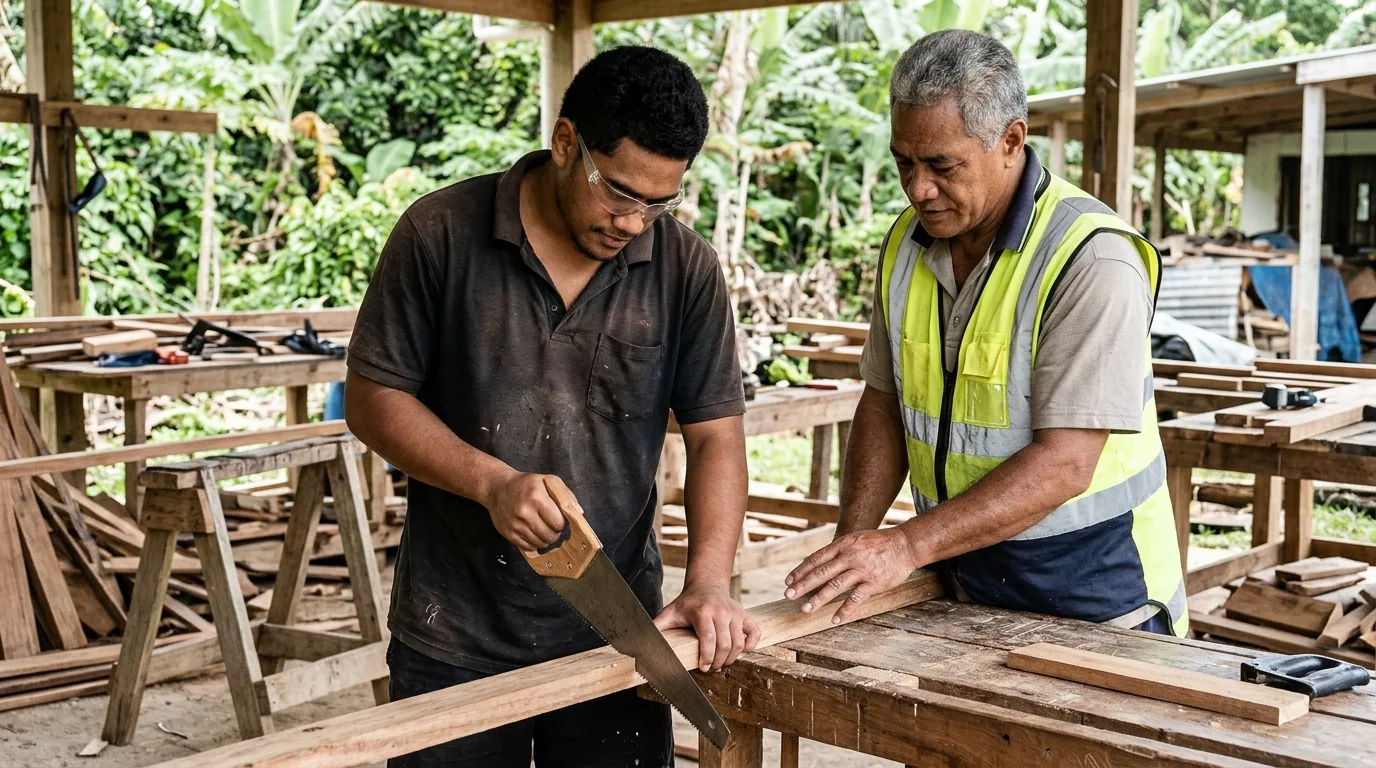
The problem starts in high school, where only an estimated 5% of students study vocational subjects, almost exclusively in church and community schools. While national education investments rightly prioritize recovering foundational literacy and numeracy, treating practical trades as an afterthought leaves thousands of young people without a bridge to employment. Too often, post-secondary trade courses lack modern workshop tools and qualified instructors, while unstructured work placements treat trainees as cheap labour for routine chores rather than mentored apprentices.
This gap is felt even more sharply outside Tongatapu. Because practical training remains centralized in the capital, 100% of surveyed tourism operators in Vavaʻu and Haʻapai report difficulty finding skilled staff, leaving outer-island youth behind.
In August 2026, the Tongan government responded by launching its first-ever National Apprenticeship Policy (2026–2030), aiming to expand formal apprenticeships across 10 priority trades and track graduates at 6 and 18 months post-completion.
Policies alone, however, do not build houses or staff hotels. True fatongia—our shared responsibility—requires businesses to offer genuine mentorship, families to value practical trades alongside academic degrees, and leaders to measure success not by how many certificates are printed at graduation, but by how many young Tongans secure decent, lasting jobs at home.