Tonga Has Plenty of Opinions. What We Need Are Receipts.
Why a country that loves to talk struggles to make informed choices, and whose job it is to fix that.
By The 5th Estate
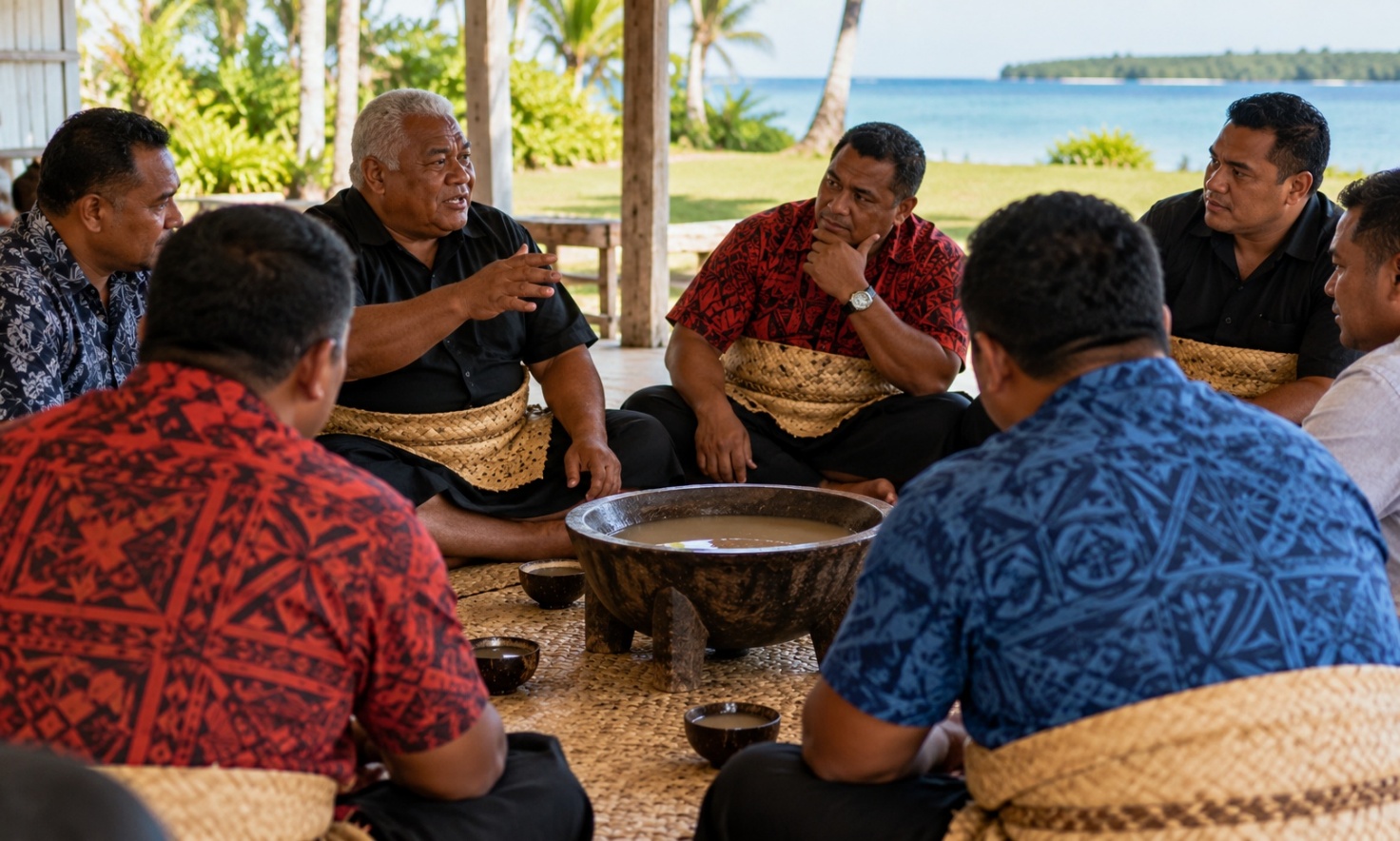
Spend an evening in any kava circle or any circle in Tonga and you’ll get a full briefing on the state of the nation. Rising cost of living, quality of education, who’s really running things, what to do about drugs, why the road outside the church still isn’t fixed. The analysis is passionate, fast and frequently hilarious.
Now ask a follow-up. What exactly is being proposed? What will it cost? Who pays?
Oh, you’ll get answers. Plenty of them. A cousin heard it from someone at the ministry. Someone else is fairly sure it’s already been decided. A third person has a theory about who’s quietly profiting. The bowl goes round, the theories multiply, and by the third round the rumour has acquired a source and a date.
What you rarely get is a document, a figure or a page number. That’s not because Tongans are uninterested or unintelligent. We’re plainly neither. It’s because, too often, the paperwork never makes it us in a form that we can find, read and use.
Would you co-sign a loan you hadn’t read?
Imagine a relative asks you to co-sign a loan – and we’ve all had that relative or friend. It’s for something wonderful, they say. Trust me, I would not default.
You’d say no. Yet as a country, we’re regularly asked to cheer for or rage against decisions with long-term price tags that we’ve never seen itemised. We pick sides first and look for the facts later, if at all.
Knowing a problem exists is easy. Understanding why it exists, what the government plans to do, the costs, what we give up in exchange and whether it’s working is the hard part. That’s what turns talk, to debate and into a meaningful decision.
“Technically public” is not the same as “actually public”
The fair but sad part: the information isn’t hidden. Parliament publishes proceedings and consultation notices. Legislation is online in English and Tongan. Parliamentary committees have taken proposed laws to public meetings across Tongatapu, ‘Eua, Vava’u and Ha’apai, backed by radio talkbacks. Government Annual Reports and Audits. That’s real effort, and it deserves credit.
But a document can be public the way the TCC terms and conditions on your phone are public. It exists. It’s forty pages long. Nobody has read it, and it wouldn’t help if they had.
So the useful questions are about delivery: Can an ordinary person find it? Does it arrive before the decision is made, or after? Is it written for non-specialists, in Tongan as well as English? Does it reach someone in ‘Eua with patchy internet as easily as someone in Nuku’alofa with fibre? Does anyone ever hear what happened to their feedback?
If the answer to most of these is “not really”, then publishing is a box ticked, not a conversation started.
News is the weather report. Understanding is knowing whether to fix the roof.
News tells us what happened. Understanding tells us what it means for us. A press release says a new policy has been launched. It rarely says what problem it solves, what evidence supports it, who benefits, who pays, and how we’ll know in two years whether it worked.
Don’t blame journalists alone. The 2025 State of the Media: Tonga report describes a media sector under legal, financial and capacity pressure, where online platforms have widened access but also made misinformation easier to spread. Expecting a small newsroom to report every announcement and independently audit every budget, bill and donor programme is like asking one cook to run the kitchen, wait the tables and wash the dishes. Something gets burnt.
And where there’s an explanation gap, something always fills it. Rumours. Half-truths. Confident Facebook posts. A claim doesn’t become more accurate by being shared 4,000 times with 2,000 likes.
A case study: the Fanga’uta Lagoon Bridge
Let’s try this on something you can see from the road.
The new bridge will span 720 metres across the Fanga’uta Lagoon, connecting Nuku’alofa with the south-eastern side of Tongatapu, with 2.1 kilometres of approach roads. It’s part of a US$97 million project funded by the Asian Development Bank and the World Bank, and it has been described as the largest development partner-financed project in Tonga’s history. The contract was signed in September 2025, with completion scheduled for the end of 2028. The pitch is easy to like: less traffic, better emergency evacuation routes and more climate resilience.
Those are good reasons. But “good reasons” are what a press release gives you. Here’s what a citizen might reasonably want on top:
i. Which problem comes first: congestion, evacuation or climate relocation? How were they weighed against each other, and against other ways of spending the same money?
ii. What does Tonga pay, now and later? That includes the government’s share and the upkeep once the ribbon is cut.
iii. What are the risks, from delays to cost overruns to the health of the lagoon itself?
iv. How will we know in 2029 that it worked? Faster journeys? A tested evacuation plan? Who will report on that, and where?
Some of these probably have good answers somewhere in a project document. The point isn’t that the bridge is a bad idea. By most accounts it’s a long-awaited one. The point is that “I support it” or “I have concerns” only means something when you can see the working. Otherwise, we’re just cheering for a crane.

We all have homework
Government carries the main duty to explain. Every major proposal should come with a short, plain-language summary in Tongan and English covering the problem, the proposal, the cost, the risks, the alternatives and how success will be measured. Consultation should start while the decision is still open, use radio and community meetings, and end with a “you said, we did” report that includes what didn’t change and why. Think of it as showing your working in maths class. You get marks for it.
Parliament could add neutral briefing notes on major bills that explain practical consequences without picking a side.
Media adds the most value when it stops simply relaying competing statements and starts testing them: comparing promises with results and asking for the evidence.
Churches, schools, universities and civil society already host many of our best conversations. They could host a few more that ask not “who’s right?” but “what does the evidence say, and what don’t we know yet?”
The rest of us have a job too: read past the headline, separate evidence from opinion, be suspicious of facts that conveniently flatter what we already believe, and say “I was wrong” when the evidence says so. That last one is harder than it sounds.
The five-question test
Here’s a simple rule for any significant national policy. If an ordinary citizen can’t answer these five questions from information within easy reach, we don’t yet have an informed debate. We have a loud one.
1. What problem is being addressed? 2. What exactly is being proposed? 3. What will it cost, and who pays?
4. What are the risks and alternatives? 5. How will we know whether it worked?
This test won’t produce agreement, and it shouldn’t. Reasonable people can read the same evidence and disagree. The goal is better disagreement, where we argue about trade-offs instead of rumours.
Back to the kava circle
An informed public isn’t a threat to good leaders. It’s their best insurance: it makes policy better, accountability sharper and hard decisions more legitimate. Citizens who understand the options can spot real progress, push back on weak ideas and accept necessary trade-offs.
So the question isn’t whether Tongans are smart enough to handle public policy. Obviously we are.
The question is whether we’ve built the institutions, media and habits to put the receipts in our hands.
Tonga doesn’t need fewer opinions. It needs better information to hold them with.