Only Four of 37 Complaints Reach Full Investigation as Anti-Corruption Commission Admits Procurement Failures
By Tuífua Vailena, Co-Editor
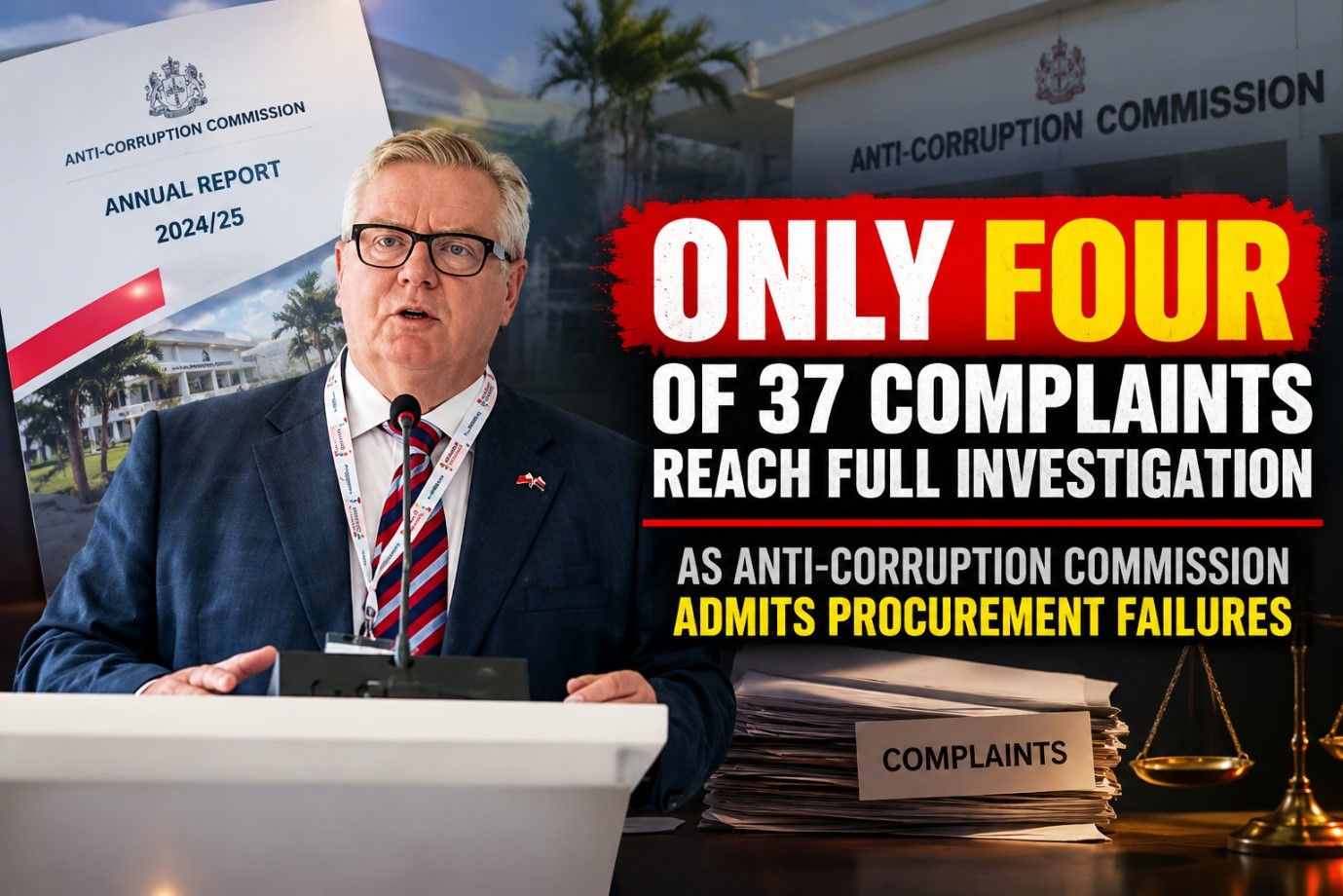
Tonga’s Anti-Corruption Commission has acknowledged that its procurement procedures were not fully followed during its first year of operation, while new information shows that only four of the 37 complaints received during that period progressed to full investigation.
The details come from the Commission’s 2024/25 Annual Report, a media fact sheet and a written response to questions from Tonga Independent News.
The Commission, headed by Anti-Corruption Commissioner Chris LaHatte, opened in July 2024 with an initial government budget of T$850,000. This was later increased by T$419,000 to T$1.269 million to meet establishment and operational costs.
In its response dated 6 October 2026, the Commission confirmed that an information technology contract was signed before all required government procurement steps had been completed.
The Commission said the urgent need to set up secure computer systems and get the office running was part of the reason the rules were not followed.
“While the urgency of establishment provides context, it does not remove the requirement to comply fully with procurement procedures,” the Commission wrote in its response.
It said corrective measures had since been introduced, including procurement planning, staff training, compliance checklists, sign-off by the Chief Operating Officer before any contract is signed and quarterly reporting to the Ministry of Finance.
The Commission described the lapse as “an exceptional circumstance” during its set-up that “is not expected to recur.”
The original annual report also said two different things about procurement. While its procurement section acknowledged that procedures had not been fully followed, its governance checklist recorded the Commission as compliant with government procurement regulations.
The Commission’s response admitted the procurement failure but did not explain why the two sections of the report differ.
Only four complaints reached full investigation
Of the 37 complaints, eight were dropped or passed to other agencies, and four went to full investigation.
The remaining 25 complaints, approximately two-thirds of those received, were still undergoing preliminary assessment as of 6 October 2026, more than 15 months after the end of the reporting year. The documents do not establish when each complaint was originally lodged.
The annual report had previously described 36 complaints as being under investigation, with one matter progressing to judicial review and no charges or prosecutions reported by the end of June 2025.
The Commission said complaints pass through several stages before reaching full investigation and that not every complaint has enough grounds or evidence to go further.
Under Section 7(6) of the Anti-Corruption Commissioner Act, the Commissioner must refer investigation findings and supporting evidence to the Attorney-General when criminal proceedings may be justified.
The Commission’s fact sheet also identifies possible prosecution powers as an area for future legal reform.
The October response gave no update on the four full investigations. None of the documents provided to TIN says whether any matter has been sent to the Attorney-General.
Establishment costs explained
The annual report records total expenditure of T$1.112 million during the Commission’s first year, about 88 per cent of its revised budget.
Among the major expenditures were T$208,694 on computers and information technology, T$150,365 on building and compound maintenance, and T$39,448 charged to hospitality.
In response to TIN’s questions, the Commission said the computer expenditure covered more than desktop and laptop computers. It included secure servers, networking, software, backup systems, video conferencing equipment, installation and specialist technical services.
The Commission said the headquarters had been empty and needed major repairs before staff could move in, including work on the roof, ceilings, walls, windows, bathrooms and kitchen facilities.
It said this was the cost of making the office usable, not routine maintenance, although the annual report lists the spending under maintenance of buildings and compounds.
The hospitality expenditure, T$39,448 of a T$40,620 budget, included the cost of a rental car for the Commissioner, who had no official car at first. The Commission said the Executive Director used her own car for official work during the same period.
The Commission said the rental arrangement ended after a Toyota Prado was transferred from the Ministry of Justice. Other hospitality expenditure covered official functions and stakeholder engagements.
It said vehicle costs should have been recorded in a more suitable category and that future financial reporting would be improved.
The response did not provide a separate breakdown of rental vehicle costs and hospitality functions.

Overseas travel partly charged to domestic budget
The Commission also confirmed that several overseas trips made by the Commissioner were partly charged to its domestic travel budget because no separate overseas travel budget existed during the establishment year.
The annual report recorded T$52,613 in spending against a revised domestic travel budget of T$59,140.
It also referred to “travel upgrades” and “per diem top-ups”, which are additions to daily travel allowances.
The Commission said all official travel had been approved through government processes before payment and that the upgrades and allowances were for official work, not salary payments or personal allowances.
A separate overseas travel budget was set up for the 2025/26 financial year.
The Commission did not disclose the specific amounts spent on overseas travel, upgrades or extra daily allowances in its response.
Commission points to establishment challenges
In a signed letter to the Tonga Media Association dated 2 October 2026, LaHatte said 2024/25 “was not a normal operating year; it was the year the Commission had to be created as a functioning institution.”
The Commission began with the Commissioner and Chief Executive Officer and had nine staff members by June 2025, including two police officers on secondment.
Its annual report identified delays in approving 24 job descriptions and salary levels, which held up recruitment until May 2025. It also pointed to a shortage of specialist investigators, lawyers and IT staff, and the need for a secure case-management system.
The Commission said these challenges slowed the building of its investigative and legal capacity.
It has identified further recruitment, stronger financial and procurement controls, legal reforms including whistleblower protection, and a secure case-management system among its priorities.
Although the Anti-Corruption Commissioner Act dates from 2007, the Commission did not open until July 2024.
That is a gap of 17 years.
LaHatte said the annual report “should therefore be read as the record of an institution being built while already at work.”
The fact sheet lists the Commission’s priorities for 2025/26, a financial year that ended on 30 June 2026. None of the October documents says which of those priorities were met.
With its first year devoted largely to establishing operations, the Commission now faces a more important test: demonstrating what it has achieved in investigating corruption complaints and whether the public funds allocated to it are producing measurable results.
Tonga Independent News will continue examining issues raised in the Commission’s first annual report, including why an institution established under legislation passed 17 years earlier was still facing significant staffing, procurement and operational difficulties when it opened in July 2024. Our follow-up investigation will examine what preparations were made before the Commission began operating, which government agencies were responsible, and whether these shortcomings could have been avoided or affected its ability to investigate corruption.