Fuel Relief or More Borrowing? Eke Questions Government Spending Priorities
By: Tuífua Vailena
As fuel prices hit record levels across Tonga, a debate has emerged over whether the Government is spending money in the right places.
The Government’s 2026/27 Budget forecasts a deficit of approximately TOP $38 million and plans to borrow around TOP $35 million through domestic bonds to help fund its spending.
Government accounts indicate cash reserves of approximately TOP $164 million. Dr Eke argues that fact should form part of the debate about whether further borrowing is necessary.
At the same time, petrol, diesel and kerosene prices have climbed sharply, putting pressure on household budgets, businesses, farmers and fishermen across the Kingdom.
Tongatapu People’s Representative No. 5 Dr ‘Aisake Eke says the issue is not simply about fuel taxes.
His question is much broader.
If the Government is prepared to borrow millions of pa’anga to fund new programmes and initiatives, why has none of that support been directed towards reducing one of the biggest costs facing ordinary Tongans?
The Government’s Budget includes an $18 million electricity subsidy, an $11 million overtime allocation, a $1.5 million school breakfast programme, affordable housing initiatives and a range of other spending measures.
Dr Eke argues that some of those expenditures should be reconsidered at a time when fuel prices are driving up the cost of transport, food, freight and doing business throughout the country.
“Fuel affects almost everything,” he argues.
“When fuel prices go up, the cost of moving goods goes up. Food becomes more expensive. Fishermen pay more to get to sea. Farmers pay more to transport produce. Businesses face higher operating costs. Ultimately, households end up paying the price.”
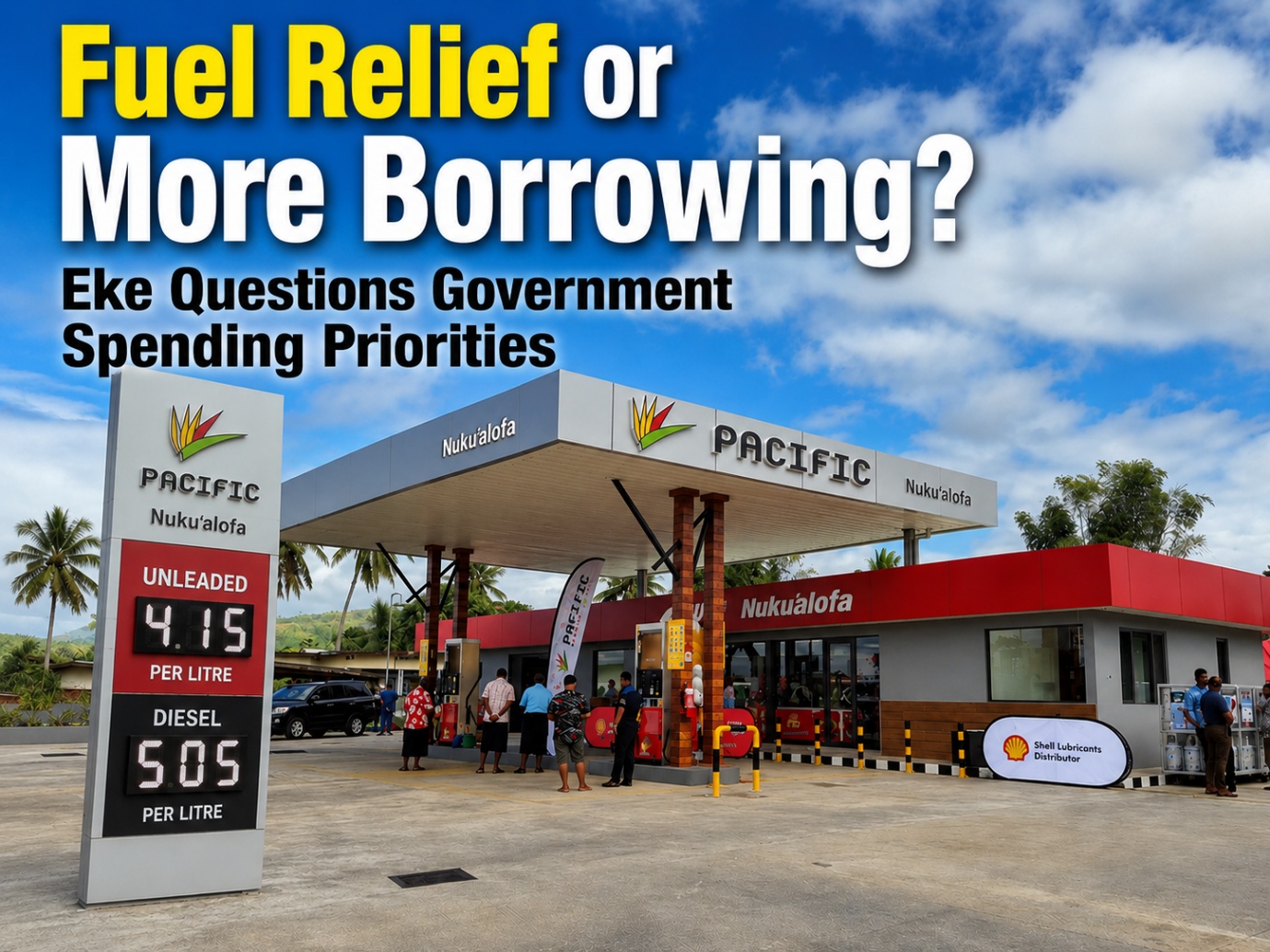
The concern comes as fuel prices have risen dramatically over the past three months.
In Tongatapu, petrol has increased from $3.05 per litre in March to $4.15 in June. Diesel has risen from $3.10 to $5.05 per litre, while kerosene has jumped from $2.35 to $4.30 per litre. In Niuafo’ou, diesel has now reached $6.00 per litre.
Diesel prices in Tongatapu have increased by approximately 63 per cent since March. Kerosene has risen by approximately 83 per cent, while petrol has increased by around 36 per cent.
The latest increase marks the third consecutive month of significant fuel price rises.
The Government has rejected calls for direct fuel relief.
Minister for Revenue and Customs Hon. Sevenitini Toumoʻua told Parliament that rising fuel prices are being driven by global events beyond Tonga’s control. Deputy Prime Minister Hon. Dr Viliami Latu similarly pointed to international conflicts and disruptions to global supply chains.
Prime Minister Lord Fakafanua argued that reducing fuel taxes would come at a significant cost to Government revenue.
According to the Prime Minister, reducing fuel excise could reduce Government revenue by approximately TOP $30 million at a time when the Budget is already forecasting a deficit.
For the Government, the argument is straightforward: fuel tax revenue helps pay for public services and reducing that revenue would place further pressure on an already stretched Budget.
Dr Eke accepts that Tonga cannot control global oil prices.
However, he argues that the country can decide how it responds to them.
He says the debate is really about priorities.
Dr Eke previously served as Minister of Finance and has been involved in the preparation and management of national budgets under previous administrations.
The former Finance Minister has also raised concerns about the Government’s broader borrowing strategy.
He notes that the projected TOP $38 million deficit is largely being used to fund operational spending, including the TOP $18 million electricity subsidy and a range of other programmes.
In his view, borrowing to fund ongoing spending creates questions about long-term sustainability.
Budget projections indicate the Government expects another deficit of approximately TOP $6 million in 2027/28.
Dr Eke argues that consecutive years of deficit spending for recurring expenditure could create future fiscal pressures.
He also draws a distinction between the current Government’s proposed deficit and the TOP $29 million deficit budgeted for the current 2025/26 financial year under the previous administration.
According to Dr Eke, the earlier deficit was linked primarily to a TOP $30 million domestic bond programme intended to support private-sector lending and economic growth. Revised estimates now indicate the 2025/26 deficit will reduce to approximately TOP $18 million because less funding than anticipated has been taken up through the programme.
Dr Eke has also questioned why the Government plans to borrow approximately TOP $35 million through domestic bonds while holding an estimated TOP $164 million in cash reserves.
He argues that if cash is already available, Parliament should consider whether some of the deficit can be funded from existing reserves rather than through new borrowing.
According to Dr Eke, more than a quarter of those reserves currently earn little or no interest, while new bond borrowing will incur interest costs of around 3 per cent.
In his view, the costs and benefits of borrowing versus using existing cash reserves should form part of the Government’s budget deliberations.

According to information provided by Dr Eke, taxes account for a significant share of the fuel price paid by consumers.
He estimates that fuel taxes consist primarily of a 65 seniti duty per litre and a 15 per cent Consumption Tax applied to the wholesale value of fuel.
Based on the Tonga Competent Authority’s fuel pricing calculations, Dr Eke estimates the Government currently receives approximately $1.19 in tax revenue from every litre of fuel sold.
With annual fuel sales estimated at around 40 million litres, he calculates fuel-related taxes generate approximately TOP $47.6 million in revenue each year.
His proposal is not to eliminate fuel taxes altogether.
Instead, he has suggested reducing fuel taxation by 30 seniti per litre, which he estimates would reduce Government revenue by approximately TOP $12 million.
Critics argue that Tonga cannot afford such a reduction while already facing a budget deficit.
Dr Eke responds that the Government has other options.
He has proposed funding the Government’s 3 per cent cost-of-living adjustment, estimated at around TOP $5 million, from existing vacancy provisions rather than through new borrowing.
He also argues that additional overtime costs within the Ministry of Health could be funded from savings generated by unfilled positions within the ministry.
Combined with additional tax revenue generated by higher fuel prices, Dr Eke estimates these measures could reduce the projected deficit by approximately TOP $32 million.
Under his proposal, the remaining funding gap would be around TOP $6 million.
Rather than issuing new bonds, he argues that amount could be funded from existing cash reserves.
Supporters of the Government may argue that programmes such as electricity subsidies, healthcare, education and social assistance provide wider benefits and justify the current spending priorities.
Others may argue that reducing fuel costs would provide broader relief across the economy because fuel affects almost every product and service.
Ultimately, the debate is about more than fuel taxes.
It is about how Government chooses to spend public money.
At a time when fuel prices are rising, the Government is preparing to borrow approximately TOP $35 million while holding substantial cash reserves.
Dr Eke believes more of that support should be directed towards easing fuel costs and reducing pressure on households and businesses.
The Government believes its current spending priorities are the right response to the challenges facing the country.
Parliament must now decide whether the greater priority is funding the Government’s current programmes or providing relief from rising fuel costs. As fuel prices continue to climb, that debate is likely to remain at the centre of the Budget discussion.