
How the Communist Party of China Leads China to Prosperity and Success
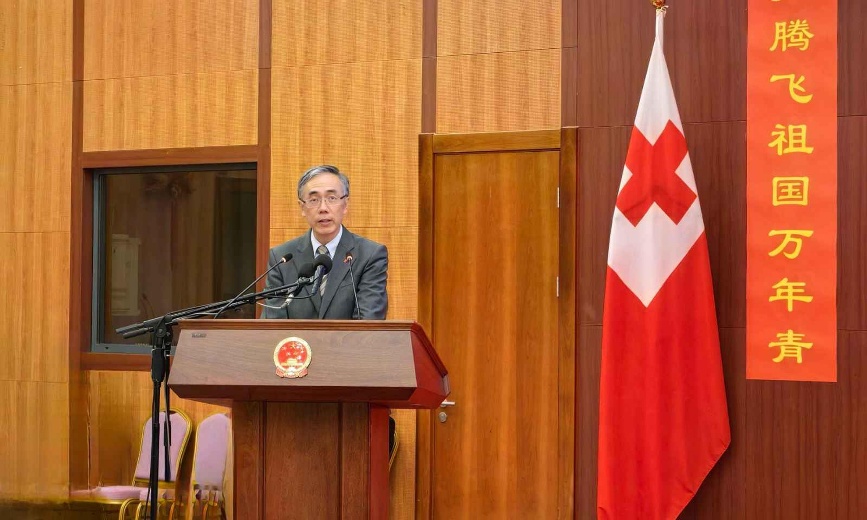
By: H.E. Ambassador Liu Weimin
On July 1 this year, the Communist Party of China (CPC) celebrated its 105th anniversary of founding. Over the past 105 years, the CPC has evolved from a small party with merely over 50 founding members into the world’s largest governing party with more than 101 million members, leading a country home to over 1.4 billion people. Along this extraordinary journey, the CPC has pioneered and unswervingly followed the path of socialism with Chinese characteristics. Within just five decades, China completed an industrialization journey that took developed nations hundreds of years, delivering two remarkable miracles: sustained rapid economic growth and long-term social stability.
The CPC has not only transformed China’s landscape but also made important contributions to world peace and development. Nowadays, the CPC has led the Chinese people in pioneering a path to Chinese modernization, offering valuable reference for all countries worldwide exploring their own modernization paths.
This naturally raises a thought-provoking question: How has the Communist Party of China led the country to such extraordinary achievements?
I. Seek Truth from Facts and Stay Pragmatic
The Party never mechanically copies foreign doctrines. Instead, it applies Marxist theories to China’s realities, develops localized theoretical innovations, and writes new chapters for Marxism.
It remains committed to the “Two Combinations” — integrating the basic tenets of Marxism with China’s specific realities and fine traditional Chinese culture.
Chairman Mao Zedong put forward revolutionary strategies for victory, including “encircling cities from the countryside” and “seizing political power from the barrel of a gun.” These theories were once labeled heretical by the Communist International, yet later proved highly compatible with China’s national conditions, becoming landmark achievements in adapting Marxism to the Chinese context. China is not alone in so doing. Tonga just celebrated the 150th anniversary of its remarkable constitution last year. As the only monarchy in the Pacific region, Tonga has forged a distinctive growth path rooted in its unique national characteristics.
During the debate over whether reform and opening-up follows a capitalist or socialist path, as well as the proper relationship between planning and the market, Deng Xiaoping set forth a set of evaluation criteria. He stressed that the relative weight of planning or the market is not the fundamental difference between socialism and capitalism. He pressed ahead unswervingly to develop the socialist market economy unique to China, elevating Marxist political economy to a new height.
The vision of building a community with a shared future for humanity draws inspiration from Confucian ideas such as “the world belongs to all” and “harmony amid diversity”. The people-centered development philosophy echoes Mencius’s famous maxim: “The people are the most important; the state comes second; the ruler is the least important.” Similarly, in Tonga, traditional wisdom such as Loto to(Humility), Mamahi’i Me’a(Loyalty), Feveitokai’aki(Reciprocation) and Faka’apa’apa(Respect) plays important part in both domestic governance as well as foreign policy.
II. Always Put the People First
The Party’s success stems from its people-centered philosophy. Not long ago, the Tongan parliamentary delegation concluded its visit to China. After returning home, many MPs told me that what struck them most deeply was how the CPC’s people-centered philosophy permeates every facet of life in China.
The CPC has always kept its original aspiration and founding mission firmly in mind: to seek happiness for the Chinese people and rejuvenation of the Chinese nation. As a well-known quote goes: The country is the people; the people are the country. Through 105 years of relentless hard work, the CPC has fundamentally transformed the future and destiny of the Chinese people. It founded New China, where the people are masters of the country, and led the nation through historic leaps from lacking adequate food and clothing to moderate prosperity in all respects, and further to comprehensive moderate prosperity.
Since the 18th National Congress of the Communist Party of China (CPC) in 2012, the CPC secured victory in the largest-scale poverty alleviation campaign in human history, eradicating absolute poverty nationwide and lifting nearly 100 million rural poor out of destitution for good. More than 1,800 CPC officials sacrificed their lives in this nationwide campaign. Today, the Chinese people hold their own destiny firmly in their hands, striding forward with confidence, self-reliance and a commitment to self improvement toward an even brighter future.
III. Distinctive Strengths in Governance
The CPC’s success can be attributed to its unique strengths in governance, supported by two core pillars.
The first pillar is its capacity to translate blueprints into tangible realities. Under the CPC’s leadership, the Chinese people formulate and implement Five-Year Plans with unified vision and concerted efforts. By pooling resources to accomplish major tasks and delivering successive Five-Year Plans, China has achieved sustained, rapid economic and social development. We are now at the starting point of the 15th Five-Year Plan period, which charts the roadmap for our next stage of development.
The second pillar is the Party’s unwavering resolve to advance self-reform of the Party. As a century-old party with over 100 million members and long-term governing experience, the CPC has weathered countless severe tests. How can a long-ruling party break free from the historical cycle of rise and fall? Chairman Mao Zedong put forward the first answer in a cave dwelling in Yan’an: to let the people supervise the government. Through a century of reflection, and especially its practices since the 18th National Congress of the CPC in 2012, the Party has found its second answer: thorough self-reform.
It has demonstrated unshakable resolve to root out corruption by launching full-scale anti-corruption campaigns to “take out tigers” “swat flies” and “hunt down foxes”. Targeting corrupt officials of all ranks and fugitives overseas, these campaigns uphold the ironclad rule that no one is above the law, with all corrupt acts punished strictly in accordance with laws and disciplinary rules.
The Party also makes full efforts to improve work conduct. It tightens restrictions on public-funded banquets, rejects privilege-seeking conduct and consistently roots out formalism, bureaucratism, hedonism and extravagance to standardize official conduct and purify the political ecosystem.
In recent thematic education campaigns, the Central Committee has urged officials to foster a correct view of political achievements. At its core, delivering benefits to the people is the greatest political achievement. Officials are encouraged to pursue long-term, sustainable development rather than short-term economic gains, and formulate pragmatic, people-centered policies that stand the test of time.

IV. Commitment to Building a Community with a Shared Future for Humanity
The CPC’s success is inherently tied to its global vision: promoting human progress and world harmony. As profound shifts unseen in a century gather pace, the world has entered a new period of turbulence and transformation, and humanity stands once again at a crossroads regarding its future direction. President Xi Jinping has proposed building a new type of international relations, and put forward the Global Development Initiative (GDI), Global Security Initiative (GSI), Global Civilization Initiative (GCI) and Global Governance Initiative (GGI), in addition to the Belt and Road Initiative, to offer China’s wisdom and solutions for a better world.
In its engagement with Pacific island countries, China follows the principle of “Four Full Respects”: full respect for the sovereignty and independence of island nations; full respect for their own will; full respect for their national cultural traditions; and full respect for their joint efforts to seek strength through unity.
Since the establishment of diplomatic ties between China and Tonga, China has been doing its utmost to support the Tongan people. Our agricultural teams have delivered remarkable results. Through the wide dissemination of advanced cultivation techniques, Tonga’s output of high-quality mushrooms has kept rising, driving the market price down from 25 to 15 Pa’anga per kilogram. Quality edible fungi are now affordable for ordinary households, enriching local diets and boosting public nutrition. Due to the team’s effort, Tonga has nearly achieved self-sufficiency in egg production, with steady output growth and stable market supply. Egg prices have fallen from 40 to 20 Pa’anga per tray, easing household living costs, supporting the sustainable growth of local livestock farming, and optimizing Tonga’s overall agricultural structure. China-aid Wind Farm Project contributes 10% of the country’s total electricity generation. We are happy to see that the gardens and parking lots at Royal Tomb have offered convenience for people’s daily life.
This year marks the launch of China’s 15th Five-Year Plan, placing the century-old CPC at a brand-new historical starting point to forge ahead. We are keen to strengthen alignment between China’s 15th Five-Year Plan and Tonga’s Strategic Development Framework III (TSDF III) 2025–2035 to open up broader prospects for cooperation.
Last year, His Majesty King Tupou VI paid a successful state visit to China, lifting China-Tonga relations to new heights. China is ready to work closely with Tonga to continuously exchange governance experience, deepen political mutual trust, expand practical cooperation, advance people-to-people exchanges, and improve cooperation on regional and international affairs, so as to truly deliver benefits to the peoples of both countries and beyond.