Tonga’s Rugby League Moment: When Political Opportunity Meets Pacific Strategy
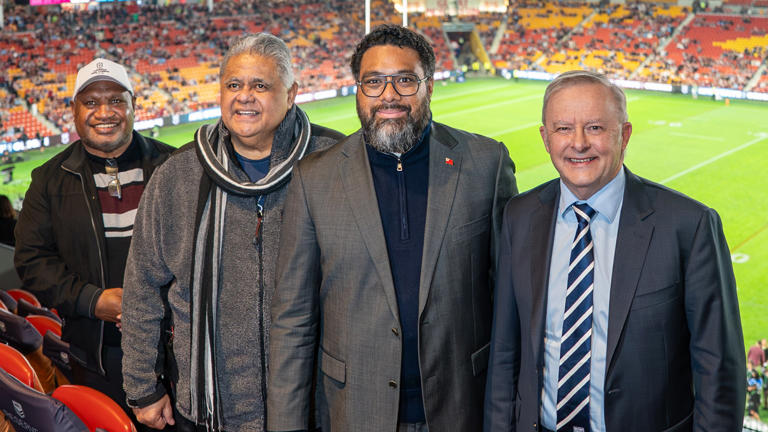
Figure 1. PNG Prime Minister James Marape, Samoa Prime Minister Laʻauli Leutele Schmidt, Tonga Prime Minister Fatafehi Fakafanua and Anthony Albanese at the State of Origin.
When Mate Ma’a Tonga runs out onto the field, something happens that no government press release can create. Living rooms in Nuku’alofa, Auckland and Sydney fill with red. Grandparents who have never set foot in Tonga’s stadiums cheer for players they have never met. For a few hours, a small island nation feels like it stands at the centre of the world.
That is where Mate Ma’a Tonga’s power has always come from. Not from government. From the people.
The team’s rise was built by the Tongan diaspora in Australia and New Zealand, by players who chose to wear red instead of playing for bigger, richer nations, and by a wave of national pride that turned a rugby league side into a symbol of what it means to be Tongan. Nobody in government built that. It grew from the ground up.
The question now is whether political leaders are attaching themselves to that success rather than creating it.
The political attraction is obvious
Any government, especially a young one still building public trust, gains something real by standing next to a winning national team. Former Prime Minister Akilisi Pohiva did this. Various government officials have attached themselves to the success of the national team since its rise at the 2017 Rugby League World Cup. Mate Ma’a Tonga carries pride, unity, and a global audience that most government announcements will never reach. A leader photographed with the team gets visibility and goodwill that policy debates rarely deliver.
This is not unique to Tonga. Governments around the world do the same thing, because sport builds an emotional connection with the public that politics usually cannot.
The risk is not that a Prime Minister supports the team. The risk is what happens when political ownership starts to replace community ownership.
Why this fits into Australia’s wider strategy
This is where Australia’s Pacific strategy comes into the picture. Influence is not only built through formal government agreements. It is also built through the networks and institutions that shape everyday life, and rugby league is one of them.
If Tonga’s rugby league structures become more closely tied to government, the NRL, the IRL, and Australian sporting bodies, then Australia naturally becomes a bigger player in the direction Tongan rugby league takes. That does not require any kind of conspiracy. It is simply how influence works. Whoever provides the funding, the coaching pathways, the international access and the governance support usually ends up shaping the institution.
The governance question is the real issue
Nobody is questioning whether a Prime Minister should support rugby league. That is normal and expected.
The real question is whether the national sport should be politically tied to one government, or whether it should stay independent and belong to all Tongans equally.
Strong sporting federations are usually kept separate from government for a simple reason. Governments change. Political priorities change with them. Sporting institutions need to survive beyond any one administration, and that only works if they are not built around a single leader or party.
When the head of government becomes directly involved in the governing structure of the sport, that separation starts to blur.
Tonga has already seen a version of this before. Semisi Sika had been President of Tonga National Rugby League until a Supreme Court order dissolved that board in 2016 over financial mismanagement. In September 2019, while serving as Tonga’s acting Prime Minister, Sika wrote to the sport’s international governing body raising concerns about the administration that had replaced him, a letter that helped trigger TNRL’s suspension and, eventually, its expulsion in 2020. The following year, an IRL implementation committee shortlisted two people for the role of independent chairman of the new governing body: Sika, and the then-Speaker of Parliament, Lord Fakafanua.
The same pattern has repeated since. The International Rugby League recognised Tonga Rugby League XIII as the sport’s official governing body in August 2024, replacing TNRL, which had been expelled in 2020 and was never readmitted. Tonga Rugby League XIII was chaired by Lord Fakafanua. In December 2025, Fakafanua was elected Prime Minister of Tonga. The man now leading the government is the same man who chaired the body now running the national game.
Tonga Independent News wrote to the Prime Minister’s Office asking whether the Prime Minister sees any tension between his role leading the sport’s governing body and his current position as head of government, and whether he has taken any steps to separate the two. A response was requested by 5pm Monday 13 July. The Office had not responded or acknowledged the request by the time of publication.

The irony for Tonga
The irony is hard to miss. Mate Ma’a Tonga’s greatest strength has always been that it belongs to the people, not to any government. It represents the villages, the clubs, the diaspora, the families watching from overseas, and the players who chose Tonga out of identity rather than obligation. Its power came from being bigger than politics.
That independence is what gives the jersey its power.
The challenge now is making sure that political leaders and international partners do not, even unintentionally, turn a people’s movement into a government project.
The wider Pacific lesson
The ABC’s report “Invisible string that Australia attached to PNG’s rugby league team” shows how far this strategy already reaches, and it reaches Tonga directly. Australia has committed $600 million to rugby league across the Pacific, and that funding is not limited to the Papua New Guinea Chiefs. $250 million of that commitment funds the Pacific Rugby League Partnership, a ten-year program covering Papua New Guinea, Tonga, Samoa and Fiji together.
Four days before Tonga Independent News wrote to the Prime Minister’s Office, Fakafanua stood in Brisbane alongside Australian Prime Minister Anthony Albanese to launch that partnership. The launch was announced by the Australian Prime Minister’s office on 8 July 2026.
But Tonga’s position in this strategy is not the same as PNG’s. Papua New Guinea’s challenge was building the professional infrastructure to support a licensed NRL team, in a country where rugby league is already the No. 1 sport. Tonga’s challenge is different. The game is already embedded in every village and every diaspora household. Mate Ma’a Tonga is a household name, even though rugby union remains Tonga’s official national sport. Nobody needs to be convinced to care about the game. The question for Tonga was never whether people would follow it. It is who ends up shaping where it goes next.
Australian minister Pat Conroy was blunt about the thinking behind the investment, telling the ABC the funding was “not about sport, it was about relationships and influence.” That line applies to Tonga just as much as it applies to Port Moresby.
The reasoning is straightforward. About half of all NRL players are of Pacific heritage, even though Pacific people make up only around three percent of Australia’s population. That gives rugby league a level of trust and cultural connection in Tonga that money alone cannot buy, which is exactly why the sport has become such a useful diplomatic tool.
There is a gap worth pointing out here too. Australia has put its weight behind rugby league, while China has been quietly building interest in rugby union, particularly in Fiji. Rugby union still holds real cultural power in Fiji, Tonga and Samoa. That leaves Tonga sitting in the middle of both codes, and both strategies, whether the country chose that position or not.
Rugby league in the Pacific is no longer just a game. It carries weight as diplomacy, as identity, as an economic opportunity, and as a source of regional influence.
The challenge for Tonga is not whether to accept the benefits of these partnerships. A small island nation cannot afford to ignore the opportunities that come with them. The real challenge is who ends up shaping the game once the funding, the pathways and the influence arrive.
Because whoever shapes the future of rugby league in Tonga is not just shaping a sport. They are shaping one of the most powerful expressions of what it means to be Tongan.