NEMO Headquarters Opening Stalled Over Palace Lease Dispute
Palace intervention raises questions over legality of land arrangements between Tonga Power and MEIDECC
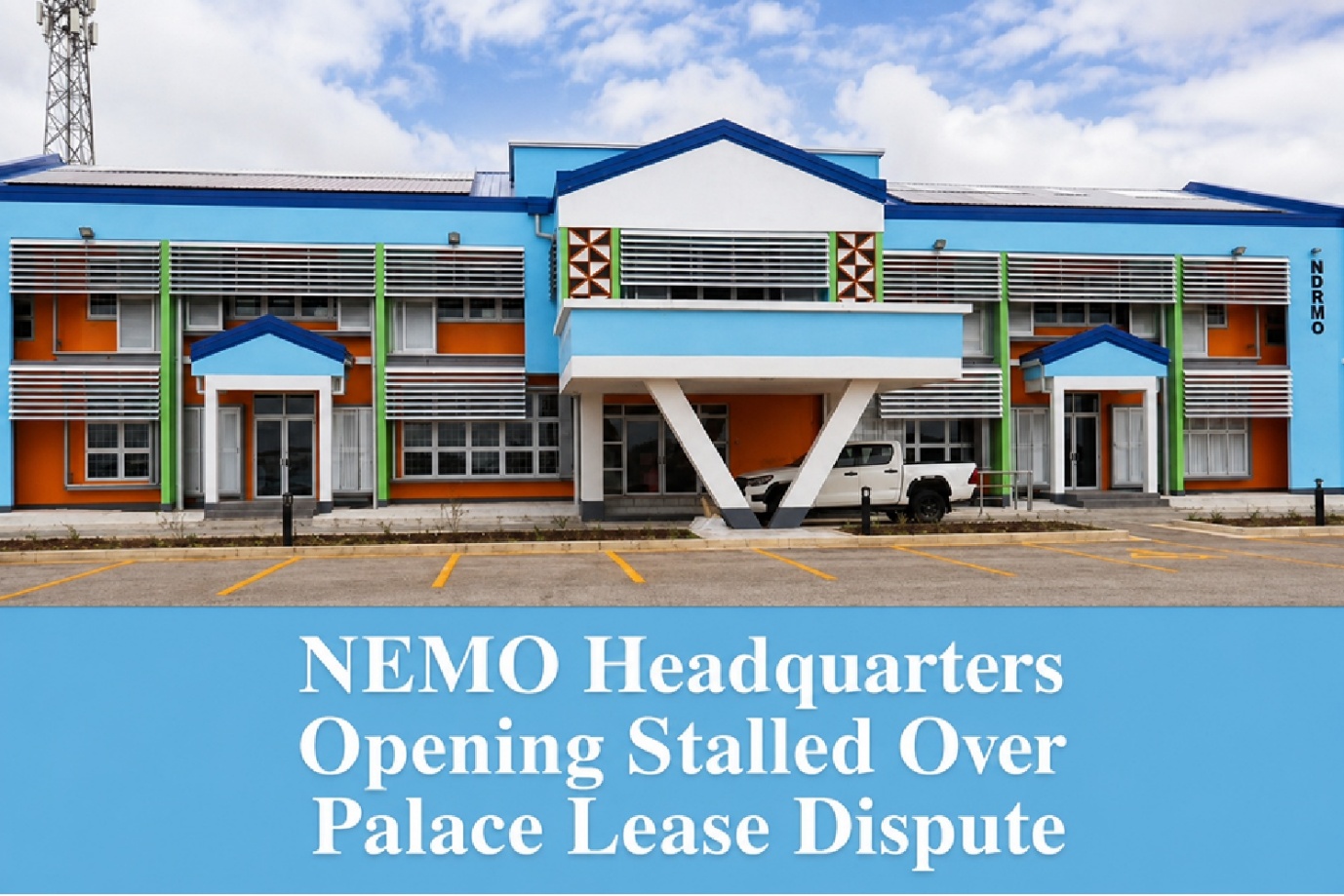
The official opening of Tonga’s new National Emergency Management Office (NEMO) headquarters continues to stall due to a dispute arising from the Palace Office’s disapproval of the sublease of the original lease to Tonga Power.
Documents obtained by Tonga Independent News show the dispute has left government agencies scrambling to unravel years of lease arrangements involving Tonga Power Limited (TPL), the Ministry of Meteorology, Energy, Information, Disaster Management, Environment, Climate Change and Communications (MEIDECC), and the Ministry of Lands.
The documents suggest the issue extends well beyond a simple administrative oversight, raising questions about how a major public infrastructure project proceeded before the underlying land tenure was fully resolved.
At the heart of the dispute appears to be differing interpretations of the procedures governing Royal Estate leases, particularly the relationship between Cabinet’s approval of a sublease and the rights of the Royal Estate as lessor. Whatever the cause, the result has been a complex land dispute affecting infrastructure funded by millions of paʻanga in development assistance.
According to the lease, Tonga Power Ltd entered into a 50-year lease over the Matatoa site in 2015 for the construction of its headquarters. In August 2016, following a request from the then Deputy Prime Minister for Tonga Power to accommodate the new NEMO HQ, TPL agreed to sublease approximately 7,446 square metres of that land for a new Meteorology and NEMO head office funded by the Asian Development Bank (ADB).
The arrangement was approved by a special meeting of the Tonga Power Board and became Sublease No. 264, issued by the Ministry of Lands for a term of 35 years (24/11/2016–23/11/2051) with an annual rent of $1.00.
Safety concerns changed the project
The documents show the original site was later considered unsuitable due to safety concerns, because of its proximity to the Tonga Gas depot.
In July 2022, the Public Enterprises Chief Executive requested that the gas depot be relocated because of concerns about locating the country’s emergency headquarters so close to a fuel installation.
As a result, Tonga Power cancelled the original sublease and sought approval for a revised lease area incorporating the former Tonga Gas depot site. Tonga Power wrote to the Ministry of Lands in November 2022 requesting cancellation of the original sublease to make way for the expanded lease area. The revised proposal was approved by a special board meeting of the Tonga Power Board in September 2022, and Cabinet approved the new sublease arrangement on 3 February 2023.
Cabinet’s decision, recorded in a memorandum signed by Chief Secretary and Secretary to Cabinet Paula Ma’u, approved the cancellation of Sublease No. 264 and authorised a new sublease to MEIDECC for the revised site, subject to payment of outstanding rental arrears in full.
Palace raises legal concerns
The issue resurfaced only after construction of the new headquarters had been completed.
According to internal documents, MEIDECC invited Their Majesties to officially commission the building on 30 January 2026.
However, the documents show the King’s Private Secretary informed the MEIDECC Chief Executive that the sublease from Tonga Power to MEIDECC had been ‘illegally done’, according to correspondence from the Palace Office because it did not comply with the terms and conditions of the original Royal Estate deed. The correspondence says the commissioning would remain pending until the land issue was resolved.
The same correspondence records that Palace officials recommended terminating the existing lease arrangements altogether and replacing them with two separate leases directly from the Royal Estate: one for Tonga Power and one for MEIDECC.
MEIDECC seeks termination
In a Savingram dated 19 January 2026, MEIDECC Chief Executive Sione ‘Akau’ola formally asked the Minister for Lands, Survey, Planning and Natural Resources to terminate Sublease No. 337 between MEIDECC and Tonga Power.
‘Akau’ola wrote that, following concerns raised by the Palace Office in early January, the existing sublease was “non-compliant with the original deed of the land lease conditions of TPL to the Royal Estate,” and asked for approval for MEIDECC to obtain a direct lease from the Royal Estate instead. He noted that commissioning of the building remained pending until the matter was resolved.
PM’s comments
At a press conference on Friday, 31 July, the Prime Minister was asked about the delay in commissioning the new MEIDECC and National Emergency Management Office headquarters.
He said his administration had identified an error in the lease arrangements after His Majesty declined to commission the building and that the Government subsequently cancelled the lease.
However, contemporaneous correspondence and official documents obtained by Tonga Independent News indicate that the sequence of events began several months earlier.
The documentary record indicates that the issue first emerged in January 2026, when the King’s Private Secretary advised the Chief Executive of MEIDECC that the existing sublease between Tonga Power Limited and MEIDECC appeared to be inconsistent with the conditions of the original Royal Estate lease. As a consequence, His Majesty deferred any decision to attend the commissioning ceremony until the land tenure issue had been resolved.
The documents further show that MEIDECC subsequently met with the Palace Office, where it was recommended that the existing Tonga Power lease be terminated, thereby extinguishing the associated sublease, and that two new lease applications be lodged directly with the Royal Estate, one for Tonga Power and one for MEIDECC.
Consistent with that recommendation, on 19 January 2026 the Chief Executive of MEIDECC formally wrote to the Minister for Lands requesting the termination of Sublease No. 337 and seeking approval for MEIDECC to obtain a direct lease from the Royal Estate.
The documents therefore indicate that the process leading to the cancellation of the lease arrangements began after concerns were raised by the Palace Office, rather than with the Government independently identifying the issue.

The $1 Question
Perhaps the most intriguing question arising from the documents is not whether the sublease was lawful, but why it was structured the way it was in the first place.
The sublease registered by the Ministry of Lands granted MEIDECC exclusive use of approximately 2 acres, 1 rood and 39.7 perches of Royal Estate land at Matatoa for a term of 29 years at a rental of just $1 per annum.
On one view, the arrangement may have appeared entirely reasonable. Tonga Power Limited is a government-owned public enterprise, while MEIDECC is a government ministry. One possible explanation is that officials regarded the arrangement as a transfer between two government entities, making a nominal rental appropriate.
However, the land itself did not belong to Tonga Power.
TPL was the lessee, not the owner. The Royal Estate remained the lessor and retained an ongoing interest in how the land was used and on what terms.
That raises an important question. If almost one-third of Tonga Power’s leasehold was being transferred to another government entity for nearly three decades at a nominal rent, what consideration was given to the interests of the Royal Estate when the arrangement was approved?
The documents do not answer that question. Nor do they explain in detail why the Palace Office later concluded that the sublease was inconsistent with the conditions of the original Royal Estate deed. They simply record that the concern was raised, and that the recommended solution was to terminate the existing lease arrangements and replace them with two separate leases directly from the Royal Estate.
That recommendation prompts another question.
If MEIDECC was always intended to occupy the site permanently as the nation’s Meteorology and National Emergency Management headquarters, why was a direct lease from the Royal Estate not pursued from the outset?
Instead, the Government adopted a more complex arrangement:
Royal Estate → Tonga Power Limited → MEIDECC
Only after the buildings had been completed did officials begin pursuing what appears to have been the simpler structure:
Royal Estate → Tonga Power Limited
Royal Estate → MEIDECC
Whether the dispute ultimately arose from an administrative oversight, competing legal interpretations or failures in the approval process remains unresolved. What is beyond dispute, however, is that a major public infrastructure project progressed through board approval, ministerial approval, Cabinet approval, registration and construction before the underlying lease arrangement was challenged.