
Artemis II Astronauts Return to Earth After Historic Lunar Flyby
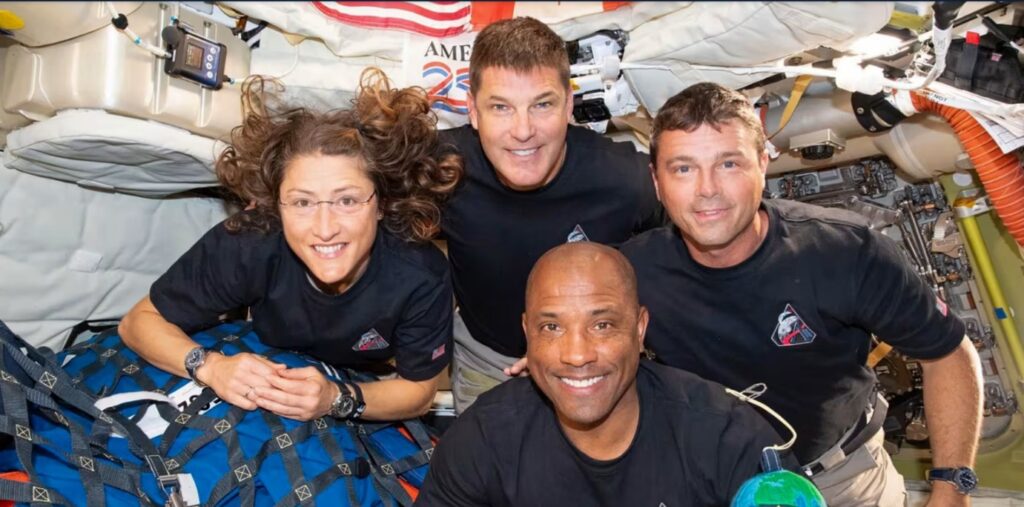
For the first time in more than 50 years, humans have flown around the moon and safely returned. The four astronauts of NASA’s Artemis II mission splashed down in the Pacific Ocean off the coast of San Diego on Friday at 8:07 p.m. ET, marking the successful end of a 10-day, 700,237-mile journey.
The capsule, named Integrity by its crew, endured a fiery 15-minute re-entry through Earth’s atmosphere, with temperatures reaching nearly 5,000 degrees Fahrenheit. A six-minute communications blackout during the descent made for a nail-biting finale. Then, a welcome crackle broke the silence.
“Houston, Integrity, we have you loud and clear,” radioed Commander Reid Wiseman.
Seconds later, three giant parachutes deployed, lowering the Orion capsule to a gentle, upright splashdown. NASA flight director Rick Henfling later confirmed the landing was “near-perfect,” touching down less than a mile from its target.
Recovery teams from NASA and the U.S. Navy quickly secured the area. The crew—NASA astronauts Wiseman, Christina Koch, Victor Glover, and Canadian astronaut Jeremy Hansen—were extracted one by one and flown by helicopter to the USS John P. Murtha for medical evaluations. Later that night, they were expected to fly to NASA’s Johnson Space Centre in Houston.
“Y’all, we did it,” said Lori Glaze, acting associate administrator of NASA’s Exploration Systems Development Mission Directorate. “We sent four amazing people to the moon and safely returned them to Earth for the first time in more than 50 years.”
What Made This Mission Different from Apollo?
While Apollo astronauts also flew to the moon, Artemis II set new records and accomplished feats even those pioneering missions did not. The crew became the first humans to see the entire lunar far side with their own eyes—a hemisphere that permanently faces away from Earth. Most Apollo missions followed trajectories that never revealed the full far side.
During their lunar flyby, the astronauts photographed rugged topography, ancient lava plains, and impact basins formed billions of years ago when large objects smashed into the lunar surface. They also studied the moon’s “terminator”—the dividing line between light and darkness—where jagged features cast dramatic shadows. NASA says these images will help scientists understand how the moon formed and how its landscape has evolved.
The crew also set a new distance record for human spaceflight: 252,756 miles from Earth, surpassing the 248,655-mile record set by Apollo 13 in 1970 during its emergency return.

A Critical Test: The Heat Shield Problem
Re-entering Earth’s atmosphere is always dangerous, but Artemis II carried an extra layer of risk. During the uncrewed Artemis I test flight in 2022, NASA discovered a flaw in Orion’s heat shield: parts of the protective material cracked and broke off during re-entry.
To protect the astronauts, engineers modified the flight plan. Instead of a shallow descent, the capsule followed a steeper, faster path, reducing the time it spent at the most extreme temperatures. The gamble paid off. NASA will now conduct a full analysis of the heat shield’s performance after the capsule is returned to the Kennedy Space Centre in Florida.
“The successful re-entry is a huge relief and a testament to the ingenuity of NASA’s engineers,” said Amit Kshatriya, NASA’s associate administrator.
Why This Matters: The Road to the Lunar Surface
Artemis II was never meant to land on the moon. Its goal was to prove that Orion, the Space Launch System rocket, and all supporting systems are safe for humans on long-duration lunar missions. With that goal achieved, NASA is turning its focus to landing.
The next mission, Artemis III, is scheduled for mid-2027. It aims to land astronauts near the moon’s south pole, a region never explored by humans, where permanently shadowed craters may hold water ice. That ice could be converted into drinking water, oxygen, and even rocket fuel—key resources for future lunar bases.
In 2028, Artemis IV will begin assembling the Lunar Gateway, a small space station in orbit around the moon that will serve as a waypoint for deeper space exploration.
“The path to the lunar surface is open,” Kshatriya said. “Fifty-three years ago, humanity left the moon. This time, we return to stay.”
For the four astronauts of Artemis II, their work is just beginning. They will now spend weeks sharing their experiences with scientists and engineers, helping to refine the technologies that will carry the next crew down to the lunar surface—and, one day, on to Mars.
Melino Maka