Climate Justice Must Begin at Home
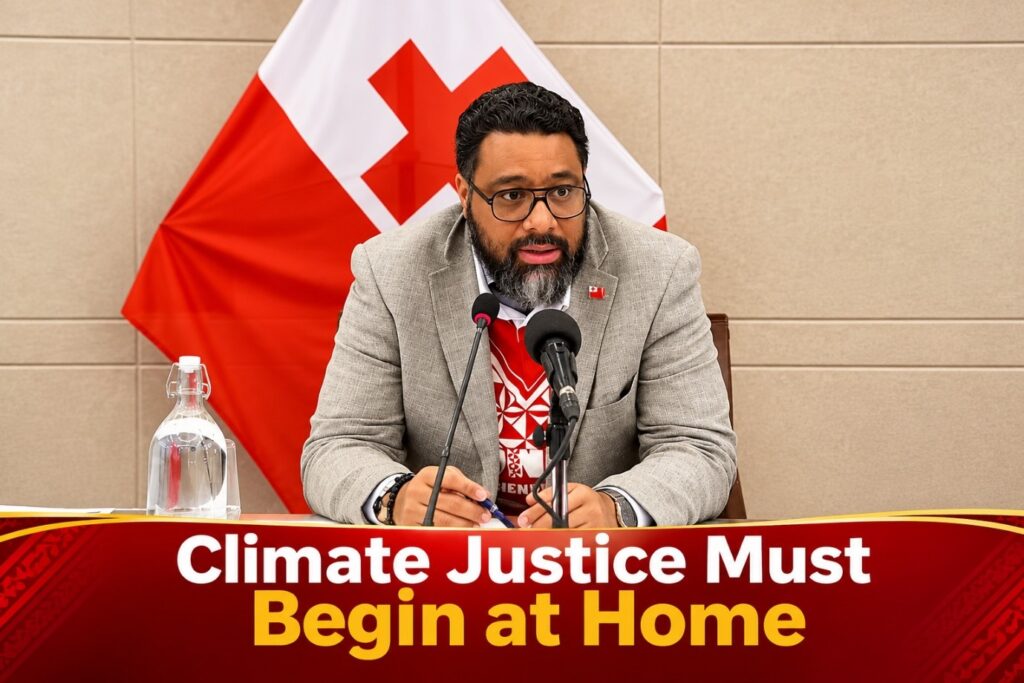
Tonga’s leaders are seeking hundreds of millions of dollars in international climate financing while communities at home face worsening drought and delays in accessing existing assistance. The Government must demonstrate that its overseas efforts are producing results while addressing the immediate needs of its people.
Tonga has every right to demand that the world’s major polluters take responsibility for the damage caused by climate change. Our contribution to global emissions is negligible, yet our islands face rising seas, coastal erosion, prolonged droughts and increasingly unpredictable weather.
But demanding more money from the international community must be matched by our ability to manage and distribute the funding already available.
That is where Tonga’s political leadership deserves closer scrutiny.
Prime Minister Lord Fakafanua has made international climate financing a major priority, particularly efforts to secure US$500 million for the Pacific Resilience Facility (PRF), which will be headquartered in Nuku’alofa.
The facility is intended to invest contributions from international partners and use the returns to finance climate resilience projects across the Pacific.
Meanwhile, former Prime Minister Siaosi Sovaleni, serving as the Pacific Political Champion for Loss and Damage, has called for stronger international commitments and greater access to grant-based climate financing.
He argues that climate financing is a matter of justice, not charity.
These are legitimate objectives. But the Government must also demonstrate that the climate assistance already available to Tonga is reaching the communities that need it.
The Prime Minister Knew the Situation Before Leaving
At his 14 October press conference, Prime Minister Lord Fakafanua identified what he described as a “super El Niño” as a major concern for Tonga.
Government officials responsible for climate change and disaster response were present to brief the media on water shortages affecting some outer islands and the impact of prolonged dry conditions on local crops.
The Prime Minister was therefore aware of the difficulties facing communities before departing Tonga the following day, 15 October, for an extended overseas programme.
His travels began with a visit to Perth to support Mate Ma’a Tonga in its Rugby League World Cup match against England, followed by official engagements in the United States and attendance at COP31 in Türkiye.
As of 15 November, the Prime Minister has been overseas for 31 consecutive days without returning to Tonga.
His extended absence comes at a time when the country is facing drought conditions, pressure on water supplies and rising living costs.
The Prime Minister had indicated that securing financial support for the US$500 million Pacific Resilience Facility would be a major focus of his international engagements.
The importance of that undertaking is not in question. Its establishment in Tonga is a significant development for the country and the wider Pacific.
But the timing and duration of his overseas programme deserve scrutiny.
Having publicly acknowledged the seriousness of the drought, what arrangements did the Prime Minister and Cabinet put in place to ensure that affected communities received the assistance they needed during his absence?
And what progress has the Government made in addressing the water shortages and agricultural difficulties identified at his press conference more than a month ago?
There is nothing wrong with our leaders representing Tonga at international conferences. These meetings provide opportunities to secure funding, strengthen diplomatic relationships and influence decisions affecting small island nations.
But the Prime Minister and Cabinet have responsibilities that extend beyond representing Tonga overseas.
The Government should be able to explain the purpose, cost and outcomes of these visits, particularly when the country is facing serious economic and environmental pressures.
The Prime Minister does not have to personally administer every climate project. He does, however, have a responsibility to ensure that the ministries and agencies under his Government are delivering the assistance communities need.
Communities Cannot Wait for Bureaucracy
Tonga Independent News recently reported complaints from applicants seeking assistance through the Tonga Climate Change Fund (TCCF).
Applicants described lengthy assessments, complicated paperwork, poor communication and uncertainty over when their projects would be approved.
One non-government organisation seeking funding to provide solar electricity to vulnerable households in Hihifo has been waiting since August for a decision. Supplier quotations obtained for the project are expiring while the application remains under assessment.
The fund has indicated that assessments should be completed within three months, a period that has not yet expired. Nevertheless, the complaints raise questions about whether its procedures are suited to communities facing immediate climate risks.
Another applicant seeking assistance with cyclone protection questioned why accessing financial support involved so much paperwork that some applicants simply gave up.
Climate funding is supposed to help communities prepare for disasters, not leave them waiting for decisions while the risks continue to grow.
The concerns come as Tonga has secured approval for another US$14.98 million in climate adaptation financing, including approximately US$10.3 million earmarked to support the TCCF.
The six-year programme, approved by the Adaptation Fund Board in October, is intended to support water security, infrastructure, agriculture and community adaptation.
The Pacific Community (SPC), which will oversee the programme, has acknowledged concerns about application requirements and assessment periods.
It has confirmed that the programme will include a review of the fund’s procedures, governance and administration.
That is welcome, but why should applicants have to wait for another internationally funded programme before existing administrative problems are addressed?
The new funding is not yet available for immediate distribution, with implementation planned to begin in 2027. The complaints, however, concern a fund that is already operating.
Tonga Independent News has sought information from the responsible ministry on the number of applications received, approved, rejected and still awaiting decisions, along with average processing times.
Those figures have not been provided.
Without that information, the public has no reliable way of judging how efficiently the fund is operating.
El Niño Will Not Wait
The need for action is becoming more urgent.
Tonga is already experiencing serious drought conditions, with the risk of further dry weather threatening water supplies, agriculture and household livelihoods.
The difficulties outlined by government officials at the Prime Minister’s October press conference demonstrate why practical climate adaptation measures are so important.
Communities need reliable water storage, renewable energy, stronger homes and measures to protect their livelihoods.
They need these projects completed before conditions worsen, not after the damage has been done.
There is little value in announcing millions of dollars in climate financing if the people who need assistance cannot access it in time.

We Must Move Beyond the Victim Narrative
Tonga’s vulnerability to climate change is real, and the international community has a responsibility to help countries facing consequences they did little to create.
But vulnerability should not become an excuse for permanent dependence on overseas assistance.
Our leaders must move beyond repeatedly presenting Tonga as a victim deserving more financial support and show that the country can put the assistance it receives to effective use.
This does not mean abandoning our demands for climate justice. It means demonstrating that we can manage the resources entrusted to us.
The success of climate financing cannot be measured simply by the millions announced at international conferences.
It must be measured by the number of households receiving reliable electricity, communities with secure water supplies, homes protected against severe weather and families better prepared for disasters.
International donors are often criticised for complicated requirements and lengthy approval processes. Some of that criticism is justified.
But Tonga’s own institutions must also take responsibility for the systems they administer.
Where procedures are unnecessarily complicated, they should be simplified. Where applications are delayed, applicants deserve explanations. Where staffing or technical capacity is inadequate, those problems must be addressed.
The Government should publish regular reports showing how much climate funding has been received, how much has been spent, which projects have been approved and what has actually been completed.
The public is entitled to know how these resources are being used.
The Government Must Get Its Priorities Right
Tonga’s leaders are right to remind the world that small island nations should not carry the financial burden of a crisis they did little to create.
But international recognition and financial commitments mean little to communities that cannot obtain assistance when they need it.
The Prime Minister has now spent more than a month overseas pursuing international engagements. The public is entitled to know what those engagements have achieved and how effectively the Government has responded to the drought during his absence.
With households already struggling with rising prices and communities facing water shortages, the Government has immediate responsibilities that require sustained attention.
Tonga should continue seeking its fair share of international climate financing. But securing more funding cannot be the only measure of success.
Before celebrating the next multimillion-dollar announcement, our leaders should answer a much simpler question.
What have we actually achieved with the money and assistance already provided?