Opinion:The Pacific Chessboard: Tonga Between Two Superpowers
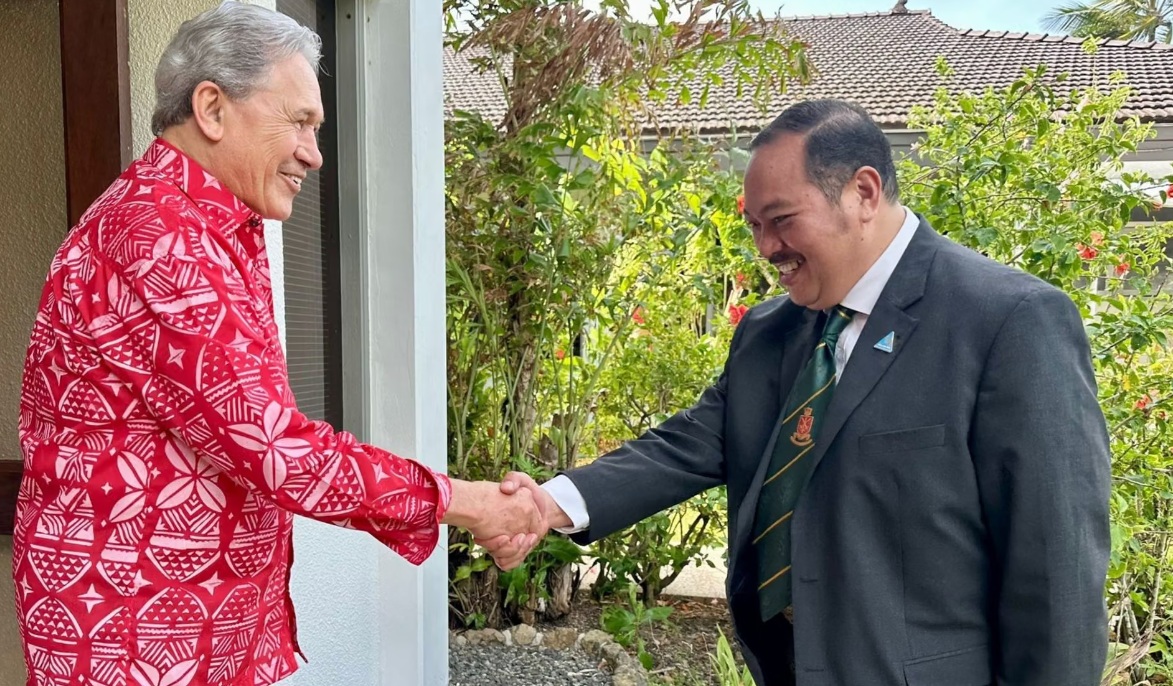
NZ Foreign Minister Winston Peters meets Tonga’s Crown Prince Tupoutoʻa ʻUlukalala in Palau:
By Melino Maka
As the United States unfurls its cheque book across the Pacific with a US$150 million investment package, Tonga finds itself at the crossroads of a geopolitical contest it never asked for. The kingdom, one of the oldest diplomatic partners of the United States in the region, now emerges as a key beneficiary of Washington’s renewed strategic push. Yet beneath the headlines of energy security, digital infrastructure, and port upgrades lies a more complex question: what becomes of Tonga’s relationship with China as American dollars flow in and the U.S. quietly lifts its travel ban while leaving prohibitive visa fees intact?
The American Opening
At the Pacific Islands Forum Partners Dialogue in Palau, Deputy Secretary of State Christopher Landau unveiled a package that positions Tonga at the centre of U.S. Pacific strategy. The support spans multiple fronts: a feasibility study to modernise Tonga’s national data centre and network, backed by American cloud technology; a US$60 million Regional Energy Security Initiative to expand fuel storage capacity; and plans to upgrade port facilities that currently leave Tonga exposed to supply disruptions.
For a nation that imports every drop of its fuel and has long weathered the volatility of global prices, these promises carry tangible weight. Stéphane Cadel of Pacific Energy called the fuel infrastructure project “the most significant energy sector development in the Kingdom of Tonga for decades.” The proposal to expand storage from 15–20 days to 60 days of supply would transform the kingdom’s resilience.
Landau emphasised that the Pacific is of “strategic interest” to the United States, noting that “if you don’t pay attention to what happens here, you might pay a serious price in blood”. The U.S. has also announced a second Pacific Islands Investment Summit for early 2027, following the inaugural Honolulu gathering in February.
The Shadow of China
Yet the American pivot arrives against a backdrop of deep, existing ties with Beijing. Tonga’s relationship with China dates back to 1998, when it switched diplomatic recognition from Taiwan to China, receiving large Chinese loans for infrastructure projects. Today, those loans carry a heavy price.
Budget documents show a $67.36 million loan owed to China’s Exim Bank, taken out in 2008 to rebuild Nuku’alofa’s central business district after the 2006 riots. With interest, the debt exceeded $100 million by 2024. In the year to June 2025, Tonga paid China $17.7 million as part of total debt repayments of $29.4 million—a sum that dwarfs the nation’s annual infrastructure budget of just $10.1 million and cuts deeply into health spending.
Prime Minister Lord Fakafanua has made his position clear: “We’re currently in a position where we’re not taking any more loans, we’re not taking any more debt. We’re being a lot more clever with our fiscal management”. The International Monetary Fund considers Tonga at high risk of debt distress.
For its part, Beijing insists its loans were extended when Tonga faced economic difficulties and “China was the only country to step forward and lend a helping hand”. The Chinese embassy has accused Western media of “sensationalising” the debt issue and distorting the full picture of China’s support, which included swift disaster relief following the 2022 volcanic eruption—with military aircraft and naval ships delivering supplies and emergency cash.

Trust, Sovereignty, and Public Sentiment
Tongan attitudes toward these competing powers tell a revealing story. A 2023 survey of over 1,000 citizens found that New Zealand ranks as Tonga’s most trusted partner, followed by Australia, the United States, and the United Kingdom. China sits further down the list. Nearly 90% of Tongans expressed concern about China’s influence, though 70% also worried about American influence—suggesting wariness is not reserved for Beijing alone.
Perhaps most striking: 80% of Tongans believe China is “likely” or “very likely” to become a military threat to Tonga in the next two decades. A slim majority would strongly favour a U.S. military base in Tonga, while more than half are strongly opposed to a Chinese one. Yet China is still ranked as Tonga’s second “best friend in the world”—a perception likely tied to which nations Tongans believe their government is closest to.
This ambivalence reflects a deeper anxiety about sovereignty. Olive Mafi of the Civil Society Forum of Tonga warns: “A sovereignty we cannot afford to use isn’t really sovereignty.” She argues that major decisions increasingly “come with price tags set by outside powers or arbitrators in someone else’s country”. Palau’s President Surangel Whipps Jr. echoed this at the Forum, urging partners to “sail with us” but insisting they “do not choose our destination”.
The Path Forward
For Tonga, the U.S. investment push represents both opportunity and challenge. The kingdom stands to gain tangible benefits—improved energy resilience, modernised digital infrastructure, and potential economic growth from private sector engagement. Yet the American embrace comes with its own contradictions: the visa bond requirement remains in place, and as Landau acknowledged, it is a “worldwide issue” the U.S. is rolling out to “disincentivise people from overstaying their visas”.
The deeper question is whether Tonga can navigate this intensifying rivalry without becoming a pawn in a game it did not choose. Pacific leaders have repeatedly stressed that external powers should support regional priorities rather than define them. China’s response to the U.S. move has been measured, urging all parties to “embrace an open and cooperative mindset” rather than cling to “an outdated mentality of sphere-of-influence and geopolitical competition”.
Tonga’s relationship with China is unlikely to end abruptly—Beijing remains a major diplomatic partner, and the debt repayments will continue for years. But the era of new Chinese loans appears over, at least for now. The United States is stepping into the void with check book in hand, but whether Tongans will see this as genuine partnership or another form of external control remains an open question.
As the Forum chair’s Solomon Islands representative put it: “Friendship and threat cannot travel in the same canoe”. For Tonga, the task ahead is to ensure that its relationships with both Washington and Beijing serve its own people’s needs—not the strategic ambitions of distant powers.