Who Is Holding Tonga’s Public Service Accountable?
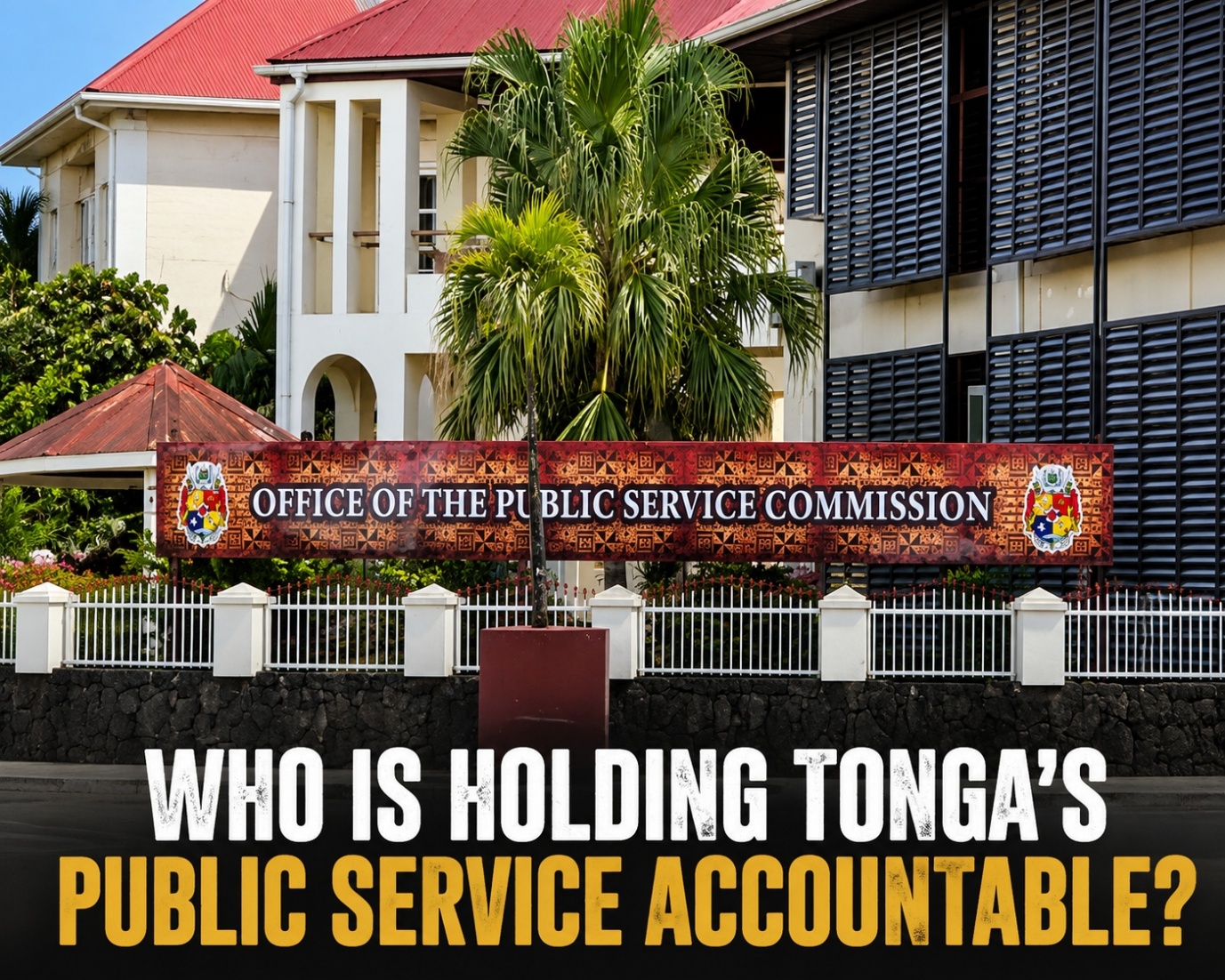
The Public Service Commission has not published an annual report since 2021/22. In the years since, Auditor-General findings and ministries’ own reports have documented recurring failures in financial controls, procurement and record keeping — with little visible evidence of consequence. That gap raises a specific question: is Tonga’s accountability chain still functioning, or has it quietly broken down?
The missing reports
The PSC’s website publishes annual reports only up to the 2021/22 financial year — a three-year gap.
Tonga Independent News wrote to both the Chief Executive Officer of the Public Service Commission and the Chairperson of the Commission, requesting the 2022/23, 2023/24 and 2024/25 reports. The PSC acknowledged the request: “We will look into it and will contact you.” A reminder sent three days later has not been answered. At the time of publication, neither the reports nor an explanation for their absence has been provided.
There are two possible explanations, and they carry very different weight. The reports may exist but simply haven’t been published or supplied to TIN — an administrative lag. Or they may not have been completed at all — meaning the body responsible for overseeing public-service performance has itself fallen years behind on its own statutory obligation. TIN cannot yet determine which is the case, and this article does not assume the more serious explanation is correct. But the distinction matters, because under Tonga’s Public Service Act, the Commission’s Chairman is required to furnish the Prime Minister with a report on the Commission’s operations — and on the efficiency and effectiveness of the Public Service — by the end of May each year. Either explanation is worth a public answer.
What the law asks of PSC
The PSC is not simply another government office managing its own affairs. Under the Public Service Act, it is responsible for monitoring the efficiency and effectiveness of the public service, reviewing management and internal controls within ministries, overseeing the performance-appraisal system, and playing a central role in the appointment and accountability of Chief Executive Officers.
That mandate is what makes the recurring weaknesses documented across ministries directly relevant to an assessment of the Commission itself. Each CEO is legally responsible for the proper, efficient and economic administration of their ministry. When that administration fails repeatedly, the question of responsibility runs upward — to the CEO first, and from there to the body with statutory responsibilities for CEO appointments, performance and public-service management.
The clearest evidence: Internal Affairs
The strongest documentation of this problem comes from the Ministry of Internal Affairs’ own 2024/25 Annual Report — not from inference, but from the ministry’s own figures.
The Ministry spent TOP 27.21 million during the year while completing only around 70 percent of its planned outputs. Against a procurement compliance target of more than 80 percent, it achieved 15 percent. By the ministry’s own account, 85 percent of the procurement activities examined were non-compliant — work beginning before Central Procurement Unit approval, approvals sought retroactively, incomplete documentation, missed contract deadlines, and spending committed ahead of required procedure.
These were not trivial sums. Fencing and upgrade work at the ministry’s former Tonga Water Board premises proceeded before procurement clearance, through payments of TOP 109,500 and TOP 70,000.15. Repair and painting work at the Head Office followed the same pattern, totalling TOP 157,989 and TOP 68,624. No procurement training was conducted during the year.
Set against this record, the ministry’s Human Resources Unit reported receiving a “Green Light” performance assessment from the PSC — the same year the Minister described average staff performance as being in “critical need for improvement.” That contrast is the single most concrete piece of evidence in this investigation: a ministry can fail 85 percent of its procurement compliance checks and still clear its PSC performance review. If that combination is defensible, PSC has not yet explained how. If it isn’t, it points to exactly the enforcement gap this article is asking about.

A pattern, not an isolated case
Internal Affairs is the most fully documented example available, but it is not presented here as unique. Auditor-General findings on the Ministry of Health have identified weaknesses in overtime documentation and missing approvals. Because Tonga’s financial-management system runs centrally through Finance and Treasury, similar control weaknesses there carry consequences across government rather than within one ministry alone.
These cases are included to establish a pattern, not to add independent proof — the underlying evidence for Health and Finance is thinner than for Internal Affairs, and is drawn from Auditor-General summary findings rather than the kind of itemised breakdown available for Internal Affairs. The comparison that matters is structural: in each case, a diagnosis exists (an audit finding or a ministry’s own reported shortfall), but there is no public record of what happened next — whether the finding triggered a corrective plan, whether that plan was implemented, or whether repeated failure affected any CEO’s performance assessment.
That absence of a visible second step — not the individual findings themselves — is the actual subject of this article.
Why the follow-through matters more than the finding
The Office of the Auditor-General’s role is to independently identify and report weaknesses. It does not manage ministries or carry responsibility for implementing the corrective action its findings may require. Responsibility for that response sits elsewhere — with ministry management in the first instance, and within the wider public-service accountability framework overseen by the PSC.
Without visible follow-through, an audit finding risks becoming an annual ritual rather than a mechanism for change: a weakness is identified, a report is tabled, and the same weakness reappears the following year. The PSC’s own earlier reporting, from 2020/21, described exactly this risk in its own words — identifying “weak enforcement” and “lack of political will” as risks to improving public-service efficiency. That the Commission diagnosed the problem in its own institution five years ago, and that its more recent reporting is now unavailable to check whether the diagnosis has been acted on, is the crux of the story.
What PSC’s older data shows — and its limits
The PSC’s 2020/21 report recorded 5,596 public servants, of whom 4,377 (78 percent) were evaluated under the performance system. Of those assessed, the large majority were rated as meeting or exceeding expectations; only 13 were rated as failing to meet them.
That figure is now five years old, and it is worth being explicit about what it can and cannot show. It cannot tell us how CEOs have been assessed since, or whether performance ratings have tracked the audit and procurement failures documented more recently. It can only establish a baseline: that PSC’s performance-management framework, at least as of 2020/21, rated failure as rare. Whether that pattern has held is precisely the question the missing 2022/23–2024/25 reports would answer — which is itself the argument for why their absence matters.
The core question
This article does not allege misconduct by the PSC Chairperson, its CEO, or any individual ministry head, and an audit finding is not proof of incompetence. The question is narrower and more structural: does Tonga have a working mechanism connecting audit findings to consequences, or does accountability stop at the point of diagnosis?
The Internal Affairs case shows that a ministry can fail badly on procurement while passing its performance review — a combination that, on its face, calls for explanation. The missing PSC reports mean there is currently no public way to check whether that combination is an outlier or a pattern. Until the Commission publishes its 2022/23, 2023/24 and 2024/25 reports — or explains why it hasn’t — that question will remain open, and the burden of resolving it sits with the PSC, not with the public asking it.