
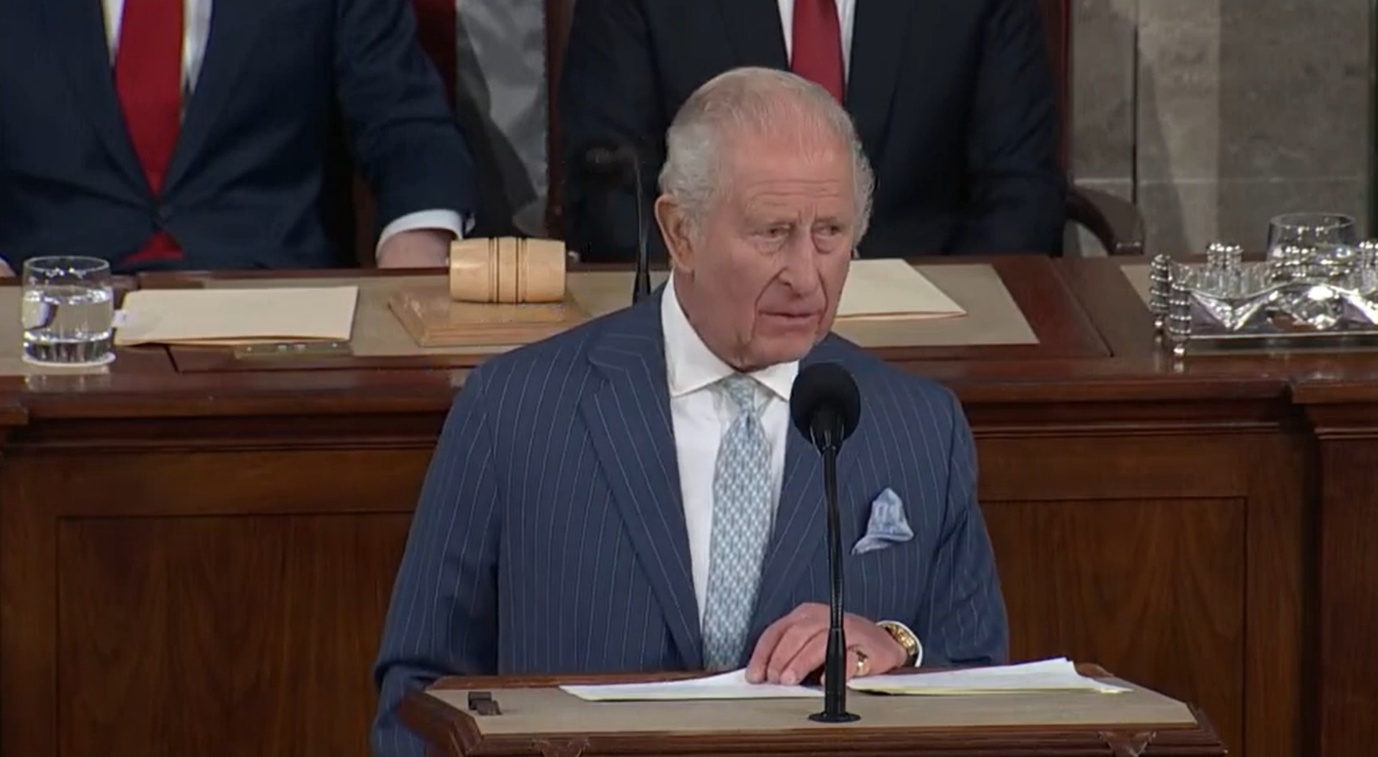
In a chamber that has witnessed some of the most consequential debates in American history, King Charles III stood not as a distant ceremonial figure, but as a living bridge between centuries. His address to the Joint Meeting of Congress—delivered during the semi quincentennial year of the Declaration of Independence—was a masterclass in diplomatic oratory: warm yet weighty, humorous yet grave, and steeped in a profound understanding of the Anglo-American relationship. More than a simple celebration of shared history, the King’s speech was a urgent call to renew that alliance in the face of modern turmoil, from the battlefields of Ukraine to the melting ice caps of the Arctic.
The Weight of History, Lightened by Wit
King Charles opened by acknowledging the “weight of history” on his shoulders, noting he is the nineteenth British sovereign to study American affairs daily. He deftly navigated the delicate memory of the Revolutionary War, referencing his five-times great-grandfather, King George III, with a self-deprecating joke: “I am not here as part of some cunning rearguard action!” He even borrowed a line from Oscar Wilde—about the two nations having everything in common except language—to break the ice. Such levity was not mere decoration; it was a strategic recognition that the strongest partnerships are those that can laugh at past disagreements. The King framed the very dispute over “no taxation without representation” not as a permanent wound, but as the birth pangs of a shared democratic value.
Yet the humor gave way to solemnity. He explicitly referenced the recent violent incident near the Capitol, praising the resilience of American leadership and declaring with “unshakeable resolve” that such acts of violence will never succeed. In that moment, Charles positioned himself not as a foreign king, but as a fellow defender of democratic institutions.
A Eulogy for the Queen, A Testament to Continuity
One of the most touching passages paid homage to his late mother, Queen Elizabeth II, who addressed the same chamber in 1991. By invoking her memory under the watchful gaze of the Statue of Freedom, Charles subtly argued that the special relationship is not dependent on any single personality; it is institutional, intergenerational, and sacred. He also noted his own 20th visit to the US and his service in the Royal Navy, grounding his authority in lived experience rather than mere title.
The Grim Canvas of a Dangerous Era
The King did not sugarcoat the present moment. He described a world “more volatile and more dangerous” than in 1991. From Europe to the Middle East, conflict abounds, uncertainty reigns. Here, Charles moved from historian to strategist. He made clear that the UK is not merely asking for American leadership but is contributing materially. He announced, “the biggest sustained increase in defence spending since the Cold War” and highlighted joint projects like the F-35 and the AUKUS submarine partnership with Australia.
Most pointedly, he threw the full weight of the Crown behind Ukraine. “The same, unyielding resolve is needed for the defence of Ukraine and her most courageous people,” he said, framing the fight as essential to a “truly just and lasting peace.” For an apolitical monarch, such direct language was striking—a reminder that the King sees Russian aggression as an existential threat to the very values both nations hold dear.
Values as the True Anchor
Throughout the speech, Charles returned to a set of foundational principles: the rule of law, independent judiciary, Magna Carta, and the English Bill of Rights of 1689. He noted with evident pride that Magna Carta has been cited in at least 160 Supreme Court cases. This was not academic nostalgia; it was a political argument. The King was reminding Congress that the transatlantic alliance is not merely transactional—about trade or troops—but constitutional. It is rooted in a shared DNA of limited government, checks and balances, and liberty under law.
He also spoke movingly of faith, both Christian and interfaith, describing it as a “firm anchor” and expressing hope that people of different religions can grow in mutual understanding. In an era of identity-based strife, this was a quiet plea for pluralism.
A Warning Against Inwardness
Perhaps the most urgent line came near the end: “I pray… that we ignore the clarion calls to become ever more inward-looking.” In a single sentence, Charles addressed the populist and isolationist currents on both sides of the Atlantic. He argued that the challenges—climate collapse, technological disruption, authoritarian resurgence—are “too great for any one Nation to bear alone.” He further warned against resting on past achievements, insisting that “our Alliance cannot rest… or assume that foundational principles simply endure.”
His reference to nature was also notable. By linking the ancient geology of the Appalachians and Scottish mountains, he made environmental protection a shared, almost spiritual duty. “We ignore at our peril,” he said, “the fact that these natural systems… provide the foundation for our prosperity and our national security.”
Conclusion: Rededication, Not Remembrance
King Charles III did not come to Congress simply to reminisce about World War II or praise the Marshall Plan. He came to rededicate the alliance. Quoting Lincoln’s Gettysburg Address—that the world “will never forget what we do”—he challenged the assembled representatives to act. The speech was a gentle but firm rebuttal to any who dismiss the “special relationship” as a relic. In a time of renewed great-power competition, the King offered a vision of two nations, bound by law and liberty, choosing to stand shoulder to shoulder. Whether Congress heeds that call is another matter. But for those words, Charles III made an eloquent case that the Anglo-American partnership is not just history—it is the future.
By Melino Maka