TONGA’S TROUBLED WATERS: Why Deep Sea Mining Demands a National Rethink
By Melino Maka
Political and Economic Commentator
In 2021, under the leadership of the late Prime Minister Pōhiva Tu’i’onetoa, the Government of Tonga quietly entered into a legally binding Sponsorship Agreement with Tonga Offshore Mining Limited (TOML) — authorizing the company to explore for deep sea minerals in the Clarion-Clipperton Zone (CCZ), a vast seabed region between Mexico and Hawaii.
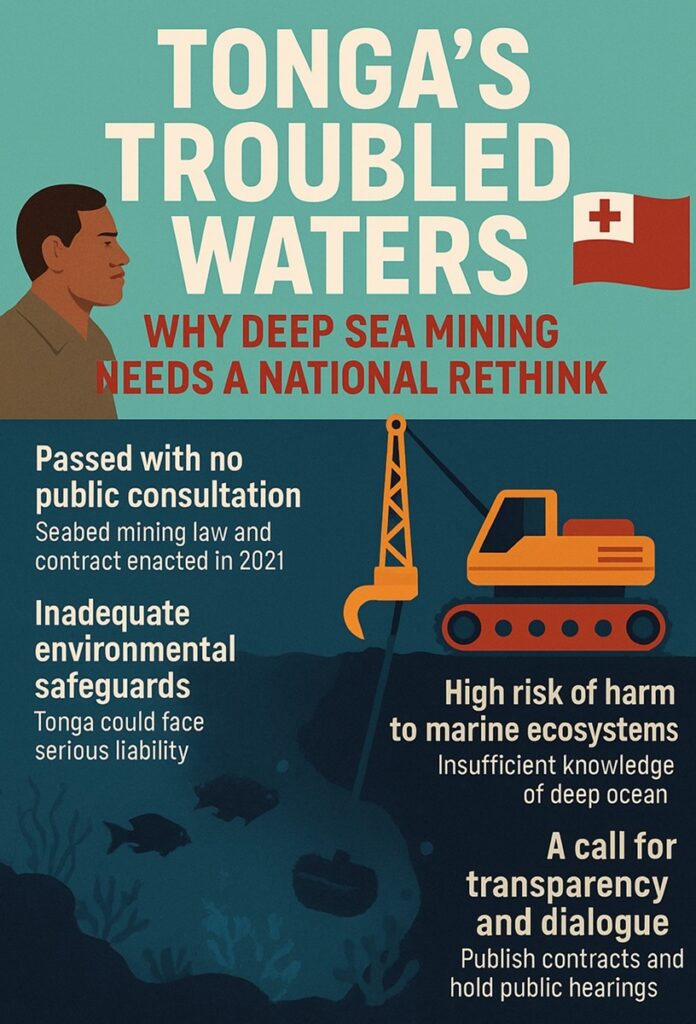
This agreement was executed with little to no public consultation, no parliamentary transparency, and no national dialogue. Few Tongans knew it was happening. Fewer still understood what it meant. The deal essentially committed the Kingdom of Tonga to sponsor a foreign commercial venture to mine the ocean floor in international waters — with Tonga carrying the legal, financial, and environmental risk.
Today, as more scientific evidence emerges about the dangers of deep sea mining (DSM), it is time for Tonga to pause, reflect, and reassess its direction. This article explores the findings of a 2023 legal report commissioned by the Civil Society Forum of Tonga (CSFT), revealing serious gaps in Tonga’s legal readiness, oversight capacity, and long-term liability risks associated with DSM.
A Legacy Written in Secrecy
Deep sea mining is the extraction of minerals such as cobalt, nickel, copper, and manganese from the seabed, often at depths of 4,000 to 6,000 meters. These metals are considered critical to the global transition to renewable energy — yet their extraction carries profound environmental costs.
The government’s 2021 deal with TOML — a Canadian-owned company — was passed without national consultation, despite its serious implications. The Seabed Minerals Act and subsequent Sponsorship Agreement were enacted through executive action and Cabinet approval under Tu’i’onetoa’s leadership, bypassing any opportunity for open public dialogue.
Tonga’s Constitution (Clause 8) grants every citizen the right to petition the government and be informed of proposed legislation. That right was ignored.
Worse still, the Sponsorship Agreement — upon legal review — appears heavily skewed in favour of the contractor. The 2023 CSFT report warns that Tonga’s ability to amend contract terms, enforce new environmental laws, or hold the contractor accountable is weak. Any misstep or environmental damage by TOML could result in Tonga being held liable by international courts, including the International Tribunal for the Law of the Sea (ITLOS).
The Environmental Gamble
Tonga’s involvement in DSM includes activities within its own Exclusive Economic Zone (EEZ) and in the international seabed area, regulated by the International Seabed Authority (ISA). While the commercial incentives are alluring — potential royalties, economic growth, and foreign investment — the environmental and legal risks far outweigh the rewards.
DSM operations disturb the seabed using heavy equipment that scrapes up polymetallic nodules and discharges sediment plumes into the ocean. These plumes can travel vast distances, smothering marine habitats and contaminating the food chain. Scientific studies have raised alarm bells over irreversible damage to biodiversity, including species unknown to science, some of which play vital roles in climate regulation.
Yet, as the CSFT report points out, less than 20% of the global deep ocean has been mapped, and even less has been studied. We are digging in the dark — and Tonga is volunteering to hold the liability torch.
Learning from NORI’s Mistakes
The report draws extensively from the case of Nauru Ocean Resources Inc. (NORI), another Pacific-based contractor sponsored by the Government of Nauru. NORI’s environmental impact statement (EIS) was rushed, incomplete, and failed to include proper mitigation measures or baseline scientific data. After pushing its test-mining equipment into the CCZ, NORI experienced an accidental sediment discharge — which it failed to report until weeks later.
The ISA’s review process of NORI’s application has been widely criticized as opaque, biased, and riddled with conflicts of interest. Despite substantial shortcomings, NORI was allowed to proceed — revealing how weak the global regulatory system is when weighed against commercial pressure.
Tonga’s contractor TOML is poised to follow a similar path, and unless Tonga builds stronger legal protections, we risk repeating NORI’s failures — but bearing the consequences ourselves.
Gaps in Tonga’s Legal Armour
Tonga has over 20 different laws that govern various aspects of marine and resource management — including the Environmental Impact Assessment (EIA) Act, Fisheries Management Act, Parks and Reserves Act, and the Seabed Minerals Act. But as the CSFT report outlines, these laws are fragmented, conflicting, and woefully outdated for managing the complexities of DSM.
For example:
- Tonga’s EIA laws do not contain mandatory scientific benchmarks, stakeholder engagement protocols, or enforcement mechanisms.
- The Seabed Minerals Act offers no clear path for rejecting a mining application on environmental grounds.
- The current regulatory system lacks transparency, accountability, and procedural fairness.
Compounding the issue is the fact that Tonga, as a sponsoring state under the United Nations Convention on the Law of the Sea (UNCLOS), carries an international legal duty to ensure its contractors behave responsibly. Failure to meet these obligations could result in Tonga being sued by other countries or held responsible for environmental harm.

Who Benefits? Who Pays?
The DSM venture raises fundamental questions about sovereignty and national interest. While contractors and foreign investors stand to earn millions from selling seabed metals to battery manufacturers, what does Tonga get?
The Sponsorship Agreement with TOML provides only vague references to benefits, royalties, and taxes — with no guarantee of jobs, training, local investment, or even data-sharing. Tonga is essentially renting out its good name to allow foreign companies to profit in international waters, while absorbing all legal risks.
As a result, if things go wrong, Tongan taxpayers could be left with the clean-up bill, legal defense costs, and ecological damage that could take centuries to recover.
The Nobles Must Rise to Protect the Realm
This is not just a political issue — it is a matter of national sovereignty and generational responsibility. That is why there is a renewed call for Tonga’s Nobles to stand at the forefront of protecting the Kingdom from this kind of corporate encroachment.
The Nobles, as guardians of the land and stewards of the Kingdom’s traditions, hold a unique constitutional and moral duty to shield the country from exploitation. Their silence in the face of corporate ventures like TOML is not neutrality — it is absence. Now is the time for them to lead with conviction.
They must advocate for greater transparency, push for public debate in the Legislative Assembly, and ensure that any law or contract affecting Tonga’s natural resources reflects the will of the people and the protection of the environment. If Tonga is to stand strong in the face of extractive capitalism, it must do so with the Nobility defending the rights of the Kingdom and its people.
A Call for Moratorium and National Dialogue
In light of the report’s findings, the people of Tonga must now ask: Was this decision made in our name? And if so, why weren’t we told?
To uphold its constitutional duty to act for the good of all its citizens, the Government of Tonga must:
- Impose an immediate moratorium on all DSM-related activities — including prospecting and exploration — until proper legal, environmental, and public safeguards are in place.
- Publicly release the 2021 Sponsorship Agreement and any related contracts, and ensure future agreements are subject to parliamentary scrutiny and public hearings.
- Conduct a full legal audit of Tonga’s EIA and DSM-related laws, with support from independent legal and scientific experts.
- Establish an Independent Environmental Review Board with authority to assess all mining proposals, monitor compliance, and report directly to the people.
- Hold a national public consultation — including traditional leaders, civil society, churches, youth, and the scientific community — to determine whether DSM is acceptable for Tonga at all.
Reclaiming Our Moana
The ocean is not just Tonga’s economic frontier — it is the cradle of our culture, our identity, and our survival. The Moana feeds us, teaches us, and connects us. To risk its health without the informed consent of the Tongan people is not just bad policy — it is a betrayal of our legacy.
We must shift the conversation from how we can profit from the seabed, to how we can protect the ocean for our children and grandchildren. Tonga must lead with wisdom, not haste.
Because in the end, deep sea mining is not just about minerals — it is about who we are, and what kind of nation we choose to be.