Opinion: How Israel Manipulated the U.S. Into Its War with Iran
By Melino Maka, Tonga Independent News
As missiles fly between Israel and Iran, and civilians from Tel Aviv to Tehran brace for further escalation, one question cuts through the fog of war: How did the United States find itself implicated in yet another Middle Eastern conflict that serves no clear American interest?
The answer lies not in new threats or alliances, but in a carefully cultivated narrative Israel has spent over two decades refining—a narrative designed not only to justify its attacks on Iran but to pressure the U.S. into joining its cause, diplomatically, militarily, and financially. That narrative is built on fear, misinformation, political coercion, and the quiet purchase of American loyalty.
And now, the price of that loyalty is war.
“Weeks Away” for 20 Years: The Myth of the Iranian Bomb
Since the early 2000s, Israeli leaders—chief among them Prime Minister Benjamin Netanyahu—have repeatedly warned that Iran is on the verge of acquiring a nuclear weapon. These warnings were delivered with grave urgency: Iran was “months away” in 2012, then again in 2015, and once more in 2018. Now, in 2025, the same warning is repackaged as justification for unilateral military strikes.
But where is the bomb?
Despite all the apocalyptic predictions, no credible intelligence has verified that Iran has actively weaponized its nuclear enrichment program. In fact, when the U.S., under the Obama administration, negotiated the Joint Comprehensive Plan of Action (JCPOA), international inspectors found that Iran was complying—rolling back enrichment levels, reducing centrifuge numbers, and opening its facilities to monitoring.
Israel opposed that deal vehemently. Why? Because it undercut the central plank of its narrative: that Iran is an imminent existential threat that justifies any Israeli action and demands unconditional U.S. backing.
Israel’s Strategy: Manufacture the Threat, Demand the Response
This is how Israel has played the long game:
- Inflate the Iranian threat with repetition and theatrics—PowerPoints, dramatic speeches at the UN, and press conferences showcasing “secret nuclear archives” that never produce operational evidence.
- Weaponize U.S. politics—mobilizing powerful lobbying groups like AIPAC, aligning with evangelicals, and leveraging campaign donations to ensure that criticism of Israel becomes political suicide in Washington.
- Undermine diplomacy—aggressively opposing peaceful solutions like the JCPOA that might reduce tensions without war.
- Launch unilateral strikes—and then frame them as “defensive,” pushing the U.S. to either back the action or risk looking weak and disloyal.
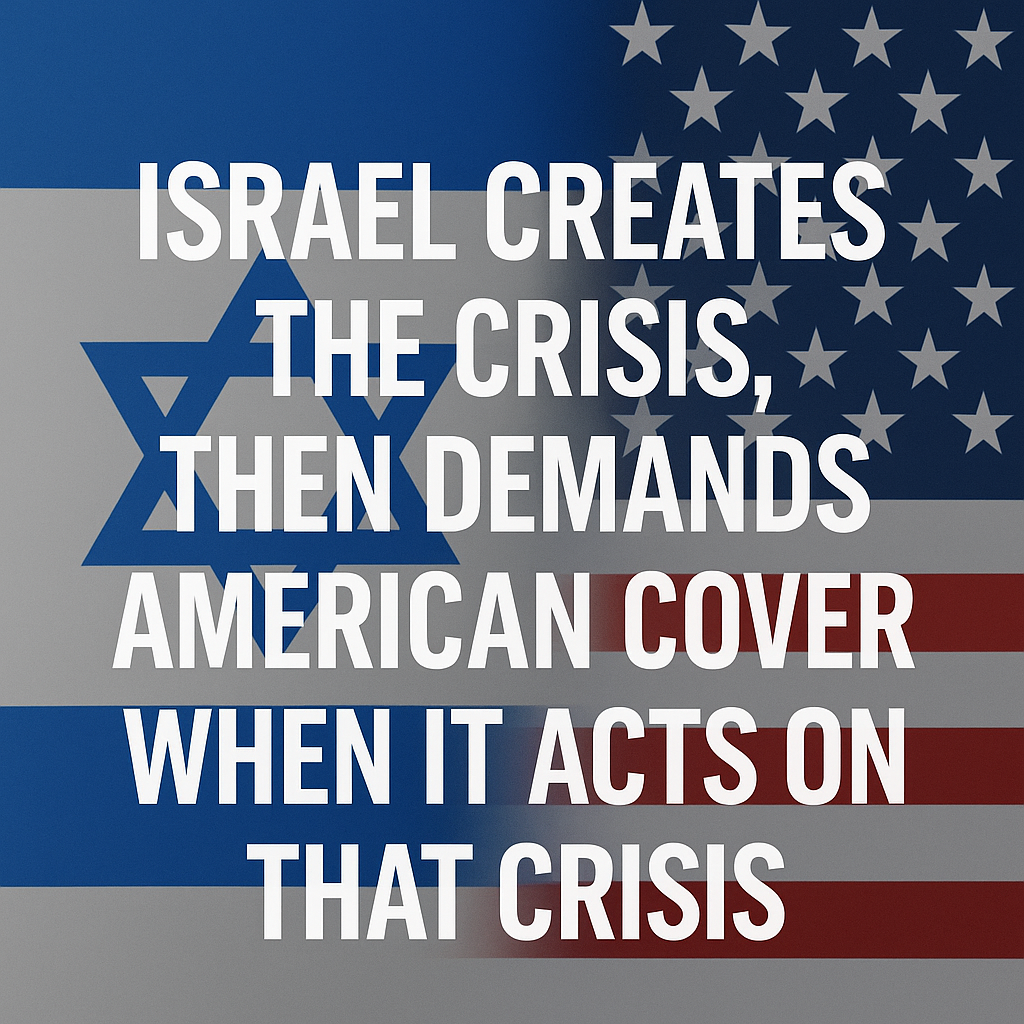
In short, Israel creates the crisis, then demands American cover when it acts on that crisis. The current war is the inevitable result of this strategy. Israel struck first, targeting Iranian military and nuclear infrastructure, claiming it had no choice. Iran retaliated. Now, with bombs falling in Tehran and Tel Aviv, the U.S. is being dragged—willingly or not—into the fire.
The Illusion of Non-Involvement
Despite statements from officials like Secretary Marco Rubio insisting the U.S. is “not involved,” the facts say otherwise:
- U.S. weapons and equipment were used in the Israeli strike.
- President Trump was informed beforehand and reportedly gave a “green light.”
- Trump’s own post boasted, “We now have complete and total control of the skies over Iran.”
So much for neutrality.
The administration’s contradictory messaging—claiming America is staying out while boasting about its military assets in play—only underscores the theatrical posturing designed to placate public scepticism while appeasing pro-Israel hardliners behind the scenes.
Make no mistake: the U.S. is involved. By supplying arms, by giving political approval, by providing intelligence. And more importantly, by allowing itself to be manipulated into this position through decades of narrative conditioning.

Buying America’s Foreign Policy: The Role of Political Influence
None of this would be possible without Israel’s extraordinary influence over American politics. That influence is not the result of shared values or mutual defense—it is the result of money and messaging.
- AIPAC and affiliated lobbyists spend millions each election cycle to ensure pro-Israel candidates are funded, and critics are politically destroyed.
- American media coverage of Israeli actions, even when aggressive or illegal under international law, is often sanitized or framed in Israel’s favor.
- Politicians across both parties, fearful of being labeled “anti-Israel,” parrot Tel Aviv’s talking points without scrutiny.
The result? A foreign country has been able to shape America’s Middle East policy for its own benefit, with near-total impunity. That manipulation has cost the U.S. billions in aid, cost regional stability, and now may cost American lives if this war escalates further.
What’s the Endgame? And Who Pays the Price?
Let’s be clear: Iran is no angel. Its regime is repressive, its proxies destabilize the region, and it has contributed to violence. But the question isn’t whether Iran is bad—the question is whether it justifies war, and whether that war serves American interests.
It doesn’t.
There is no direct threat to the U.S. homeland. There is no credible evidence that Iran is days away from a nuclear weapon. There is no strategic benefit in fighting Israel’s war, except to protect the political careers of American leaders who are too afraid to say no.
Meanwhile, American cities face mass shootings, economic instability, and deteriorating infrastructure. Veterans of past Middle East wars still wait for adequate healthcare. The American people are weary of foreign entanglements—and for good reason.
Yet here we are again. Another war, another justification, another manipulated reality.
The Pacific Perspective: Sacred Allies or Strategic Puppeteers?
From here in Tonga and across the Pacific, we often view Israel as “the people of God.” That religious imagery is powerful, especially in deeply Christian nations like ours. But we must be cautious not to confuse spiritual narrative with geopolitical behavior.
Israel, in this context, is not acting with divine clarity. It is acting as a state pursuing its interests—interests that do not always align with America’s, or the world’s, or even its own long-term security.
And yet, it wraps its actions in existential panic and religious legitimacy, shielding itself from criticism. Meanwhile, its wealth and lobbying power in the U.S. give it a megaphone no other ally possesses. This should alarm every democracy that values sovereignty, accountability, and peace.
Conclusion: Reclaiming America’s Foreign Policy
The United States must draw a hard line—not against Iran alone, but against the manipulation of its own decision-making by foreign governments, including Israel.
If Israel chooses to go to war, that is its sovereign right. But America must choose whether to follow based on its own principles, not emotional blackmail or political pressure.
It is time for U.S. leaders to:
- Demand a return to diplomacy and restraint.
- Reassert Congressional authority over war-making powers.
- Reduce the influence of lobbyist dollars on foreign policy.
- Stop treating Israeli interests as interchangeable with American interests.
Because if America fights every war Israel wants, it loses the ability to say no—and ceases to be an independent power.
And in that future, every bomb dropped in Iran becomes a bomb of American making—with blood on American hands, for someone else’s war.