Canberra’s Colonial Playbook: How Australia’s Hardball Diplomacy Risks Driving the Pacific Toward China
By Melino Maka
The following article is adapted from commentary by Australian academic Siobhan McDonnell, whose research focuses on Vanuatu and the Pacific Islands. The views expressed are her own and reflect her analysis of recent regional security developments. McDonnell argues that while China’s approach to the Pacific—at least rhetorically—appears to respect the sovereignty and autonomy of island nations, Australia’s heavy-handed tactics risk pushing these countries toward Beijing by contrast.
In the last fortnight, the Australian government has loudly celebratedpublicly celebrated the signing of two new security treaties in the Melanesian region. The first, the Nakamal Agreement, was signed with Vanuatu on 29 June 2026. The second, the Ocean of Peace Alliance, was signed with Fiji on 6 July. McDonnell argues Australia’s motivation has been to maintain its regional security role while limiting the influence of other international players, particularly China. She contends that, in pursuing these agreements through pressure rather than partnership, Australia may be achieving the exact opposite of its strategic intent.
The Nakamal Agreement: A Treaty Secured by Leverage
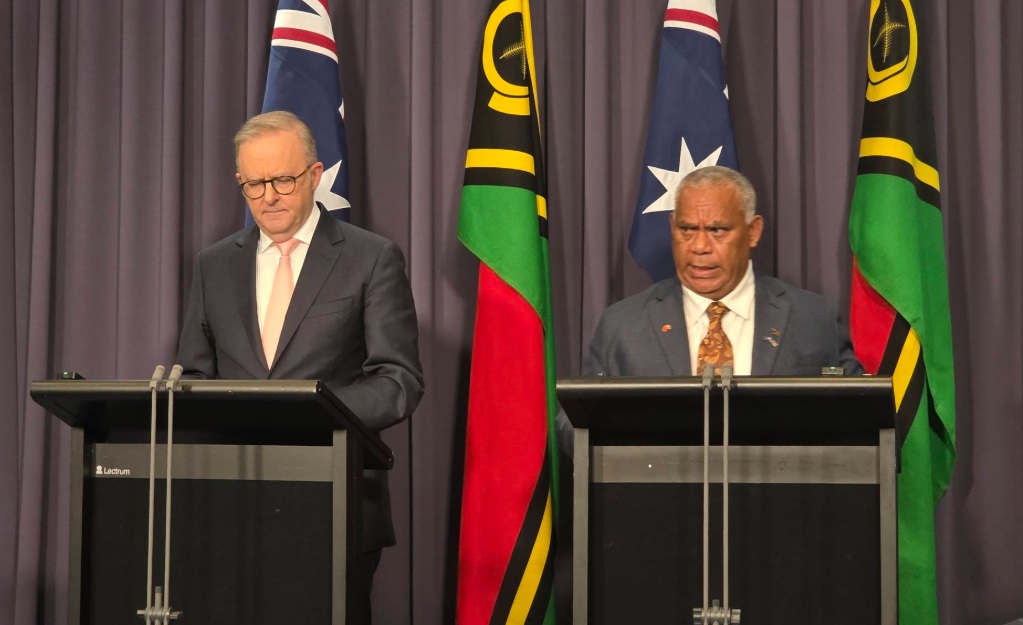
This was not the first signing, nor the first mention, of the Nakamal Agreement. Readers might remember the iconic August 2025 images of Australia’s Deputy Prime Minister Richard Marles with Ministers Pat Conroy and Penny Wong on one side of the table on the slopes of Mount Yasur volcano on the island of Tanna, and Vanuatu’s Deputy Prime Minister Johnny Koanapo flanked by Ministers Ralph Regenvanu and Andrew Napuat. That occasion was supposed to mark a provisional agreement on $500 million in Australian funding over ten years. It turned out the Vanuatu government was not ready to sign due to concerns about sovereignty and control over critical infrastructure.
By 2026, McDonnell writes that Australian patience had run out. In her role as an adviser to the Vanuatu government, she says senior representatives told her Australia withheld sectoral funding usually released as part of the budget cycle, along with funding for ongoing in-country placements and a long-announced renewable energy program. The Australian High Commissioner ceased meeting Vanuatu government ministers. Most tellingly, the Australian Pacific Engagement Visa ballot listed eligible Pacific countries—but specifically excluded Vanuatu, a nation that has long been a major contributor to the Pacific seasonal worker scheme.
Shortly afterwards, the treaty was signed. McDonnell argues Australia’s approach ultimately achieved its objective. But when you pressure a country into an agreement, what is the geopolitical trade-off?
The Symbolism That Cannot Be Ignored
The term nakamal is defined in the treaty as “a traditional meeting place where community and its leaders discuss, consult, make decisions and resolve points of difference with mutual respect, trust and understanding.” Locally, nakamals are often called the house of the chief. To close a nakamal, two large namale (cycad leaf fronds) are laid across the pathway to the door. It then becomes tabu—prohibited—to pass inside.
The Vanuatu government’s naming of its parallel agreement with China the “Namale Agreement” was no accident. It was a signal: the country’s sovereignty and its enduring commitment to geopolitical neutrality must be respected.
Unequal Obligations, Colonial Echoes
The most important clauses of the Nakamal Agreement are Article 7 (Security and Stability) and Article 8 (Resilient Infrastructure). While the preamble speaks to “co-operation” and “equal partnership,” the operative clauses bind Vanuatu in mandatory language:
- Article 7(3): “Vanuatu shall not permit its territory to be used for any foreign military base or infrastructure.”
- Article 7(4): “Vanuatu shall prioritise any policing request to Pacific Islands Forum members.”
- Article 8(2)(a): “Vanuatu agrees that its critical infrastructure shall remain free from militarisation, any form of foreign interference or unauthorised access.”
All obligations are placed on Vanuatu. None are placed on Australia. Australia continues to allow United States joint military facilities at Pine Gap, Shoal Bay, Kojarena, North West Cape, RAAF Base Edinburgh and HMAS Harman. Australia entered into the AUKUS agreement without any intention of alerting Pacific leadership. McDonnell describes these as neo-colonial concepts of security with very little reference to the concerns or agenda of Vanuatu or the broader “Pacific collective security” named in the agreement.
A Veto by Another Name
The final and most controversial clause requires that: “Vanuatu agrees to consult Australia on proposed third party engagement in Vanuatu’s critical infrastructure” and that “Australia shall provide Vanuatu with technical advice and practical support.” While the clause does not expressly provide Australia with a veto, it has generated extensive domestic debate. Prime Minister Napat has publicly emphasised that the Agreement does not diminish Vanuatu’s sovereignty, arguing: “Consultation does not mean permission. Consultation does not mean approval. At the end of the day, Vanuatu has the sovereign right to decide what is in its best interests.”
But the concern remains: when consultation is mandated by treaty, and when the partner providing “advice” also controls funding and visa access, the line between consultation and control becomes dangerously blurred.
What Wasn’t Delivered
The Nakamal Agreement could have been something better. It has clauses that speak to relational, careful diplomatic practices—forging ties between Vanuatu and Australia, building rather than testing concepts of “Pacific family.” Many of these priorities were adroitly identified by ni-Vanuatu scholar Anna Naupa, and include Indigenous engagement, economic transformation, and climate cooperation, to which I would add humanitarian partnerships.
On these fronts, McDonnell argues little new has been delivered. The announced $500 million over 10 years is a continuation—or in fact a real-terms reduction—of the current allocation. Australia’s bilateral Official Development Assistance to Vanuatu in 2024-25 was $50 million, and in 2025-26 and 2026-27 is again projected to be $50 million.
On climate change, Article 4 reiterates existing commitments and includes specific reference to preservation of maritime zones and statehood “notwithstanding climate change-related sea level rise.” While important to Pacific atoll states, this clause is also viewed by Australia as vital for preventing any further encroachment by China into maritime zones as sea levels rise.
Article 5 requires that Vanuatu seek assistance from the FRANZ trilateral arrangement (France, Australia, New Zealand) before it can request assistance from a third party in a disaster. One hopes this process is prompt enough to ensure ni-Vanuatu receive the best available humanitarian support.

The Pacific Engagement Visa Exclusion: Leverage Laid Bare
The exclusion of Vanuatu from the 2026 Pacific Engagement Visa ballot is perhaps the clearest evidence of Australia’s transactional approach. The PEV is an incredibly popular pathway for Pacific Islanders seeking a better life in Australia. A Vanuatu government adviser described the removal as “difficult to read as anything other than leverage: a signal that access to opportunity for ni-Vanuatu depends on agreement to terms set elsewhere.”
This undermines the “Pacific family” rhetoric and signals that Australian partnerships are conditional, contingent, and revocable when political compliance is not forthcoming.
The Ocean of Peace Alliance: Solidifying the Hard Security Agenda
The agreement with Fiji—the Ocean of Peace Alliance—represents Fiji’s first-ever mutual defence treaty. While backed by significant economic investment, the focus on hard security may not fully align with Pacific island states’ priorities: climate resilience, economic development, and genuine sovereignty. The message to the region is clear: Australia’s primary interest is strategic denial, not shared prosperity.
A Self-Fulfilling Prophecy
The broader strategic risk is that Australia’s single-minded focus on excluding China becomes a self-fulfilling prophecy. By making every element of the bilateral relationship—aid, visas, diplomatic access—contingent on security compliance, Australia conditions the Pacific to see itself as a chessboard in great-power competition. This prioritises Australian interests over Pacific development agendas.
McDonnell argues that if China continues to offer infrastructure, investment and climate partnerships without comparable security conditions, Australia’s coercive approach may not push China out. Instead, it may encourage Pacific nations to look increasingly toward Beijing as a counterweight.
Australian officials have consistently argued that the agreements strengthen regional stability, respond to the security priorities identified by Pacific governments and respect the sovereignty of partner nations. Canberra has rejected suggestions that the agreements diminish the independence of Pacific states.
Conclusion: The Namale Leaves at the Door
In speaking to the Vanuatu public, Prime Minister Napat said: “We do not take sides. We will always defend what is in the best interests of Vanuatu as a sovereign country.” Australia has taken a significant diplomatic gamble and secured the Nakamal Agreement. It is a high-stakes strategy, and in the process, Australia may have sacrificed a significant amount of goodwill for the sake of a single treaty.
Time will tell whether the treaty is a worthwhile diplomatic outcome. But namale leaves may yet block the pathways to nakamals. The hard truth is this: Australia may have won the paper, but it is losing the Pacific’s trust—and in doing so, it may be driving the very outcome it most fears.