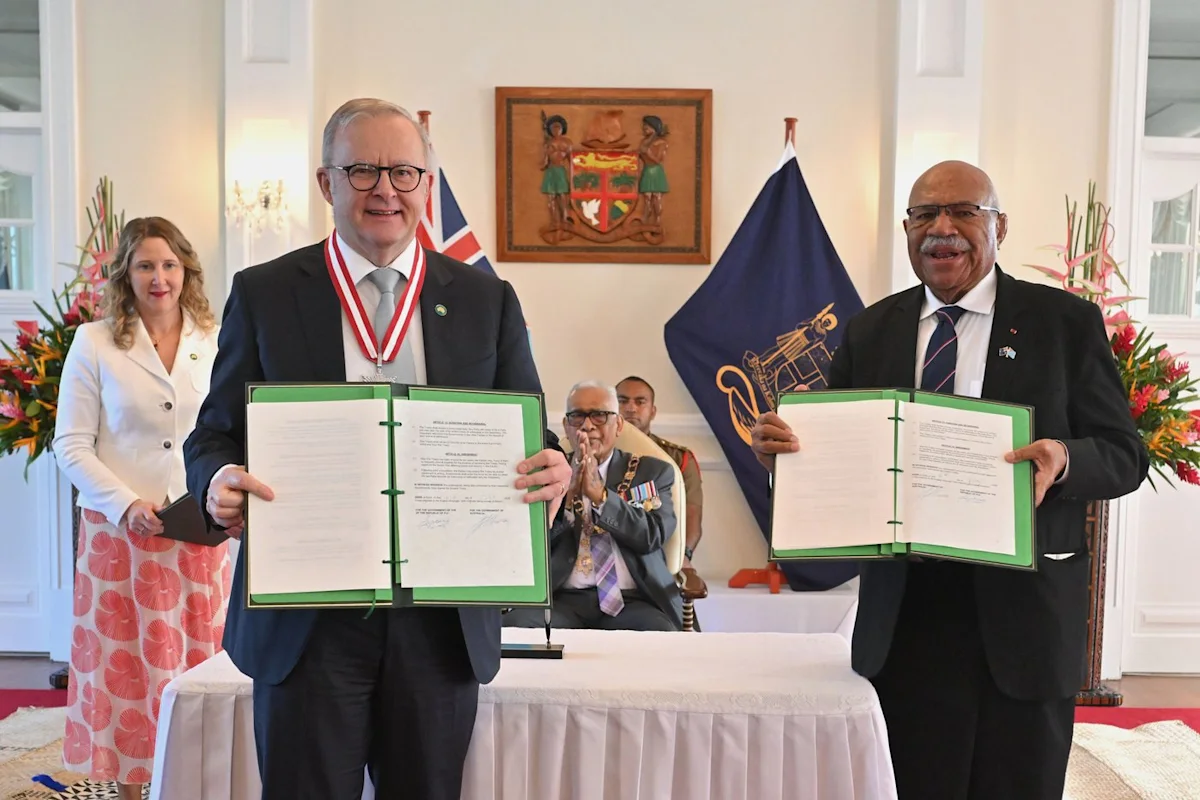
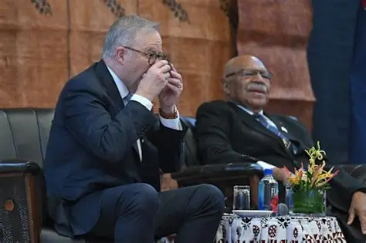
Prime Minister Anthony Albanese and Fiji’s Sitiveni Rabuka were offered kava at a welcome ceremony in Suva on Monday, before signing agreements that will shape the region for decades: the Vuvale Union, covering security, economy and people-to-people ties, and the Ocean of Peace Alliance, also known as the Veitacini Treaty, Fiji’s first mutual defence pact.
Rabuka called it a huge step-up in the relationship. Wong called security its central pillar. Neither treaty mentions China by name. Both were negotiated as Beijing’s influence in the Pacific continues to grow, and both fit a pattern Canberra has now applied twice this year: first with Vanuatu’s Nakamal Agreement, now with Fiji.
For Tonga, the question is no longer hypothetical. If a similar agreement lands on Nuku’alofa’s table, what would it actually contain, and what would Tonga be trading for it.
Reading the fine print
The text of all three agreements, published by Australia’s Department of Foreign Affairs and Trade, is now public, and it settles a question that diplomatic language usually obscures: which obligations are binding, and which are aspirational.
On security, both treaties are specific. The Vuvale Union’s Article 4 treats a third-country “military or other security base, ongoing presence, arrangements or visits” as a threat to both parties’ security, and commits Fiji and Australia to “integrated policing, defence and border protection.” The Nakamal Agreement goes further with Vanuatu, which agrees under Article 8 that its critical infrastructure “shall remain free from militarisation, any form of foreign interference or unauthorised access,” and commits to consult Australia before letting any third party near that infrastructure.
On money, the language changes register entirely. The Vuvale Union’s economic provisions, in Article 3, are built almost entirely from “commit to,” “recognise” and “shall consider.” There is no figure, no deadline, no threshold. Vanuatu’s equivalent, Article 3 of the Nakamal Agreement, has Australia developing a “traineeship program,” supporting the shift to a digital economy and providing “budget support to assist Vanuatu’s economic and fiscal certainty.” Again, no number attached.
That gap between specific security commitments and vague economic ones is not incidental. It’s the structure of the agreement.
The billion-dollar gap
Alongside the Fiji signing, Australia announced it would invest more than A$1 billion in Fiji over the coming decade. Pressed at the Suva press conference on where that money was actually coming from, Albanese said it was provided for in the Australian budget handed down on May 12. So the funding isn’t a loose promise. It has a domestic budget line behind it.
But it still doesn’t appear anywhere in the Vuvale Union itself. That matters because of what each form of commitment survives. A treaty obligation binds Australia for as long as the treaty runs, and either side needs 24 months’ written notice to walk away from it. A budget allocation binds Australia for one financial cycle, and a future government can revise it in the next one without touching the treaty at all. The security provisions in Article 4 don’t depend on any government renewing them each May. The money does.
 That’s a narrower gap than “unaccounted for,” but it’s still a real one. Fiji’s claim on that funding runs through the ordinary give and take of the relationship and future Australian budgets, not through anything written into the document Rabuka signed.
No court, no referee
Both treaties bar either side from taking a dispute to any national or international tribunal. Instead, disagreements go to bodies the treaties themselves create, the Vuvale Forum and Vuvale Bukmak for Fiji, the Nakamal Committee for Vanuatu, all of which decide by consensus. Either government can walk away entirely with 24 months’ written notice.
That cuts in both directions. Australia has no external mechanism to force Fiji or Vanuatu to hold up their end either. But given the asymmetry already built into what each side is obligated to deliver, a lack of outside enforcement matters more for the party whose main gain is a funding promise than for the party whose main gain is a security commitment already written into binding text.
The Ocean of Peace Alliance, Fiji’s separate defence pact with Australia, is hedged in its own way. Article 6 states that an armed attack on either party “would be dangerous to each other’s peace and security,” and that each side would act to meet the danger “in accordance with its domestic processes.” That’s a commitment each government interprets and triggers for itself, closer to the ANZUS model than to an automatic mutual-defence clause. Withdrawal is also looser here than in the other two agreements: a single party can exit with a year’s written notice under Article 15, against 24 months for the Vuvale Union and the Nakamal Agreement.