
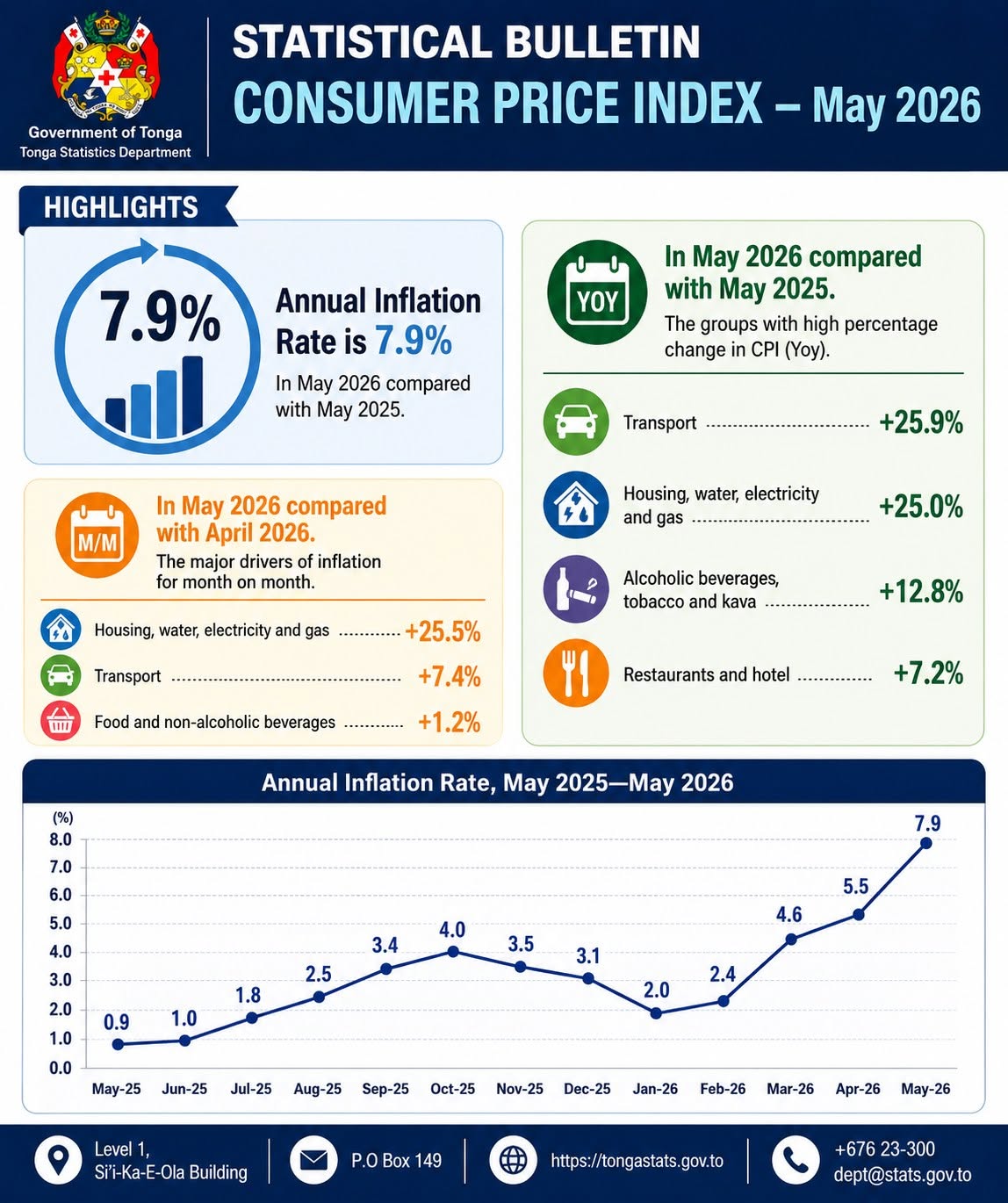
Tonga’s cost-of-living pressures have intensified sharply, with new figures showing annual inflation has risen to 7.9 per cent, the highest level in more than a year.
The latest Consumer Price Index (CPI) report released by the Tonga Statistics Department shows prices are rising much faster than they were just a few months ago, confirming what many families and businesses have already been experiencing in their daily lives.
Inflation simply means the prices of goods and services are increasing. When inflation rises faster than wages and incomes, people can afford less with the same amount of money.
For example, a family that spent TOP $500 a week on groceries, fuel and household expenses a year ago would now need about TOP $540 to buy the same items.
The report shows inflation has accelerated rapidly, climbing from 2.4 per cent in February to 4.6 per cent in March, 5.5 per cent in April and now 7.9 per cent in May.
The figures also reveal what is driving the increase.
According to the report, transport costs rose by 25.9 per cent over the past year, making it the single largest contributor to inflation.
The increase was driven largely by higher petrol and diesel prices, along with increases in international airfares and inter-island ferry fares.
The pressure intensified further in May. The report shows the Housing, Water, Electricity and Gas category increased by 25.5 per cent in a single month, largely driven by higher electricity and kerosene prices. It was the single biggest contributor to inflation during the month, highlighting how quickly energy costs are affecting household budgets.
For many families, electricity is not an optional expense. Households must continue paying for lighting, refrigeration, cooking and other essential services regardless of price increases. As electricity costs rise, families often have less money available for food, school expenses and other household needs.
Together, transport and utility costs accounted for more than five percentage points of the overall inflation rate.
For many households, these are not abstract economic statistics.
They are the higher fuel bills, the rising cost of electricity and the growing expense of travelling between islands.
The report also found imported goods prices increased by 11.7 per cent, compared with a 4.5 per cent increase for locally produced goods.
This is important because Tonga imports most of its fuel and many of the products sold in local shops.
When international fuel prices rise, or shipping costs increase, those higher costs eventually appear at the fuel pump, in supermarkets and throughout the wider economy.
Fuel prices affect far more than motorists.
Fuel is used to transport food, building materials and goods across the country. Fishermen rely on diesel to operate their vessels. Farmers depend on fuel to move produce to markets. Businesses use fuel to transport stock and provide services.
As fuel costs rise, many businesses are forced to increase prices to cover their own expenses.
The result is that higher fuel prices eventually flow through to consumers in almost every part of the economy.
The figures are also likely to add further momentum to the debate over how Government should respond to rising living costs and where public money should be directed.
 During Budget deliberations, Tongatapu People’s Representative No. 5 and Chair of the Finance and Public Accounts Committee, Dr ‘Aisake Eke, questioned whether more should be done to address rising fuel and energy costs.
Dr Eke argued that while Government was prepared to fund a range of new programmes and initiatives, greater consideration should be given to measures that directly reduce the costs facing households and businesses.
His comments generated considerable debate, particularly regarding fuel taxes, government spending and borrowing.
The CPI report does not take a position on those policy questions.
However, it does identify fuel, transport and electricity as the primary drivers of inflation.
Critics of Dr Eke’s position have argued that Government must balance many competing priorities, including housing, youth programmes, infrastructure and public services. However, the CPI data shows that transport and electricity costs accounted for the majority of inflationary pressure experienced by households over the past year. While the report does not prescribe policy solutions, it does indicate that the very costs highlighted by Dr Eke are among those having the greatest impact on family budgets.