How Donald Trump’s 16-Year Bet on Viktor Orbán Ended in Humiliation
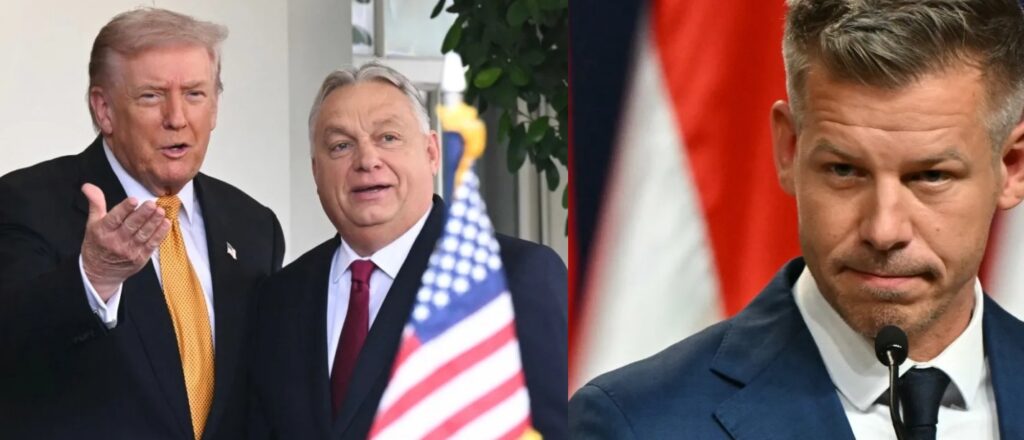
For 16 years, President Donald Trump openly and enthusiastically backed Hungarian strongman Viktor Orbán—a far-right leader who systematically dismantled democratic norms, aligned with Vladimir Putin, and positioned himself as the poster child for illiberal rule. Trump saw Orbán as a kindred spirit: a nationalist strongman who defied the EU, controlled the media, and attacked immigrants and LGBTQ+ rights.
But this past weekend, the people of Hungary finally had their say—and they delivered a political earthquake that left Trump humiliated. Going into the election, Orbán had spent years rigging the electoral system in his favour: gerrymandering districts, seizing control of the courts and press, and rewriting voting rules to lock in his power. Despite all that, the opposition—led by a centre-right newcomer, Péter Magyar—won a stunning, lopsided victory. Orbán himself called it a “painful” defeat and conceded, ending his 16-year reign.
Now, here’s where it went horribly wrong for Trump. He didn’t just offer a tweet of support. He sent Vice President JD Vance and Senator Marco Rubio to campaign in person for Orbán. Rubio, once a critic of autocrats, and Vance, who had styled himself as a new-generation America Firster, both flew to Budapest to prop up a man who had crushed free elections. Trump also made an embarrassing, desperate pledge just two days before the vote, promising to “use the full Economic Might of the United States to strengthen Hungary’s Economy” — but only if Orbán and the Hungarian people “ever need it.” It was a naked attempt to bribe voters with American taxpayer money, and it reeked of panic.
It didn’t work. Despite Trump’s full-court press, despite Orbán’s rigged system, despite years of propaganda, the Hungarian people rejected both Orbán and Trump’s endorsement. The result wasn’t even close. Orbán trailed badly in polls and lost decisively. The embarrassment is multilayered. Trump had bragged about his ability to pick winners and influence elections. He had called Orbán a “great leader.” He had compared himself to Orbán. Now, his handpicked strongman was thrown out by voters who saw through the corruption and authoritarianism. Trump’s political instincts—already damaged by 2020 and 2024—took another brutal public hit. The irony is crushing Trump, Vance, and Rubio all campaigned for a man who had turned Hungary into a cautionary tale of democratic backsliding. And the Hungarian people, in a rare moment of electoral clarity, proved that even a broken system can be overcome when voters are fed up. They chose a pro-EU, anti-Putin, reform-minded opposition instead. So, in the end, Trump’s 16-year investment in Viktor Orbán yielded exactly nothing except global ridicule. The man he hailed as a model for American conservatives was booted out of office by the very people he claimed to represent. And Trump’s desperate last-minute pledge of U.S. economic might? It was ignored.
But the fallout extends far beyond Trump’s humiliation. For Europe, Orbán’s defeat is a political lifeline. For years, Budapest acted as Moscow’s Trojan horse inside the EU—blocking sanctions on Russia, vetoing aid to Ukraine, and undermining EU unity on nearly every foreign policy front. Orbán’s government also systematically eroded rule-of-law standards, triggering Article 7 proceedings and costing Hungary billions in frozen EU funds. With Orbán out, Brussels suddenly has room to breathe. Péter Magyar’s Tisza party has already signalled a rapid realignment: rejoining the European Public Prosecutor’s Office, unlocking frozen cohesion funds, and ending the blackmail politics that Orbán perfected. More importantly, Hungary will likely drop its veto on Ukraine’s EU accession talks and military aid packages. That removes a major obstacle just as Europe scrambles to counter growing Russian aggression. The psychological impact across the continent is equally significant. Far-right leaders from France’s Marine Le Pen to Italy’s Giorgia Meloni had looked to Orbán as a blueprint for how to capture democratic institutions from within. His sudden, humiliating loss—despite controlling the courts, media, and electoral rules—sends a powerful message: voters will eventually punish corruption and isolationism.

For Ukraine, the fall of Orbán is a strategic gift. Hungary under Orbán was the single most hostile EU member to Kyiv’s aspirations. Budapest blocked €6.6 billion in EU military aid, refused to approve the 12th sanctions package against Russia, and repeatedly demanded that Ukraine grant sweeping minority rights to Hungarians in Transcarpathia as a precondition for any support. With Magyar’s expected pivot, Ukraine can expect three immediate changes: First, Hungary will likely stop vetoing EU defense funding for Ukraine, allowing the €50 billion Ukraine Facility to flow faster. Second, Budapest may quietly allow NATO logistics to transit Hungarian territory again—something Orbán blocked for over a year. Third, Ukraine’s path to EU membership, already underway, will accelerate without Hungarian obstruction. That doesn’t mean all problems vanish. Ukraine still faces war fatigue in Western capitals, and a Trump return to the White House in 2025 could upend everything. But for now, Kyiv has lost one of Moscow’s most effective European allies.
For Vladimir Putin, Orbán’s defeat is a disaster. Budapest under Orbán was Russia’s best friend in the EU and NATO—a rare voice that consistently defended Moscow’s interests, from energy deals to narratives about the war. Orbán met with Putin in Beijing as recently as October 2023, flouting EU isolation efforts. He also kept Hungarian banks open for Russian transactions long after other allies complied with sanctions. With Orbán gone, Putin loses his only veto-wielding ally inside the EU’s decision-making machinery. That makes it far harder for Moscow to split the West or delay new sanctions. Worse for the Kremlin, Hungary’s shift toward Brussels could inspire other Eastern European nations with pro-Russian fringe parties to reconsider their loyalties. If the Orbán model—rigged media, captured courts, and Putin-friendly rhetoric—proves electorally fatal, other autocrats-in-waiting may distance themselves from Moscow. In the short term, Russia will likely escalate hybrid attacks against Hungary, funding disinformation campaigns aimed at destabilizing Magyar’s new government. But the damage is done Putin has lost his most reliable European partner. And Trump, who once promised to “get along” with Putin, just watched his own proxy crumble. The message from Hungarian voters is clear: even a rigged system can be broken when people choose democracy over strongman theatrics. For Trump and Putin alike, that’s a terrifying precedent.
By Melino Maka