Why Nauru and Samoa Can Run Airlines — and Tonga Cannot
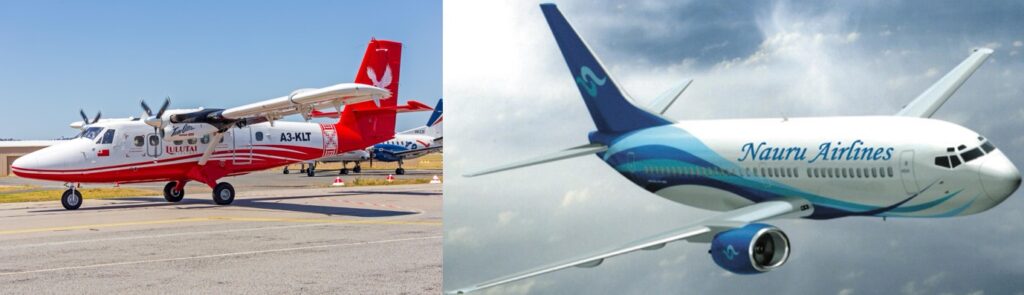
Lulutai Airlines is struggling to survive, weighed down by debt, safety breaches and poor governance. Yet Nauru, with a population barely one-tenth of Tonga’s, has sustained its national carrier for decades. Samoa, with comparable challenges, has staged a dramatic turnaround. Tonga’s leaders must now explain why this country cannot achieve the same.
Tonga founded Lulutai Airlines in 2020 to fill the gap left by the collapse of Real Tonga. It began with government backing and the promise of professional oversight. Five years later, the airline has become a cautionary tale. It is burdened by debt, grounded by repeated safety breaches, and sustained only by loans from public funds. Now, as it searches for investors, reports suggest even the tendering process lacks professionalism. This is not simply an airline problem. It is a governance problem.
Look across the Pacific and the contrast is sharp. Nauru, a state of fewer than 10,000 people, has kept its airline afloat for more than 50 years. Despite bankruptcy, the loss of phosphate wealth and repeated financial crises, Nauru Airlines continues to fly. Its survival rests on discipline: strict safety standards, credible external oversight through an Australian Air Operator’s Certificate, and partnerships that add value rather than drain resources. It is treated as a national lifeline, not a political project.
Samoa has gone further, transforming its national airline from a loss-making liability into a profitable enterprise. Samoa Airways has just declared a $1 million dividend for the year ending June 2025, following an $11 million profit after tax. Equity has swung by $87 million in three years, from a negative $54 million in 2022 to a positive $33 million in 2025. Debt has been cut from $80 million to $10 million. The turnaround was driven by government support, but also by credible management and accountability. The airline is reinvesting in its fleet, upgrading its Twin Otters to ensure reliability and service. Samoa now has a carrier that is not only stable but a source of national pride.

Lulutai, meanwhile, cannot manage even the basics. In July 2025, Tonga’s regulator suspended its maintenance certificate, grounding its fleet. The airline has relied on millions in loans from the Retirement Fund Board without producing timely audited accounts. Its route network has shrunk to a single service between Tongatapu and Vava’u, kept alive by a damp leased aircraft. Investors see not opportunity but risk.
The problem is not money or market size. The problem is governance. Too often in Tonga, the management of public assets is treated as a test of political authority rather than professional competence. Paper qualifications are praised, while execution is ignored. Transparency is treated as optional. The result is predictable: failure, repeated at public expense.
Managing an airline is not about prestige. It is about competence, accountability and the willingness to treat public funds as a trust, not a political tool. Nauru and Samoa have shown that when governance is taken seriously, even the most fragile carriers can endure and prosper. Tonga’s leaders must now prove they are willing to meet that standard.