Opinion: Unmasking the Siege: Israel’s War Crimes in Gaza and the Case for UN Intervention
By Melino Maka, Tonga Independent News
The ongoing war in Gaza has escalated to one of the deadliest conflicts in the 21st century, with the death toll surpassing 37,000 Palestinians—most of them women and children—since October 7, 2023. Israel’s military campaign, launched in response to the deadly Hamas attacks, has transformed into what numerous international human rights experts and institutions are now calling a full-scale genocide. The United Nations Human Rights Council Commission and various global legal scholars have documented a consistent pattern of disproportionate use of force, mass civilian casualties, and systematic targeting of infrastructure essential to life.
In its latest findings, the Commission concluded that Israeli authorities are responsible for a series of war crimes and crimes against humanity. These include extermination, intentional attacks on civilians, murder and willful killing, starvation as a weapon of war, forcible population transfer, gender persecution, and sexual violence. The deliberate destruction of hospitals, schools, refugee camps, and civilian shelters has become a hallmark of this campaign.
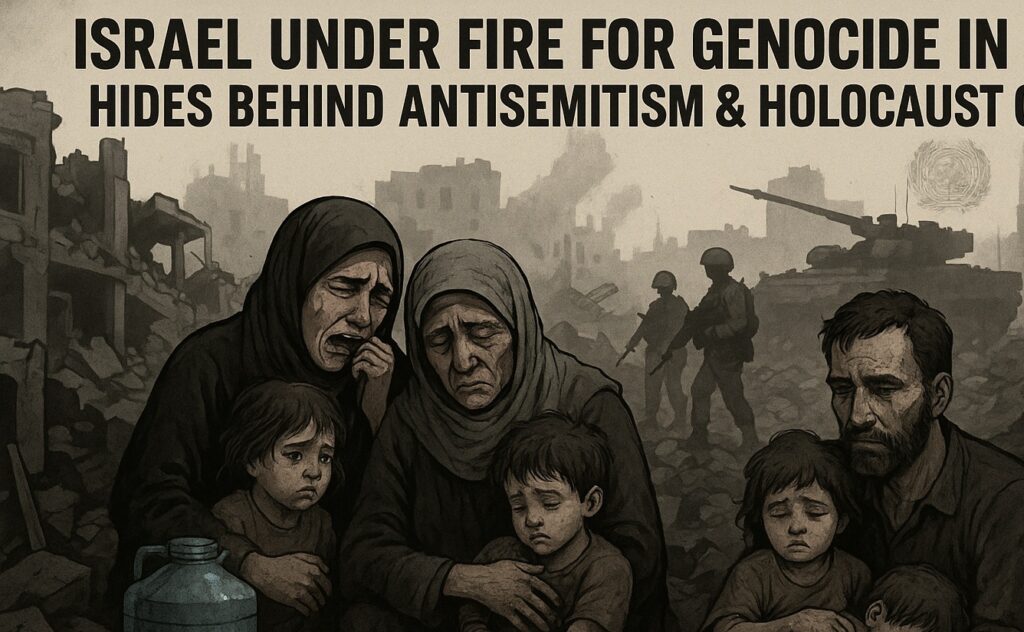
Israel’s “total siege” on Gaza has systematically weaponized basic human needs. By cutting off access to clean water, food, electricity, fuel, and humanitarian assistance, Israel has used collective punishment as a military and political tool. This blockade, which the UN describes as illegal under international law, has caused immense suffering—particularly among pregnant women, the disabled, and children—many of whom have died from starvation, dehydration, or untreated wounds.
The Israeli Defense Forces have continued to deploy heavy artillery and aerial bombardments in densely populated areas, resulting in entire neighborhoods being reduced to rubble. Children are among the most affected, with UNICEF reporting that over 17,000 Palestinian children have been orphaned and thousands more killed, maimed, or psychologically scarred. Many bodies remain buried under debris, uncounted and unrecovered.

The Commission has also confirmed credible evidence of systematic sexual and gender-based violence by Israeli forces, aimed at dehumanizing and humiliating the Palestinian population. These actions are not isolated incidents but part of established military procedures, and they constitute some of the gravest violations of international law.
Despite this, Israel continues to deflect international scrutiny by invoking antisemitism and the memory of the Holocaust. While the historical trauma of Jewish persecution is undeniable, critics argue that these references are being misused to shield the Israeli state from accountability. This conflation serves to silence legitimate criticism, stifle debate, and dismiss the Palestinian plight as secondary or illegitimate.
As global outrage mounts, there is renewed momentum behind calls for the deployment of UN peacekeepers to protect Palestinian civilians and ensure the flow of humanitarian aid. Several nations, including South Africa, Ireland, Brazil, and Spain, have initiated or supported legal actions at the International Court of Justice (ICJ) and the International Criminal Court (ICC) to hold Israeli leaders accountable.
The international community stands at a moral crossroads. Will it allow the continued erasure of an entire population under the pretext of self-defense, or will it intervene decisively to uphold the principles of human rights and justice?
The time has come for the United Nations to move beyond resolutions and deploy peacekeepers to Palestine. This must be accompanied by targeted sanctions, legal accountability, and a serious diplomatic push to end the occupation and recognize Palestinian sovereignty. Only through urgent and unified international action can we prevent further atrocities and secure a just peace for all in the region.