Opinion: Tonga’s FinTech Sandbox: Innovation or Bureaucratic Desperation?
By Melino Maka
Tonga Independent News
8 June 2025
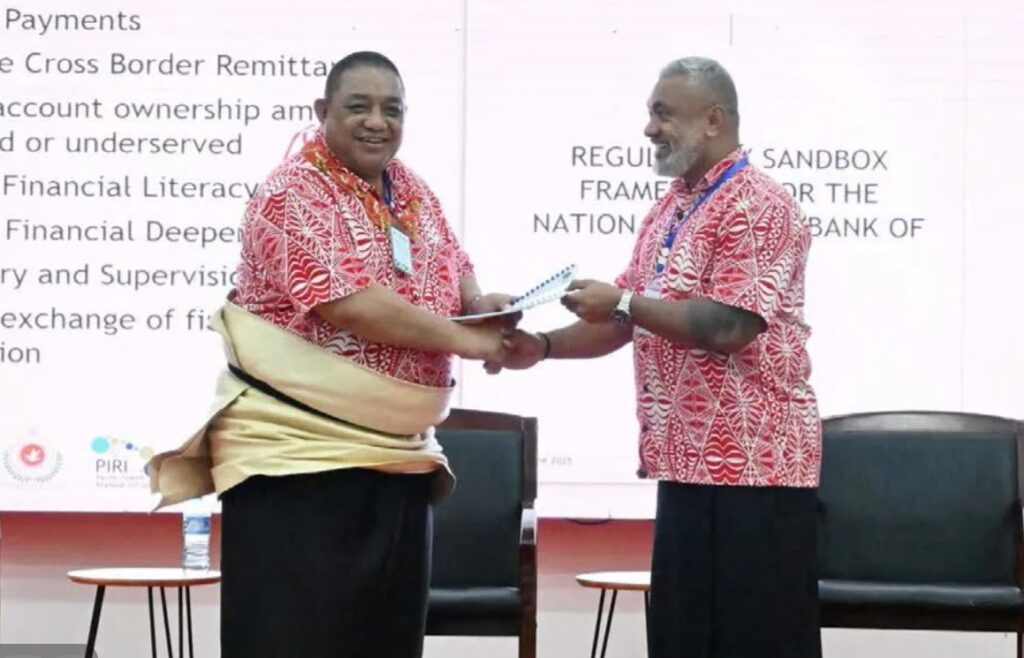
In recent years, the global rise of financial technology—or FinTech—has sparked waves of innovation across the world. Countries from Singapore to Rwanda are embracing regulatory “sandboxes,” controlled environments where new technologies can be tested under the watchful eye of regulators. Tonga has now followed suit, with the National Reserve Bank of Tonga (NRBT) announcing its own FinTech sandbox initiative.
But one question must be asked plainly: Is Tonga’s sandbox a necessary tool for sustainable innovation, or simply a bureaucratic gimmick born of desperation?
Sandbox 101: What It Is and Why It Exists
The FinTech sandbox is, in theory, a smart concept. It creates a regulatory “safe space” where financial innovators can test out new tools—digital wallets, micro-insurance products, blockchain-based solutions—without immediately being subject to the full burden of regulation. This allows governments to encourage experimentation while minimizing risks to consumers and the financial system.
Proponents argue that sandboxes de-risk innovation, attract investors, and foster financial inclusion. And on paper, Tonga’s version checks all the boxes: a clear application process, defined test periods, temporary regulatory exemptions, and NRBT oversight.
But scratch the surface, and serious doubts emerge about whether this model is fit for Tonga’s unique realities.
A Heavy Structure for a Light Market
Tonga’s total population is just over 100,000 people. Our financial ecosystem is small, centralized, and already fragile—still recovering from natural disasters, inflation shocks, and COVID-era disruptions. Unlike the sprawling, multi-layered economies of Southeast Asia or sub-Saharan Africa, Tonga’s market lacks both the scale and diversity of players to warrant a complex testing regime.
We must ask ourselves: is the NRBT building an airport runway when all we have is a bicycle?
In such a small economy, ideas either work—or they don’t. Requiring entrepreneurs to submit elaborate applications, outline risk matrices, and await regulatory blessings before they can trial a product with 50 users in Ha’apai is more likely to stifle innovation than stimulate it.
Bureaucracy Dressed as Progress
Let’s be frank. Tonga does not have a thriving startup ecosystem waiting to be unleashed by a sandbox. What we have is a small handful of determined entrepreneurs—often self-funded or backed by family remittances—trying to solve real problems like:
- Costly and slow remittances;
- Lack of access to digital payments in the outer islands;
- Limited financial literacy, especially among youth and women.
The people closest to these challenges don’t have time to wait for a sandbox license. They need quick paths to pilot solutions, not prolonged regulatory entanglement.
The very risk the sandbox claims to mitigate—consumer harm from failed innovations—is minimal in a market this size. What’s far riskier is doing nothing while we wait for perfect conditions. Innovation in Tonga doesn’t need a padded cell. It needs open ground and encouragement.

Who Is the Sandbox Really For?
Another uncomfortable truth: much of the language in the sandbox framework is written for international development partners, not for Tongan entrepreneurs. The inclusion of buzzwords like “Money Pacific 2025” and “regional scalability” suggests this may be more about appeasing donors than empowering locals.
Indeed, one has to wonder whether this initiative is more performative than practical designed to demonstrate that Tonga is “doing something” in the FinTech space rather than cultivating a real ecosystem that can grow.
We’ve seen this before. Government after government, project after project, chasing pilot schemes with donor funding, only for those projects to fizzle out once the funding dries up. Are we about to repeat the same pattern—this time with digital finance?
Capacity Questions and Practical Constraints
Let’s also not ignore the elephant in the room: Does the NRBT have the capacity to manage a sandbox effectively?
Supervising a sandbox is no small task. It requires:
- Technical literacy to understand and assess innovations.
- Ongoing monitoring of live products.
- Feedback mechanisms to protect consumers.
- Policy flexibility to adapt rules based on test outcomes.
With an already stretched regulatory team, can NRBT genuinely engage in this level of oversight? Or will the sandbox become yet another checklist item that exists in theory but remains dormant in practice?
A Better Way Forward
None of this is to say Tonga should ignore FinTech. On the contrary, digital finance is vital to our future—from making remittances cheaper to helping farmers access microcredit. But we must pursue solutions appropriate to our size and context.
If we want innovation, let’s do the following instead:
- Create a micro-pilot program where local entrepreneurs can test solutions with fewer than 100 customers without complex applications or licensing hurdles.
- Provide seed funding (through partnerships with ADB, MFAT, or UNDP) for grassroots digital solutions, especially those targeting remote islands.
- Launch a national innovation challenge, inviting diaspora and locals to propose practical financial tools—with cash prizes and government support for winners.
- Train NRBT and Ministry staff not just in supervision but in partnership—with the private sector, academia, and civil society.
Let’s stop mimicking models from economies 100x our size and start designing approaches grounded in Tongan ingenuity, speed, and common sense.
Final Thought: Innovation Requires Trust, Not Red Tape
Real innovation thrives in trust-based environments—where the government trusts its citizens to build, and the people trust their leaders to support rather than hinder.
Tonga’s FinTech sandbox, as it stands, feels more like a bureaucratic life raft than a launchpad. It looks good in a report, but on the ground, it may do more to delay than deliver.
If we are serious about a digital economy, we need more than buzzwords. We need boldness, speed, and a deep understanding of our local realities.
Until then, the sandbox risks being just another well-dressed cul-de-sac in our long road to sustainable economic independence.