Opinion: Deputy PM’s Budget Outburst Raises More Questions Than It Answers
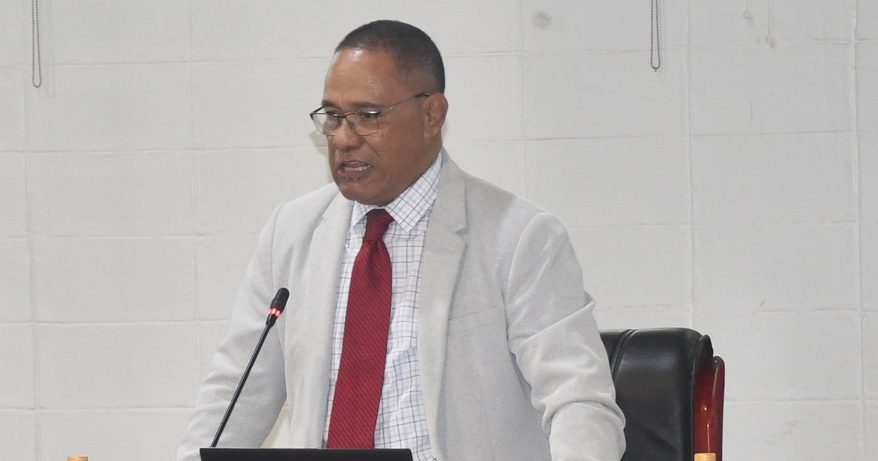
Deputy Prime Minister Taniela Fusimālohi’s recent remarks in Parliament questioning the government’s ability to fund the $36 million renovation for the 2031 Pacific Games have stirred public concern—but not for the reasons he may have intended.
Instead of reinforcing Cabinet unity, Fusimālohi’s comments signal either a deep miscommunication at the highest levels of government—or worse, a strategic political move aimed at distancing himself from the Games budget controversy while appearing to champion financial prudence. But who is this really helping—Tonga or political careers?
A House Divided?
Fusimālohi, speaking in Tongan during the June 2025 parliamentary session, revealed that unforeseen costs were now placing undue pressure on the national budget. He admitted the government could not guarantee access to the full $36 million needed for sports facility upgrades, despite the existing levy designed to support sports infrastructure.
But here’s the question: why raise these concerns in Parliament rather than in Cabinet? Why not engage directly with Prime Minister Dr. ‘Aisake Eke, who has publicly reaffirmed his government’s commitment to hosting the Pacific Games as a vital development initiative?
This isn’t just a breakdown in process—it’s a failure of leadership communication. If the Deputy Prime Minister feels uncertain about the budget or misunderstood the government’s funding strategy, shouldn’t that be resolved internally before turning it into political theatre?
By airing uncertainty publicly, Fusimālohi not only undermines his Prime Minister’s position but also sows doubt among the public and international stakeholders. It’s hard not to wonder whether this is about accountability—or positioning for the next election.
The Politics of Posturing
Fusimālohi’s critique comes on the heels of Sports Minister Sinaitaka Tu’itahi’s statement confirming that the government is actively pursuing $26 million in donor funding and leveraging the sports levy for facility upgrades.
Tu’itahi even noted potential revenue from athlete housing and marketing, referencing estimates provided by the Tonga Association of Sports and National Olympic Committee (TASANOC). That suggests a coordinated funding strategy, even if incomplete.
Yet Fusimālohi chose to question not only the numbers but also TASANOC’s transparency, claiming they’ve yet to demonstrate the economic benefits of hosting the Games.
Let’s be honest—this feels less like a financial disagreement and more like pre-election soundbite politics. With national elections approaching, politicians are keen to appear as champions of fiscal responsibility and “putting Tonga first.” But vague warnings and rhetorical alarm bells don’t substitute for constructive solutions.
Levy Legacy at Risk
Originally implemented by the late Prime Minister ‘Akilisi Pohiva in 2017, the sports levy was intended to support Tonga’s hosting of the 2019 Pacific Games—a plan later reversed over cost concerns. Despite that cancellation, the levy remained, redirected to support local sports development.
Now, TASANOC’s plan to draw on the levy for 2031 Games preparations is drawing fire, despite the fact that successive governments have continued to collect the fund with minimal transparency.
The question is not whether the levy should be used—but whether its use is being responsibly managed with proper oversight and a long-term benefit for local athletes and communities. Raising panic over its depletion without offering a serious alternative path forward smacks of political theatre.

Unpacking the “Secret Deal”
Tonga’s re-entry into the Games spotlight in 2031 wasn’t the result of a public mandate or parliamentary vote. It was brokered quietly by former Prime Minister Hu’akavameiliku, reportedly to resolve a dispute with the Pacific Games Council following Tonga’s controversial withdrawal in 2017.
Critics have labeled this a “secret deal”—one made while Tonga still had legal leverage over the Council. Whether or not that’s true, what’s clear is that the lack of transparency continues to fuel resentment and suspicion, especially now that millions are being requested for renovations with little explanation on return-on-investment.
The Real Cost
The real risk here is not just financial. It’s reputational.
Fusimālohi’s public doubt may play well with voters frustrated by economic hardship, especially in a donor-dependent country still reeling from pandemic recovery and climate-related challenges. But the long-term damage lies in eroding public confidence in government coordination—and weakening Tonga’s credibility with international donors and sporting bodies alike.
If Tonga is serious about hosting the Pacific Games and ensuring its success, then ministers must speak with one voice. The time for siloed statements and political point-scoring is over.
If Fusimālohi has legitimate concerns—and he may well do—he should raise them where they count: inside Cabinet, with the Prime Minister and Finance Minister, not from the parliamentary floor in a way that suggests discord rather than diligence.
Final Word
We should expect better from our leaders. The public deserves unity of purpose, not internal confusion masquerading as accountability. The Games, and Tonga’s future, are too important to be treated as a campaign slogan.
—
Melino Maka is a political and economic commentator in Tonga and Aotearoa