Op-Ed Continued MP Clash Reveal Structural Flaws
By Tevita Motulalo
MSc Geopolitics and International Relations
This incident is not just a clash of personalities but a symptom of a legislative framework struggling to balance the roles of Nobles and Representatives. The time has come for Tonga to adopt a bicameral parliament, with a Senate and a House of Representatives, to preserve the dignity of both groups while meeting the nation’s evolving needs.
More importantly, that it avoids the failures by numbers—that the government have unquestioned dominance of Parliament. Meaning, Parliament have no ability to really “check” the Administration as personal loyalties drown professionalism and ethics, due to the short numbers.
The Strain of the Unicameral System
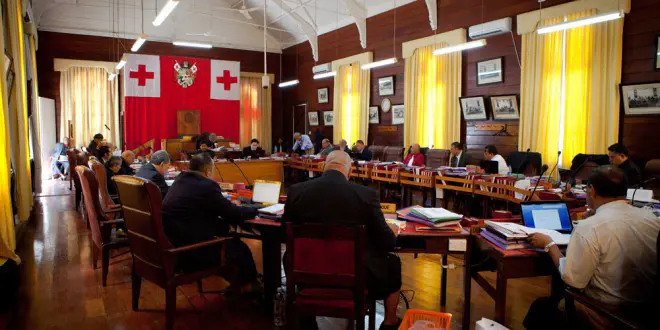
Our unicameral Parliament operates in two modalities: the solemn “House of Parliament Mode,” resembling an upper house with minimal debate, and the “Whole House Committee Mode,” allowing open discussion under a Committee Chair. This system, once innovative, now strains under modern demands. The recent altercation between a Lord MP and a Representative MP highlights this tension. The Lord MP, adhering to the formal expectations of the House of Parliament Mode, may have been justified in demanding decorum. Yet, the Representative MP, animated by his passion for his constituents, was equally justified in principle. The unicameral structure forces these conflicting roles into one chamber, creating friction that undermines effectiveness.
Honour crucial for the Morale and National Spirit
Beyond this incident, the Nobles face constant undue pressure in the unicameral system. Representatives, permitted a degree of ‘vulgarity’ and everyday in the Whole House Committee Mode (as opposed to high formal language in the full Parliament session), can direct sharp criticisms at the Nobles, who, bound by their expected dignity and demands of honourability, are often unable to respond in kind. This dynamic unfairly paints the Nobles’ restraint as silence or guilt in the public eye, particularly in media narratives.
There needs to be a pragmatic approach recognised a pragmatic need for clear and free communication, but respectful language in the Tongan custom must not be discarded anyway.
Such misconceptions come at the expense of the Nobles, whose solemnity is not merely ceremonial but vital to the steady and stable morale and psychology of Tonga’s national dynamic. Their dignified presence anchors the country’s governance, and a bicameral system would protect this role by providing a separate Senate where their decorum is preserved.
A Bicameral Solution: Senate and House of Representatives
A bicameral system offers a practical solution by creating distinct forums for Nobles and Representatives. The Senate, composed of Nobles and appointed Life Peers, would maintain the solemnity befitting state officers overseeing critical issues like finance, national security, defence, and foreign policy.
The House of Representatives, elected by the people, would serve as a dynamic platform for debate, allowing Representatives to express constituents’ concerns freely. This segregation ensures each group operates in a setting suited to its purpose, reducing conflict and enhancing legislative clarity.
Of course this does not mean they could not sit together. They together are still considered one Parliament. In fact, by choice, if both Houses so chooses, they can have a joint session where they can then simultaneously cast a vote on an issue. This includes the ballot for Prime Minister, and other extra-ordinary matters. When comes routine, run-of-the-mill, matters, MPs can choose to withdraw to their chambers and scrutinise in detail according their duties and roles.

By Tevita Motulalo
MSc Geopolitics and International Relations
Historical Precedent and Modern Needs
The late King George V recognised the value of broadening the Nobles’ ranks by appointing eminent individuals as Life Peers. With those ranks now dwindling, Prime Minister Eke has an opportunity to propose new appointees, consulting with the Nobles to strengthen their numbers (Senate).
A bicameral system aligns with this vision, creating a Senate that reflects Tonga’s brightest minds, and its strong traditional continuity, while preserving its dignity. Meanwhile, the People is allowed in their maximum numbers. The House of Representatives would initiate the National Budget, reflecting its role as the people’s voice, while the Senate could review but not reject it.
Addressing Criticisms and Restoring Balance
Critics may argue that a bicameral system risks inefficiency or elitism. However, these concerns overlook its benefits. Nobles, who view Parliament as sacrosanct, are disadvantaged in the current system, unable to engage in open discourse without compromising their dignity. Representatives, constrained by formalities, struggle to advocate effectively. A bicameral structure resolves this by providing tailored forums.
Meanwhile, in the heat of advocacy in the reform years, the discussion devolved into partisanship and mostly ego-struggles, blinded to the fact that they were construction the ship of state almost backwards: the Cabinet was defined and locked at 12 members, and then the rest of the Parliamentary institution was built in accordance.
The 2010 reforms, which retained the Nobles’ seats at 9 out of 26, but diluted individual Representatives’ influence. A Senate of 20 Nobles and a House of 40-50 Representatives would restore balance, ensuring diverse representation from all corners of Tonga, including the Church.
Sizing Parliament for the Future
According to the ACE Electoral Knowledge Network, of which Tonga is a member, formula, Tonga’s population and demographics suggest a parliament size of 51-52 members. In 1875, Tonga had a 40-member Parliament, evenly split between Nobles and Representatives. Those are close numbers for the years past until now. To avoid having to have these issues again, and to meet modern and future demands, a parliament of 60-75 members is advisable.
This means a 20-member Senate and a 40-50-member House of Representatives would provide ample diversity and capacity for robust deliberation. This size ensures the legislative process remains manageable while preparing Tonga for the next century.
A Path to a Stronger Democracy
The recent parliamentary clash is a call for reform. A bicameral parliament honours the solemnity of the Nobles, amplifies the people’s voice, and creates a legislative framework ready for future challenges. By embracing this evolution, Tonga can build a stronger, more inclusive democracy that respects tradition while addressing contemporary needs. The time to act is now, ensuring our Parliament serves as an effective instrument of state for all Tongans.