Commentary: Fiji Charts an Independent Path in Pacific Geopolitics: Rabuka Rejects Chinese Military Base and Urges Regional Neutrality
By Melino Maka, Tonga Independent News
Fiji’s Prime Minister Sitiveni Rabuka has firmly rejected the idea of China establishing a military base anywhere in the Pacific Islands, underscoring his government’s commitment to regional neutrality and collective sovereignty. Speaking at the National Press Club in Canberra on July 2, Rabuka emphasized that while China is a significant global power, its presence in the Pacific must be non-militaristic and respectful of sovereign boundaries.
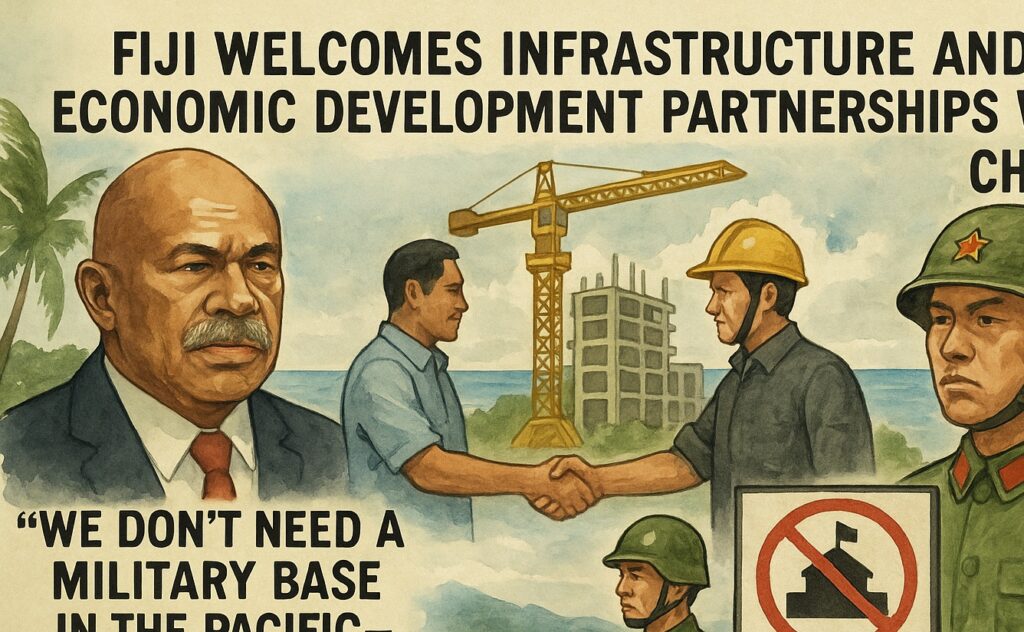
“We don’t need a military base in the Pacific—certainly not from China,” Rabuka stated, adding that Beijing’s recent demonstration of its intercontinental ballistic missile capabilities, which overflew Fiji’s territory before landing in international waters, made it clear that China can project power globally without a base in the region.
A Strategic Battleground Between Superpowers
Fiji, like many of its Pacific Island neighbors, sits at a critical juncture between the competing interests of the United States and China. With Washington and Beijing vying for influence in a region long overlooked but now seen as strategically vital, Pacific nations are increasingly caught in the middle of this geopolitical tug-of-war.
Rabuka’s remarks come amid heightened concern about China’s expanding presence in the region—including a security pact with the Solomon Islands and growing Chinese police cooperation with several Pacific governments. While welcoming Chinese development aid and infrastructure investment, Rabuka has drawn a firm line against military cooperation.
“If they want to come, who would welcome them?” he asked pointedly. “Not Fiji.”
The Illusion of Selective Engagement
However, Fiji’s position also highlights a deeper dilemma facing the Pacific: the idea that nations can simply handpick what they want from global powers—economic support without geopolitical entanglement—is becoming increasingly unrealistic.
The problem is that some Pacific countries want to hand-pick their preferred engagement model—welcoming only development projects while rejecting political or military influence. While this may seem ideal in theory, it’s rarely achievable in practice unless those countries go it alone, which is economically and diplomatically challenging.
Fiji, in many ways, is trying to play a dollar-each-way strategy: accepting Chinese infrastructure while affirming traditional security ties with Australia, New Zealand, and the United States. But this balancing act is becoming harder to sustain—especially when one side, the U.S., is not treating the region as a priority.
Is Rabuka’s Strategy Sustainable Under Trump?
This dilemma is compounded by the current reality in Washington. President Donald Trump, now serving his second term, has shown little interest in the Pacific. His administration views global engagement through a narrow transactional lens, and Trump has offered no strategic commitment to the Pacific Islands because he sees no immediate return on investment.
The result is a growing vacuum in U.S. leadership, which China is more than willing to fill—albeit on its own terms. Beijing’s approach is long-term, strategic, and patient. It offers infrastructure, concessional loans, and capacity-building—not always with transparency, but with consistency.
While Rabuka’s Ocean of Peace Treaty seeks to enshrine neutrality and regional unity, its success hinges on whether the Pacific can extract real commitments from all players—especially from a disengaged U.S. administration that remains focused elsewhere.

The Five Eyes and Pacific Security
The Pacific has historically relied on the Five Eyes security partnership (U.S., Australia, New Zealand, Canada, and the UK) for intelligence-sharing, defense training, and diplomatic support. Yet, in recent years, even the Five Eyes members have shown inconsistent and reactive engagement with the region.
Australia and New Zealand continue to play vital roles as regional anchors. But beyond rhetoric, Canada’s presence is minimal, the UK’s engagement is largely ceremonial, and the U.S.—despite its military footprint in Guam and Hawaii—has failed to build meaningful development or diplomatic bridges in much of the Pacific.
This inconsistency opens space for China’s rise in areas like:
- Infrastructure (roads, ports, government buildings)
- Telecommunications (Huawei and undersea cables)
- Security cooperation (training, policing, surveillance)
Ocean of Peace Treaty: Vision vs. Reality
Rabuka’s push for an Ocean of Peace Treaty is a noble attempt to restore Pacific agency and prevent the militarization of the region. It seeks to ensure that no foreign power uses the region to project dominance or to extract political concessions through coercion or debt diplomacy.
“Pacific leaders have long sought to be friends to all, enemies to none. It is a difficult course to steer, but it is still possible,” Rabuka said.
But in today’s multipolar world, neutrality cannot be a passive stance—it must be actively defended and backed by internal strength. That includes:
- Greater regional coordination through the Pacific Islands Forum
- Stronger internal economies to reduce aid dependency
- Transparent governance to withstand external pressure
- Clear red lines on military use and strategic assets
Conclusion: Between Giants, Pacific Leaders Must Get Real
Fiji’s strategy is bold and principled—but also precarious. Prime Minister Rabuka deserves credit for asserting Fiji’s voice on the global stage and resisting militarization from any side. His Ocean of Peace Treaty could reshape regional diplomacy if it gains full Pacific buy-in.
But the broader question remains: Can Pacific nations really stay neutral when their geopolitical landscape is shaped by the ambitions of others? And can they truly choose development without influence, when the major players—China and the U.S.—play by different rules?
As it stands, President Trump does not prioritize the Pacific because he does not see it as valuable. That absence leaves a vacuum filled by China, whose every visit, loan, and project is calculated to advance its long-term interests.
Fiji and the wider Pacific must confront this uncomfortable truth: in the absence of strong, sustained Western engagement, selective neutrality is a fantasy—and survival will require unity, clarity, and a new regional realism.