Tonga Survive Samoa Thriller, but New Zealand Will Test Their Resolve
SYDNEY, AUSTRALIA: Tonga and Samoa delivered everything expected of their fierce Pacific rivalry. Two powerful teams, neither willing to surrender an inch, fought themselves almost to a standstill in a contest that remained undecided until the final moments.
Tonga prevailed 20–18 before a record crowd of 29,411 at CommBank Stadium, but only after surviving a remarkable Samoan comeback.
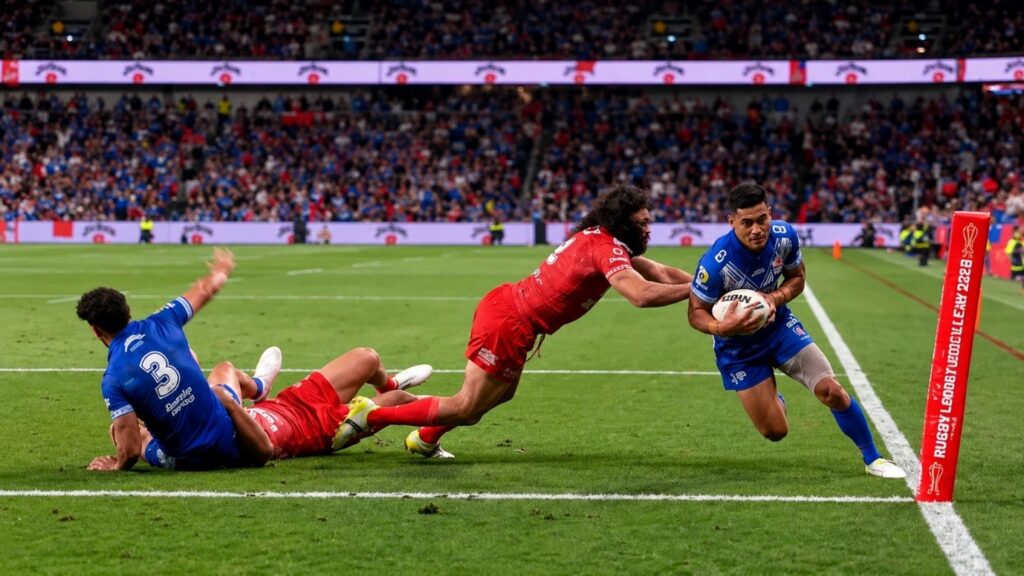
Samoa came within inches of snatching victory in the dying moments when Sua Fa’alogo attempted to reach the try line, only for his foot to touch the sideline.
They had one final opportunity when Hamiso Tabuai-Fidow collected a high kick, but his pass to Fa’alogo was ruled forward.
For Tonga, the victory secured an unbeaten passage through the group stage of the 2026 Rugby League World Cup and a semi-final meeting with New Zealand.
But the performance also raised a question: can Tonga maintain control against stronger opposition when momentum begins to turn against them?
Tonga’s forwards laid the foundation
Both forward packs attacked the defensive line with enormous physical commitment, looking to establish the dominance that would allow their outside backs room to operate.
Tonga twice came close to opening the scoring, with Dallin Watene-Zelezniak denied in the corner after his foot touched the sideline and Jojo Fifita stopped by desperate Samoan defence.
Tonga eventually broke through following a superb flick pass from Haumole Olakau’atu that released Robert Toia into space. The centre showed his speed and footwork to race 45 metres and beat the remaining defence to score.
The try demonstrated the value of Tonga’s forwards attracting multiple defenders while retaining the ability to offload and create opportunities for their backs.
Isaiya Katoa subsequently added a penalty goal to extend Tonga’s lead to 8–0.
Brian To’o crossed following a Jarome Luai kick, reducing the deficit to 8–4 at half-time.
Tonga had enjoyed the better of the opening period, but there was little between the teams.
A ten-point lead that disappeared
Tonga began the second half strongly.
A well-executed attacking movement sent the ball across the field to Jojo Fifita, who crossed to extend the lead to 14–4.
Tonga appeared to have established control. Their forwards were making ground, their attacking combinations were producing results, and Samoa faced a ten-point deficit against one of the competition’s most physical teams.
But Samoa fought back.
To’o crossed for his second try before Hamiso Tabuai-Fidow added another.
Tonga also produced an outstanding defensive effort when Lehi Hopoate and Haumole Olakau’atu combined to deny Benaiah Ioelu what appeared a certain try, forcing the ball loose on the goal line.
Despite that effort, Samoa continued to press.
Ronald Volkman crossed to put Samoa ahead 18–14 with less than ten minutes remaining.
Tonga had gone from controlling the scoreboard to facing defeat.
While Samoa’s attacking quality cannot be overlooked, Tonga’s inability to protect a ten-point advantage will concern the coaching staff.
Against New Zealand, similar lapses could prove costly.

Tonga fight back
Trailing by four points with less than ten minutes remaining, Tonga needed someone to take responsibility.
Addin Fonua-Blake provided the answer.
The powerful forward identified a gap in Samoa’s defensive line and drove through two defenders to score, before Isaiya Katoa’s conversion restored Tonga’s lead at 20–18.
Tonga had surrendered the lead, struggled to contain Samoa’s momentum and then recovered when defeat appeared likely.
Their ability to respond under pressure will give the team confidence heading into the semi-finals.
However, Tonga cannot expect to rely on late individual efforts every time an opponent gains the upper hand.
Against New Zealand, they will need greater consistency over the full 80 minutes.
Samoa exposed the challenge ahead
Samoa deserve considerable credit for their performance.
Despite trailing by ten points in the second half, they maintained their attacking ambition and turned the contest around.
Their ability to exploit opportunities showed that Tonga’s defensive structure can be challenged, particularly when opponents generate quick momentum and move the ball into space.
Tonga’s earlier performances have demonstrated their ability to withstand sustained pressure. The concern is whether they can maintain that discipline