Defendants Seek to Set Aside Lord Chief Justice’s Ruling in Liahona/Saineha Alumni Dispute
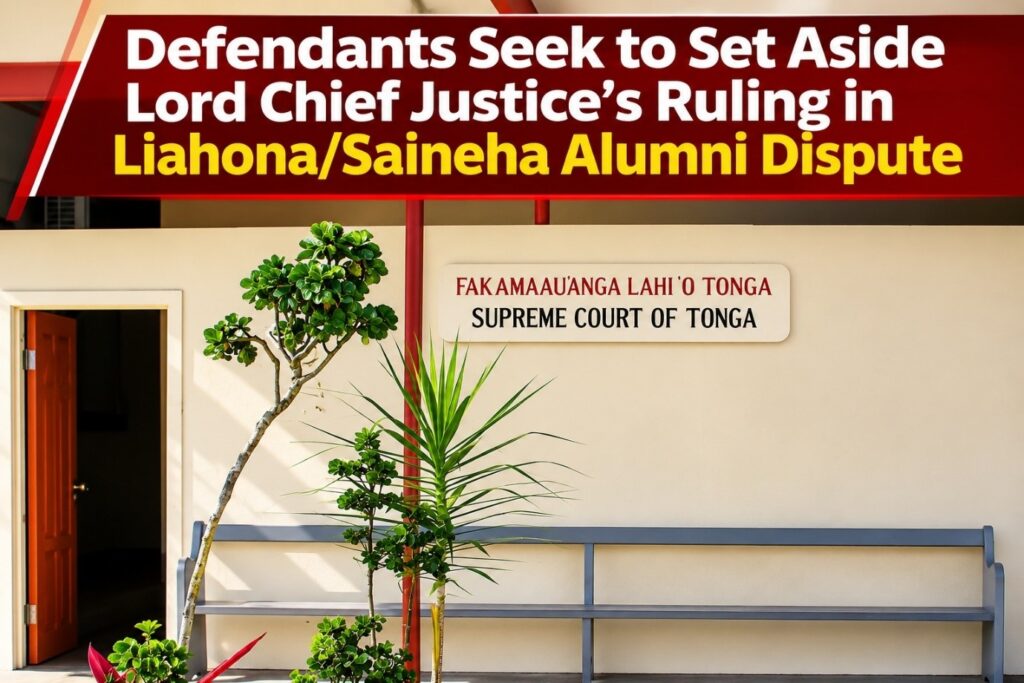
Ten defendants, through lawyer William Edwards, say the plaintiff’s submissions went beyond what both sides had agreed the Court would consider.
By Tuífua Vailena, Co-Editor
Ten defendants in the leadership dispute over the Liahona/Saineha Alumni Association have asked the Supreme Court to set aside a ruling delivered by Lord Chief Justice Malcolm Bishop KC on 26 October 2026.
The application was filed on 30 October by lawyer William Edwards, four days after the ruling. It argues that the plaintiff’s written submissions went beyond what both sides had agreed the Court would consider, and that the judge relied on those submissions when making findings about whether the Association was incorporated in 2002.
The ruling went largely in favour of the plaintiff, ʻEpalahame Taukeiʻaho. He was elected President of the Association, known in Tongan as Kautaha Kolisi Tutuku Liahona/Saineha, on 13 July 2023 for a three-year term.
On 8 October 2023, an “Emergency Board Meeting” purportedly suspended him and appointed the Second Defendant, Vili Nuku, as interim President. Mr Taukeiʻaho says that decision was invalid, in part because the meeting did not have a quorum and he was not given the hearing the constitution requires.
What the Court decided
In a Joint Memorandum dated 1 October 2026, both parties agreed to have four legal questions decided through written submissions, without a court hearing. These concerned the Association’s governing constitution, proposed amendments, its incorporation and the effect of incorporation on the leadership dispute.
The Lord Chief Justice found that the governing document was the constitution confirmed by the Association’s General Committee on 12 July 2018, in its Tongan text. The defendants had relied on what they called the “2018 Constitution with amendments”.
He also found that no amendment had been proposed, considered and passed through the three-stage process the 2018 constitution sets out before 8 October 2023.
The judge noted that the defendants relied on two different “amended” versions that contradicted each other. One, marked up with deletions and insertions, contained the changes needed to treat overseas-based former office-holders and three of the defendants as Permanent Members. Without those changes, the ruling said, the 8 October 2023 meeting could not have reached its quorum.
On incorporation, the defendants argued the Association had been incorporated since October 2002, relying on a certificate dated 23 October 2002. The judge found the Association had been entered on the register in 2002 but became an incorporated society with registered rules on 19 January 2024.
He pointed to the absence of any surviving or produced rules from the 2002 registration and to problems with the paperwork, including conflicting dates, a society name that did not match, and a certificate issued under a “Corporated Societies Act”, which does not exist. In the alternative, he found the 2024 certificate was valid and covered the same body, Society No. 69.
The judge further found that the incorporation date did not defeat the plaintiff’s claims. Every event in the case happened before 19 January 2024, and the 2018 constitution bound the members either way: as a contract between members of an unincorporated body, or as the rules of an incorporated society.
Incorporation in 2024 also could not be used to justify decisions made during the October 2023 leadership dispute, which had to be judged under the rules applicable at that time.
The Court also dismissed the defendants’ request, made in their written submissions, for declarations under section 10 of the Incorporated Societies Act and for the 19 January 2024 registration to be removed. The judge noted the request had never been pleaded. The Statement of Defence contained no counterclaim. Costs of this stage were awarded to the plaintiff.
The ruling settled these preliminary questions only. The wider claim over the President’s suspension has not yet gone to trial.
Why the defendants want it set aside
Under the Joint Memorandum, the parties agreed that the incorporation question would be decided “according to the Incorporated Societies Act, on the certificates of incorporation and registration documents relied on by each party, after hearing legal argument by counsel”.
The application says the plaintiff’s counsel, Ms A. Kafoa, went beyond this by making statements of fact rather than legal argument. It points to a section of her submissions headed “There were no rules in 2002”, and to her statement that the first rules ever lodged with the Registrar were the 2024 rules. The defendants say there was no evidence for either claim.
They say those statements went against a brief of evidence they filed in May 2026 for the trial. That brief is from Sione Loseli, who is himself the Tenth Defendant.
In it, Mr Loseli says he helped draft the Association’s constitution with then President Sione Sika and his uncle, lawyer David Tupou. He says that in early 2002 he and the president lodged “the registration documents” with the Office of Commerce. The application goes further, saying he “did in fact file the Rules in 2002”.
Mr Loseli also says he recently checked the registration and found that the Association’s records held by the Registrar were destroyed when a government building burned during the 2006 Nukuʻalofa riots.
The ruling lists the material the judge received: both sides’ written submissions, the Further Amended Statement of Claim, the Statement of Defence and the Defendants’ Court Book. Mr Loseli’s brief is not named separately in that list.
The defendants also argue that section 8 of the Incorporated Societies Act makes a certificate of incorporation legally conclusive evidence that a society was properly registered.
However, the judge found that the provision did not establish whether rules had been registered in 2002 or what those rules contained. He also noted that the same provision applied to the 2024 certificate.
In an affidavit supporting the application, Fourth Defendant Vuna Tuʻikolovatu says he is authorised by the other nine defendants. He says he was “taken by surprise” by the plaintiff’s submissions. He also disputes the finding that no seal appeared on the 2002 certificate, attaching what he says is a clearer copy showing one.
These are claims made by the defendants in support of their application. The Court has not ruled on them.

The Court’s findings on incorporation and the Association’s rules
The Lord Chief Justice also considered section 21 of the Incorporated Societies Act, which requires amendments to a society’s rules to be registered before taking legal effect.
“On the Defendants’ own case, therefore, no amendment had legal effect on that date,” he wrote, referring to 8 October 2023. He also found that a member could enforce compliance with the Association’s rules concerning quorum and removal from office in his own name, regardless of the Association’s legal status.
What happens next
The application asks the Court to set aside the ruling, make any other order it considers just, and award costs. The filed copy does not show a hearing date.
Filing the application does not overturn the ruling. The Court will decide whether the defendants have shown grounds to reopen it. The underlying dispute over the Association’s leadership has yet to go to trial.