
Militarisation or Double Standards? Pacific Tensions Put Western Policy Under Scrutiny
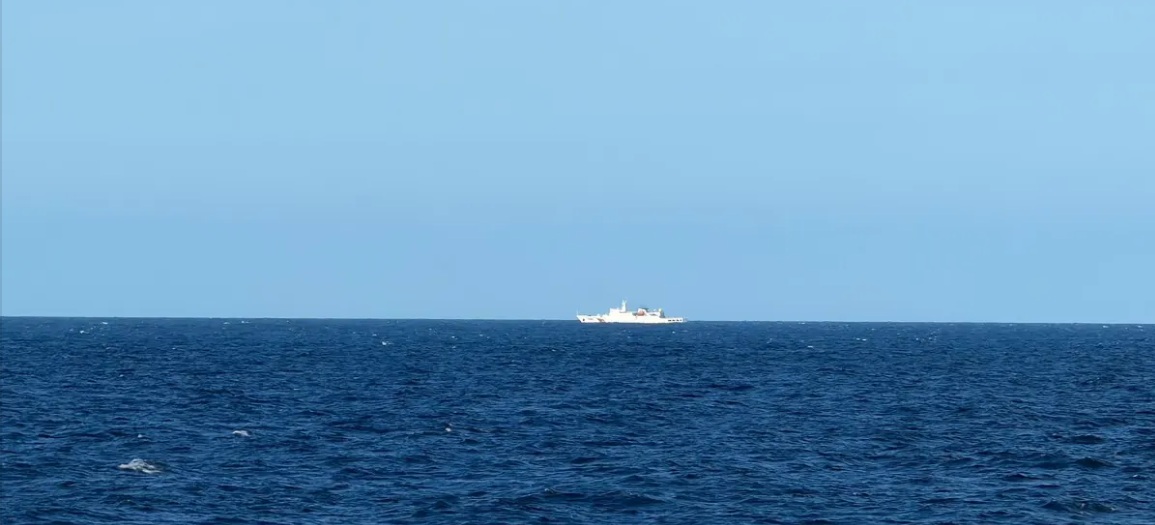
Chinese Coast Guard vessel No. 1303 being detected 23 nautical miles northwest of Pengjia Islet. Photo AFP PHOTO_ TAIWAN COAST GUAR
By Melino Maka
ANALYSIS | The United States and its allies conduct extensive military exercises across the Pacific, while Pacific travellers face new US visa bond requirements of up to US$20,000. China’s latest missile test, meanwhile, drew widespread international criticism. The contrasting responses raise a difficult question for the region: are the same standards being applied to every major power?
In June 2026, the United States and its allies launched Exercise Valiant Shield 26, a major multinational military exercise spanning Guam, Japan, the Northern Mariana Islands and surrounding waters.
The exercise integrated the US Navy, Marine Corps, Army, Air Force and Space Force alongside allied forces in what US officials described as producing “precise, lethal, and overwhelming multi-axis, multi-domain effects.”
Five days after Valiant Shield concluded, China test-fired a nuclear-capable, submarine-launched long-range ballistic missile from a nuclear-powered submarine into the Pacific. Beijing described the launch as part of routine annual military training and said it was not directed at any country.
The contrasting international reactions could hardly have been more pronounced.
A Tale of Two Military Activities
Valiant Shield 26, the 11th iteration of a biennial exercise that began in 2006, involved forces detecting, locating, tracking and engaging units at sea, in the air, in space, on land and in cyberspace.
US Pacific Fleet Commander Admiral Steve Koehler described the exercise as demonstrating America’s “enduring commitment to a free and open Indo-Pacific.”
The exercise was presented by the United States and its allies as routine military training and part of the region’s security architecture.
China’s July launch was different in nature. It involved a nuclear-capable ballistic missile and raised concerns about strategic signalling, transparency and the risk of miscalculation.
Washington said Beijing provided only limited advance notice and insufficient information about the launch. US officials argued that greater transparency was particularly important given the rapid expansion of China’s nuclear arsenal.
Following the Chinese launch and other recent missile activity in the Pacific, the United States and 40 other countries issued a joint statement calling for at least 24 hours’ advance notification of intercontinental ballistic missile, submarine-launched ballistic missile and space-launch vehicle launches.
Those concerns deserve serious consideration.
But they also raise a broader question for Pacific countries.
If growing military activity threatens the Pacific’s ambition to become an Ocean of Peace, should scrutiny depend on the type of weapon and risks involved, or should the region also examine the cumulative military expansion of all major powers operating in its neighbourhood?
The Numbers Tell a Story
Beijing has forcefully rejected Western criticism as a “double standard.”
Chinese Ambassador for Disarmament Affairs Li Chijiang has said China has conducted only three intercontinental ballistic missile test launches, compared with about 300 by the United States.
The figures are China’s comparison and should be viewed in that context, but Beijing uses them to support its argument that Western governments judge Chinese military activity differently from their own.
China’s Foreign Ministry has similarly accused the United States and its allies of “political manipulation” and double standards at international disarmament talks.
The competing arguments highlight the difficulty facing Pacific nations: how to oppose destabilising military activity without becoming aligned with one side of an increasingly intense strategic rivalry.
More Than Missiles: The Visa Bond That Speaks Volumes
Military competition is not the only issue influencing Pacific perceptions of the major powers.
Pacific governments and communities are also confronting new barriers to travel to the United States.
The US State Department’s visa bond programme requires nationals from a range of countries, including Fiji, Papua New Guinea, Tonga, Tuvalu and Vanuatu, who are otherwise eligible for B-1 business or B-2 tourist visas to post bonds that can reach US$20,000.
The programme was made permanent in August 2026.
The bonds are refundable when travellers comply with their visa and bond conditions and leave the United States within their authorised period of stay.
Under the permanent programme, bonded travellers are no longer restricted to just three designated airports. They can enter and depart through commercial US airports of entry, including authorised US Customs and Border Protection pre-clearance locations.
The US Government says the programme is designed to reduce visa overstays and encourage compliance with immigration laws.
For Pacific travellers, however, requiring a bond worth thousands or tens of thousands of dollars can present a substantial financial barrier before a journey even begins.
A Question of Affordability and Dignity
For Pacific families and small businesses, the sums involved are significant.
In Fiji, a maximum US$20,000 bond equates to roughly FJ$44,000. By comparison, Fiji’s gross national income per capita was US$5,680 in 2024.
Papua New Guinea Prime Minister James Marape has also acknowledged that visa bonds running into tens of thousands of kina represent a considerable amount of money for ordinary citizens.
The programme has had a measurable impact.
During its pilot phase, B-1/B-2 visa issuances from countries covered by the programme fell by 83 per cent compared with the corresponding 10-month period the previous year.
The United States points to another side of those figures. It says the bond system substantially improved compliance among travellers who proceeded with their applications and argues that the policy addresses genuine problems with visa overstays.
Critics, however, contend that requiring large refundable bonds can discourage legitimate travel by people from lower-income countries who may be fully capable of meeting their visa obligations but cannot afford to place thousands of dollars aside as security.
For Pacific countries, the debate therefore goes beyond immigration enforcement. It also concerns how citizens of small island states experience their relationship with one of the region’s most influential powers.
The Soft Power Contrast
The contrast with China’s approach is increasingly visible.
Fijian political analyst Jope Tarai has pointed to the fact that Fijian passport holders enjoy visa-free entry to China, arguing that the difference could have significant implications for competition between the major powers for influence in the Pacific.
That does not make China’s wider strategic intentions irrelevant.
But soft power is ultimately shaped by how policies are experienced by ordinary people.
For a Pacific traveller deciding whether one major power is making engagement easier while another requires a potentially US$20,000 financial guarantee, the contrast is difficult to ignore.

Pacific Division: A Region Torn
China’s missile test has also exposed deep divisions among Pacific Island nations, complicating any suggestion of unified regional opposition to Beijing.
At the Pacific Islands Forum Foreign Ministers Meeting in Suva, member states were unable to agree on a collective statement responding to China’s test.
The disagreement was not simply over whether the missile launch should be condemned.
Pacific Islands Forum Secretary General Baron Waqa said ministers had differing views about whether a statement should focus specifically on China’s missile test or address missile testing in the Pacific more generally.
Kiribati and Nauru, which deepened relations with Beijing after switching diplomatic recognition from Taiwan in 2019 and 2024 respectively, did not support the proposed wording.
Waqa stressed that neither country had “blocked” the statement but had instead put forward their positions for other members to consider.
The disagreement reflects the central challenge facing Pacific Island nations.
They have different economic, political and security interests. Some seek deeper security engagement with the United States and its allies. Others are wary of becoming drawn into strategic competition between larger powers.
Most ultimately want the same thing: the ability to determine their own relationships without being forced to choose sides.
An Ocean of Peace or Selective Outrage?
Pacific leaders endorsed the Ocean of Peace Declaration in September 2025, committing themselves to safeguarding regional peace and preventing the Pacific from becoming caught in the crossfire of major-power rivalry.
Yet military activity throughout the region continues to grow.
China has expanded naval deployments and conducted military exercises in Pacific waters.
The United States and its allies continue large-scale military exercises and maintain extensive military infrastructure across the region.
Australia, Britain and the United States are advancing the AUKUS security partnership.
And in July, Australia and Fiji signed the Ocean of Peace Alliance, Fiji’s first defence treaty of its kind, only hours before China’s missile launch.
None of these arrangements is identical, and governments involved argue that their security partnerships contribute to stability, disaster response and national defence.
But collectively they demonstrate an unmistakable reality: the Pacific is becoming increasingly important to the strategic calculations of much larger powers.
That creates a difficult question.
Can the Pacific credibly oppose militarisation if concern is directed primarily at one power while similar scrutiny is not applied to the growing military footprint of others?
The Nuclear Question
Western concern about China is not without foundation.
The Stockholm International Peace Research Institute estimated that China’s nuclear arsenal had reached at least 600 warheads by January 2025, up from an estimated 350 in early 2021.
China maintains that its nuclear arsenal remains at the minimum level necessary for national defence and points out that its stockpile remains considerably smaller than those of the United States and Russia.
Beijing also points to the substantial US military presence throughout the Pacific, including Hawaii, Guam and the Marshall Islands.
The United States, meanwhile, argues that its alliances and military presence underpin regional stability and deter conflict.
These positions are fundamentally different interpretations of the same increasingly militarised strategic environment.
For Pacific countries, accepting either argument unquestioningly carries risks.
A Question of Standards
The issue is not whether China’s missile test should escape scrutiny.
It plainly should not.
Launching a nuclear-capable ballistic missile into the Pacific raises legitimate questions about transparency, notification, safety and strategic intent.
But China’s actions should not prevent Pacific governments from asking equally serious questions about the broader expansion of military activity by every major power operating in their region.
US and allied exercises are generally framed by their participants as stabilising, routine and necessary for regional security. China describes many of its own military activities in similarly defensive terms.
Pacific nations do not have to accept either description at face value.
As Pacific leaders prepare to meet in Palau for the 55th Pacific Islands Forum Leaders Meeting, the Chinese missile test, regional security and Pacific unity are expected to return to the agenda.
The deeper question is whether Pacific nations can forge a consistent principle that applies to every major power, regardless of whether that power is China, the United States or one of its allies.
The Pacific has been a theatre of war, a site of nuclear testing and is now again becoming a stage for great-power rivalry.
Its people have historically borne many of the consequences while exercising comparatively little influence over the strategic decisions of larger nations.
If the Ocean of Peace is to be more than rhetoric, its credibility will depend on consistency.
China should be held accountable for actions that threaten regional peace.
So should everyone else.