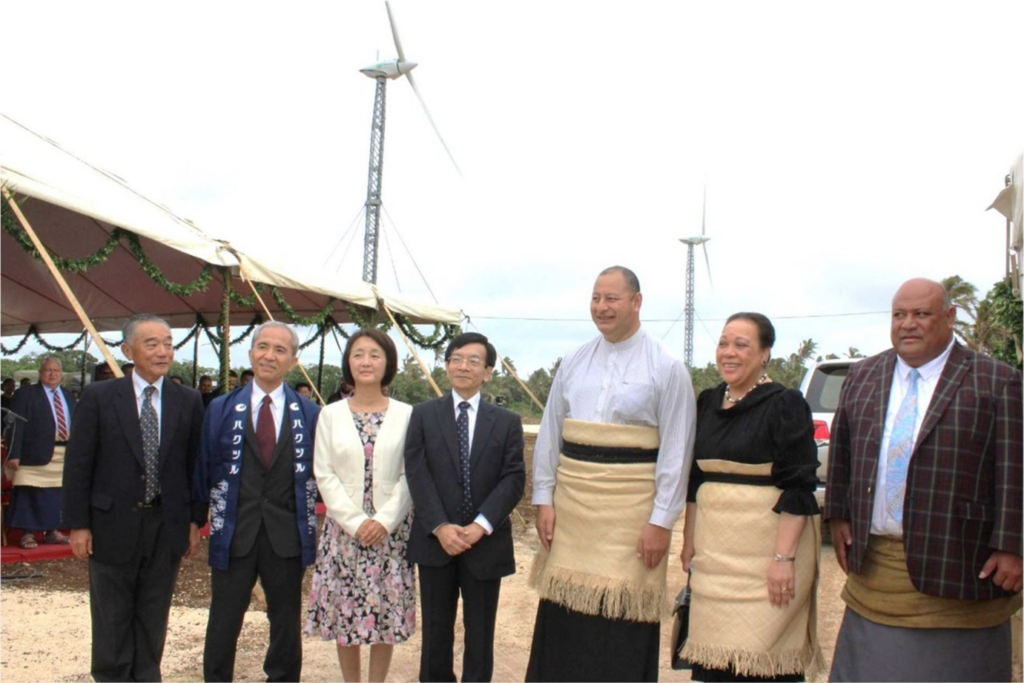
His Majesty King Tupou VI and Queen Nanasipauʻu attend the opening of the ‘Io ‘o Manumataongo Wind Farm at Niutoua in July 2019. The TOP $42 million Japanese-funded project was celebrated as a major step towards Tonga’s renewable energy future. Tonga Power’s latest annual report now reveals the wind farm recorded its worst performance since opening, with all turbines offline in May 2025 awaiting replacement parts.
Tonga’s renewable energy ambitions received a boost from a new wind farm this year, but Tonga Power’s latest annual report reveals that ageing equipment, maintenance challenges and integration issues are increasingly slowing progress towards the Kingdom’s long-term clean energy goals.
The FY2024/25 Annual Report shows renewable energy penetration increased from 18.9 per cent to 20.35 per cent during the year, largely due to the commissioning of the 2.2 megawatt China Wind Farm.
The China-aided project, officially commissioned in January 2025, consists of three 750-kilowatt wind turbines and supporting transmission infrastructure. According to the Chinese Embassy, the facility has already generated more than 2.8 million kilowatt-hours of electricity, contributing approximately 3.8 per cent of Tonga’s annual electricity supply and around one-quarter of its renewable energy output.
On the surface, that appears to be positive news.
However, a closer examination of the report reveals that while new renewable projects are being added to the system, some of Tonga’s existing renewable assets are struggling to perform at expected levels.
Perhaps the most striking example is the Niutoua Wind Farm.
Tonga Power states that the facility experienced its worst performance since commissioning, with all wind turbines offline during May 2025 while awaiting replacement parts. During that month, Niutoua contributed just 0.7 per cent of wind energy generation on Tongatapu.
The finding is particularly significant given the importance placed on the project when it was commissioned in 2019. Funded through a Japanese grant of approximately TOP $42 million, the Niutoua Wind Farm was hailed as a major milestone in Tonga’s renewable energy transition and was expected to help reduce diesel imports by an estimated TOP $1.5 million per year. At the time, the project was seen as an important step toward the Kingdom’s renewable energy ambitions. Six years later, the report’s disclosure that the facility recorded its worst performance since commissioning highlights a challenge often overlooked in renewable energy planning: building renewable assets is only the beginning. Maintaining them over decades can be equally demanding.
The disclosure highlights a challenge that receives far less public attention than the construction of new renewable projects.
Building renewable infrastructure is only the first step. Maintaining it over the long term is often the more difficult task.
The report identifies equipment degradation, maintenance delays, spare-parts shortages and staffing constraints as factors affecting the availability of existing renewable systems.
Those challenges are not unique to Tonga. Around the world, utilities are discovering that solar farms, wind turbines and battery systems require ongoing technical expertise, regular maintenance and reliable supply chains if they are to continue delivering the benefits promised when they were first installed.
The report suggests Tonga is increasingly confronting that reality.
Solar generation also faced difficulties during the year.
According to Tonga Power, persistent cloud cover and rainfall in February 2025 reduced renewable penetration to just 14.5 per cent, highlighting the vulnerability of solar production to weather conditions.
While such fluctuations are expected in renewable systems, they also demonstrate why battery storage and grid management technology are becoming increasingly important.

When sunlight and wind are plentiful, excess energy must be stored and distributed efficiently. When weather conditions deteriorate, the system must be able to rely on stored energy or backup generation to maintain supply.
This is where another challenge emerges.
The annual report references delays in implementing the Energy Management System, ongoing renewable integration issues and the need to further optimise Battery Energy Storage Systems (BESS).
Although Tonga has invested heavily in renewable generation and battery technology through donor-supported projects, the report suggests that integrating those systems into a reliable electricity network remains a work in progress.
Industry experts often describe battery storage as the key technology that enables high-renewable electricity systems.
Without effective storage and management systems, electricity generated by solar panels during the middle of the day cannot easily be shifted to meet evening demand, forcing utilities to continue relying heavily on diesel generation.
The report’s findings indicate that Tonga’s challenge is no longer simply generating renewable electricity. Increasingly, it is ensuring that renewable energy can be integrated, stored and dispatched reliably across the national grid.
This distinction becomes even more significant when measured against Tonga’s long-term renewable energy ambitions.
While renewable penetration has now reached 20.35 per cent, the figure remains well short of Tonga Power’s target of 30 per cent and far below the national goal of achieving approximately 70 per cent renewable energy by 2030 and 100 per cent by 2035.
Closing that gap will require far more than the construction of additional solar farms and wind turbines.
The report points to the need for stronger maintenance programs, improved technical capability, better spare-parts availability, enhanced battery utilisation and ongoing investment in the electricity network itself.
In many respects, the report marks a shift in Tonga’s renewable energy journey.
For more than a decade, the focus has been on building renewable projects and reducing dependence on imported diesel fuel.
Today, the challenge appears to be evolving.
The question is no longer whether Tonga can build renewable energy projects.
The question is whether it can maintain, integrate and operate them efficiently enough to support a reliable national electricity system.
The latest annual report suggests that achieving that goal may prove just as important as building the projects themselves.