
Tevita Motulalo
MSc Geopolitics and International Relations
2015 Next-Gen Pacific Security Scholar
SpaceX is reportedly preparing what could become the largest initial public offering in history. Current market reporting says the company may seek to raise around US$75 billion at a valuation of roughly US$1.75 trillion, with a planned debut on Nasdaq in mid-June. The offer is understood to represent only a small fraction of the company’s overall value, with retail investor participation also being discussed.
This is not merely a story about rockets. It is about the future compute economy.
Other countries and major institutional investors are already positioning themselves. Saudi Arabia’s Public Investment Fund has reportedly discussed a possible US$5 billion anchor investment. That should tell Pacific governments something important: this is not simply a speculative technology listing. It is being treated by serious state-backed investors as a strategic entry point into the infrastructure layer of the 21st century.
Pacific governments should study the opportunity carefully. They do not need to gamble public money or rush blindly into hype. But through national retirement funds, sovereign investment vehicles, reserve funds, development banks, or properly mandated public investment arms, they should explore lawful pathways to participate — whether through institutional IPO allocations where available, regulated brokers after listing, or global funds and indices that may eventually hold SpaceX shares. Even a modest strategic allocation would signal that the Pacific intends to own part of the future, not merely rent access to it.
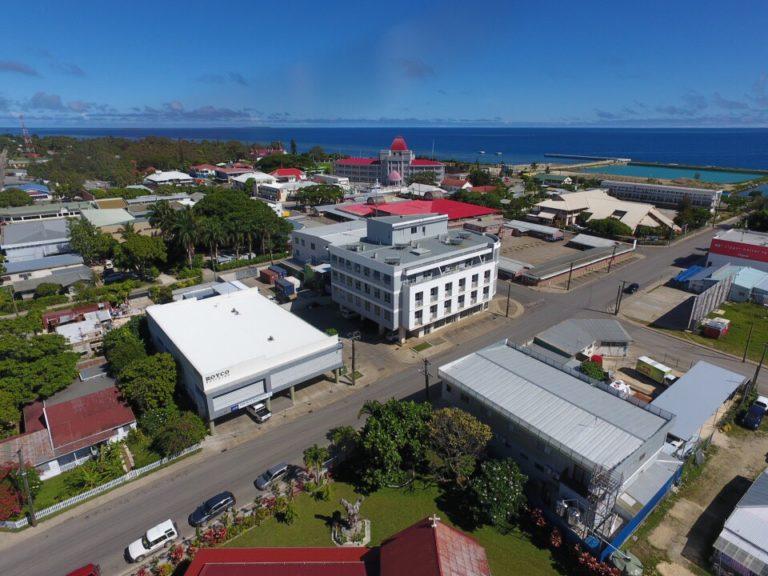
There is also a specific Pacific reason to pay attention. SpaceX is no longer some distant American company with no local relevance. Through Starlink’s licensed and registered operating presence, it is already part of Tonga’s communications landscape and increasingly part of the wider Pacific’s digital infrastructure. Starlink is already linking thousands of small islands, outer-island settlements, remote communities, vessels, resorts, churches, schools, businesses and families across a region scattered over the world’s largest ocean.
In Tonga, this connection was accelerated by disaster. The Hunga Tonga-Hunga Ha‘apai eruption and tsunami was a nuclear-scale volcanic catastrophe that shattered the country’s communications lifelines and exposed the vulnerability of relying too heavily on undersea cables alone. Yet one of the silver linings of that destruction was the rapid arrival and proving of satellite internet. SpaceX and Starlink helped reconnect parts of Tonga at a moment when communication itself had become a survival need. What began as emergency restoration has since become part of a larger Pacific lesson: for widely dispersed island communities, low-Earth-orbit satellites may sometimes be the closest major infrastructure above them.
That point should not be missed. In a region where the nearest capital, hospital, fibre cable landing station, patrol vessel, data centre or emergency response asset may be far away, a constellation of satellites only a few hundred kilometres overhead changes the geography of connection. It does not replace national infrastructure, local telecoms, public regulation or sovereign control. But it adds a new layer — overhead, distributed, resilient and increasingly central to communications, monitoring and security.
SpaceX today should therefore be understood as part of a wider technology stack: reusable launch, Starlink satellite communications, xAI-linked artificial intelligence, terrestrial and future space-based data centres, defence communications, orbital logistics and global connectivity. Together, these are becoming the infrastructure of 21st century power.
Elon Musk also operates Tesla, currently valued around the US$1.6 trillion range, which is itself part of the same strategic technology universe. Tesla’s electric vehicles, battery storage, solar systems, robotics and AI ambitions are highly relevant to the Pacific’s fight against climate change, especially for island economies seeking cleaner transport, renewable-energy storage and reduced dependence on imported fossil fuels.
For most of modern history, national strength was measured by land, ports, oil, minerals, factories, shipping routes and military bases. In the new century, compute joins that list. Compute means the ability to process vast amounts of data, train artificial intelligence, operate secure digital systems, connect machines and people, model climate threats, monitor oceans and support battlefield decisions. No serious country can afford to be without it.
For Tonga and the wider Pacific, this matters directly. We live across vast ocean space. Our communications cables are vulnerable. Our outer islands are difficult to connect. Our disaster response systems are often stretched. Satellite broadband, orbital data, AI and compute infrastructure are therefore not luxuries. They are national resilience tools.

Climate change makes this even more urgent. For Pacific peoples, climate change is not theory; it is rising seas, coastal erosion, stronger cyclones, saltwater intrusion, damaged reefs, food insecurity and the fear of displacement. Satellites can monitor coastlines, reefs, storm systems, ocean temperatures, crop stress and post-disaster damage. AI can process that information rapidly into warnings, maps and decisions. Future space-based data and compute centres may one day allow climate intelligence to be processed closer to where it is collected, improving real-time response across remote ocean regions.
The same stack is also relevant to actual warfare and national security. Modern conflict depends on communications, sensors, drones, satellite imagery, targeting data, cyber systems and artificial intelligence. SpaceX and Starlink have already shown that commercial satellite networks can become critical in war, crisis and battlefield communications. For Pacific states, this is not about becoming militarised. It is about understanding that sovereignty now requires eyes, ears and communications across vast ocean territories.
This is especially important in maritime monitoring. Our ocean is too large for patrol boats alone. Illegal fishing, trafficking, grey-zone activity and unmonitored vessels can exploit the gaps between island states. A space-and-compute architecture can help identify suspicious vessels, track dark shipping, support patrol planning and strengthen maritime domain awareness.
It is also vital in the fight against the drug tsunami moving from South America through Pacific routes toward Australia, New Zealand and beyond. Pacific communities are increasingly exposed to transnational criminal networks using ocean space, weak surveillance and small-island vulnerabilities. Satellites, AI, vessel-tracking data and secure communications will not solve the problem alone, but they can give Pacific governments better eyes, faster warning and stronger coordination.
Of course, no IPO is guaranteed. SpaceX may be expensive. Its governance may worry investors. Its ambitions may outrun its earnings. Families should not gamble school fees, remittances or household savings on hype. Governments should not buy blindly. But caution is not the same as paralysis.
The SpaceX IPO matters because it represents the fusion of space, AI, communications, defence, climate intelligence and compute into one strategic platform. For Tonga and the Pacific, it also represents something more immediate: a company whose satellites are already above us, whose services are already connecting our islands, and whose technology may become central to surviving and prospering in the century ahead.
Tongans and Pacific governments should study it seriously, prepare lawful pathways for participation, and where they responsibly can, buy into the future rather than merely pay rent to it.