Rethinking Tonga’s Sacred Sunday in a Changing Economy
His Majesty’s speech to the nation, grounded in moral reflection and constitutional duty, reaffirmed Tonga’s Christian values by referencing the Sabbath as a sacred day of rest. It is a principle deeply embedded in our culture and laws—Sunday is meant for worship, family, and reflection.
But here lies the dilemma: while we uphold this law firmly in many respects, some exceptions are already slipping through the cracks—especially in tourism. And that inconsistency is becoming harder to ignore.
A Law Observed in Spirit, But Selectively Enforced
To this day, retail shops remain closed on Sundays, and most of the country respects the quiet sanctity of the day. However, with the rise of tourism, some restaurants now open to cater to visitors, especially during cruise stopovers or weekend peaks.
In these settings, soft music is played quietly, alcohol is served, and Sunday slowly begins to resemble Saturday—just conducted with greater discretion.
This is not a full-scale erosion of Sunday law, but it is a quiet shift in practice, and one we pretend not to see. Meanwhile, air travel remains off-limits, even as tourism operators and regional partners express growing interest in Sunday flights.
So the question becomes: if discreet exceptions are already allowed, why draw the line so firmly at a single flight?
Tourism Will Force the Conversation
If we are serious about building a self-sustaining economy, tourism is essential. It is one of the few industries that can generate long-term jobs, foreign exchange, and national revenue. But tourism depends on accessibility—global accessibility, not just local convenience.
Most international destinations operate with daily flights and cruise arrivals. Tonga’s rigid Sunday restrictions make it harder for us to compete, especially for short-stay travellers from Australia, New Zealand, and nearby Pacific hubs.
But rather than frame this as a conflict between faith and tourism, we should consider creative alternatives that preserve both.
Turning Sunday into a Signature Experience
Rather than shy away from Sunday tourism, Tonga could redefine it. Why not allow cruise ships to dock on Sundays, and instead of the usual tourist excursions, invite visitors to experience a Tongan Sunday?
Let them attend our church services, hear the choirs, join a family-style feast, and witness the spiritual rhythm of our lives. No shopping. No beach parties. Just culture, reverence, and community.
This could become one of Tonga’s most unique tourism offerings—a sacred, signature experience that no other destination in the region provides. It’s not a compromise of values. It’s a bold presentation of who we are, on our terms.

We Can’t Have the Cake and Eat It Too
Let’s be realistic: opening one regulated flight on Sunday will not dismantle our identity or weaken our faith. It can be managed with care—limited in number, respectful of local customs, and subject to community oversight.
The current approach is unsustainable. We’re enforcing the law unevenly, and that undermines both the law and the spirit behind it. We must decide whether to uphold the Sabbath law fully, or to evolve it responsibly and transparently.
The Path Forward: Honest Dialogue, Not Silent Drift
Tonga must stop pretending this is a non-issue. The pressure is coming—not just from abroad, but from within. If we truly want to be self-reliant and globally connected, we need to reconcile our religious convictions with practical economic strategy.
Let us not wait until the decision is forced upon us. Let us shape it ourselves—with national dialogue, cultural integrity, and policy foresight.
The Elephant Is Already Here
The King’s speech calls us to reflection and moral clarity. But clarity also requires courage. If we are to uphold the principles of our faith, we must do so without contradiction or quiet exceptions.
Whether through a single Sunday flight or a uniquely Tongan tourism model centred around church and community, the question is no longer if change will come—it is how we will manage it, and whether we do so with vision, unity, and dignity.
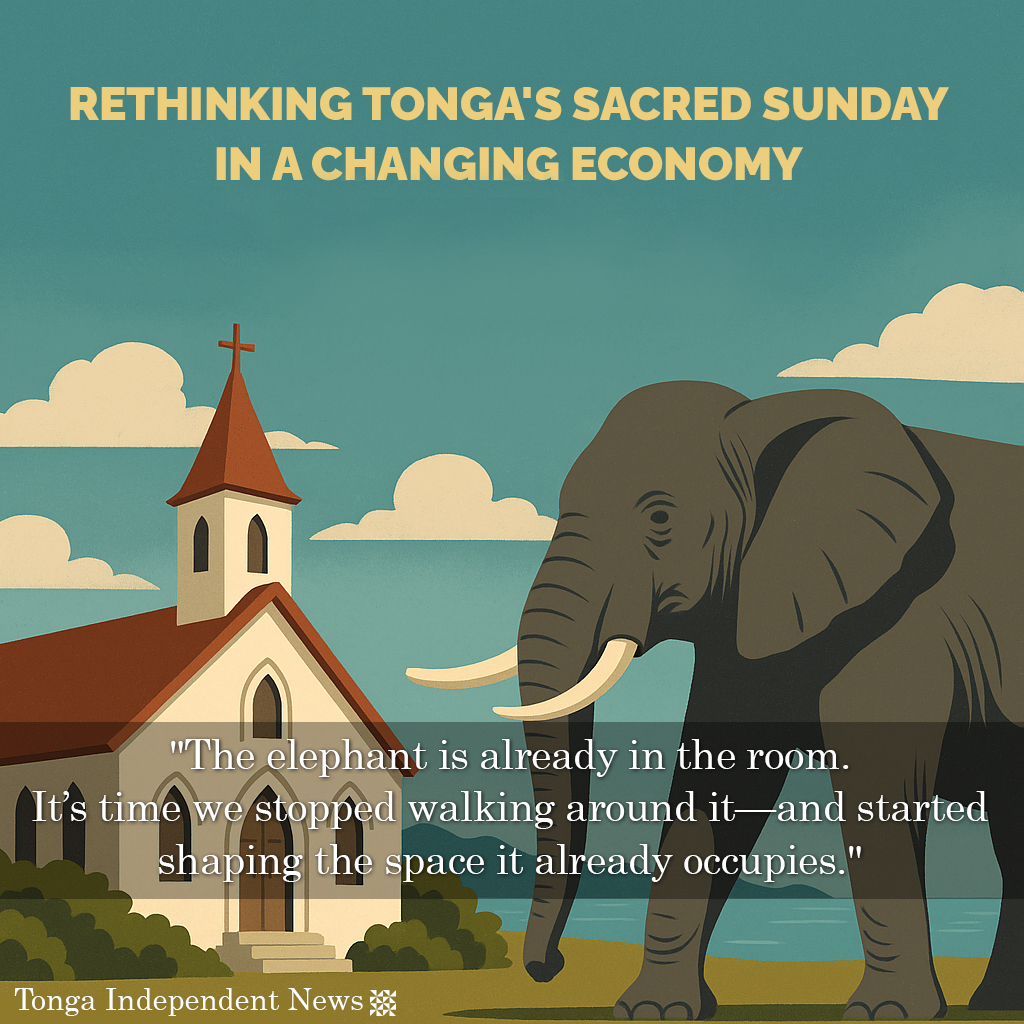
The elephant is already in the room. It’s time we stopped walking around it—and started shaping the space it already occupies.
Editor’s note: Editorials reflect the official opinion of Tonga Independent Online News. They are written by senior editorial staff and informed by ongoing reporting and public interest.
Tu’ifua Vailena