Public Trust on the Tarmac — When Ministers Double Down, Who Pays the Price?
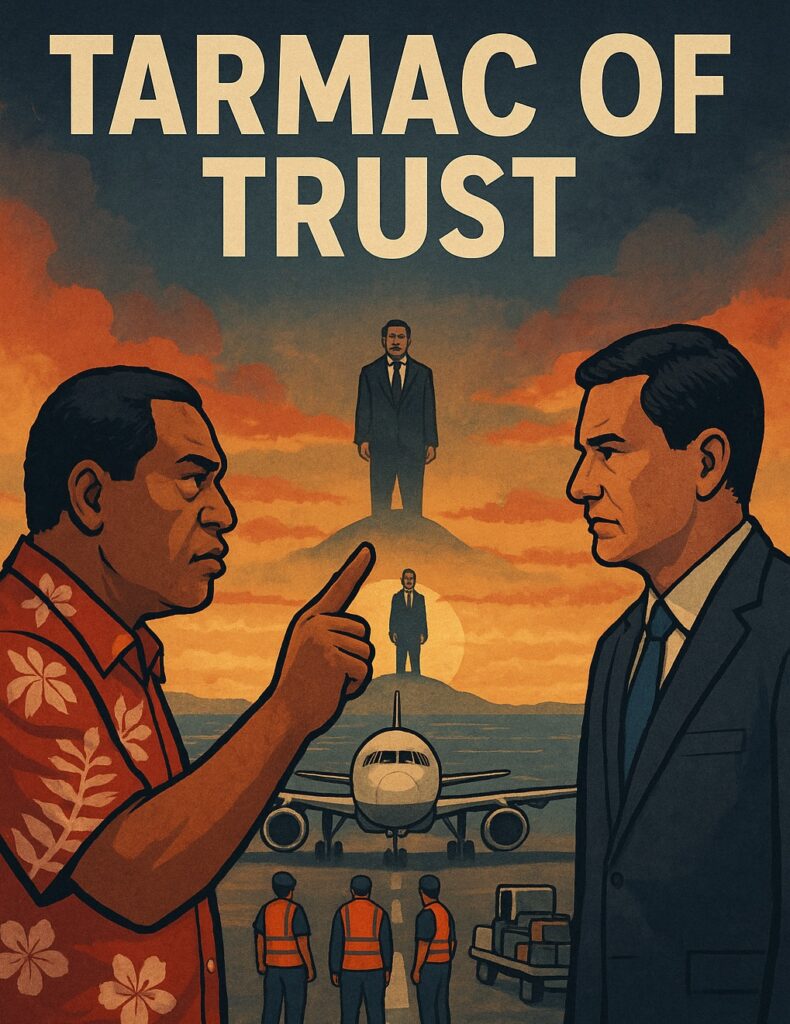
By Melino Maka, Tonga Independent News, Political and Economic Commentator (NZ & Tonga)
In Tonga, it is often said that our smallness demands wisdom in leadership. Yet recent events involving Hon. Piveni Piukala, Minister of Police and Public Enterprises, have raised alarming questions about whether political power is being wielded with wisdom—or recklessness.
At the centre of the controversy is Air Terminal Services (Tonga) Limited (ATS), a privately-owned Tongan company with over 20 years of proven service in ground handling. It is, to this day, the only certified provider of ground handling services for both domestic and international flights at Fua‘amotu International Airport. And yet, ATS has found itself under public assault by the Minister—twice.
The Minister’s Dangerous Game
On two separate occasions—2 March and 13 April 2025—the Minister for Police denied permission for urgent Sunday mercy flights by the New Zealand Air Ambulance Service (NZAAS). In both cases, ATS simply passed along the requests as an appointed agent, fulfilling its role under international aviation protocols.
Rather than accepting this as fact—even after being directly briefed in meetings—the Minister doubled down. He not only refused to correct his public misrepresentations but intensified his attacks on ATS. He implied financial motives for a refueling stop and launched public tirades based on assumptions rather than facts. Such behavior is unbecoming of any minister. It betrays a dangerous tendency: a refusal to listen, an allergy to accountability, and a preference for public spectacle over policy substance.
If these were isolated incidents, perhaps they could be written off as political inexperience. But they are not. They reveal a consistent pattern of undermining private sector credibility without evidence—something that should concern every investor, entrepreneur, and citizen in Tonga.
Ground Handling Is Not a Game
Let us be clear: ATS is not just any company. It holds all international certifications and has exclusive contracts with every airline that lands in Tonga. It owns and maintains the critical equipment, employs trained professionals, and operates in compliance with international civil aviation standards.
Its removal, or worse, replacement by an unqualified or politically favoured entity under the guise of “renationalisation,” would not only compromise aviation safety—it would send a chilling message to the international community: Tonga is not safe for business.
We are already seeing the consequences. False reports began circulating that Air New Zealand would cancel its services to Tonga starting 1 July 2025, allegedly in protest against the government’s moves to take over baggage handling services. While Air New Zealand has now formally denied this, the fact remains: the Minister’s statements and policy moves have created unnecessary confusion and panic.
The People Will Pay
This has real consequences.
Families planning holidays, funerals, weddings, or medical treatment are now uncertain. Travel agents, hoteliers, and small business operators who rely on a steady stream of visitors are worried. If travellers lose confidence in Tonga’s airport operations, they will vote with their wallets and choose other Pacific destinations—Fiji, Samoa, or even New Caledonia.
While the Minister tries to “assert control” in the name of national security, what he has failed to do is provide reassurance, clear policy direction, or even an acknowledgment of the importance of communication in a tourism-dependent economy. His silence on the Air NZ matter allowed speculation to grow—and that alone is a dereliction of ministerial duty.
Where Is the Prime Minister?
This is no longer a personal spat between a minister and a company. It is a matter of national security, economic stability, and international reputation.
Prime Minister Dr. ‘Aisake Eke must now intervene. Silence is no longer neutral—it becomes complicity. The country needs clarity, not confusion. The PM must:
- Affirm the role of ATS until and unless an equally certified and experienced entity is ready to replace them safely and legally.
- Direct all ministers to cease public commentary that could destabilize Tonga’s aviation sector.
Launch a formal, independent review of ground handling operations and any proposed “renationalisation” to ensure it is done transparently, legally, and with the public interest in mind.

Lessons in Leadership: Public Service, Not Personal Ego
Leadership is not about who can shout the loudest or make the boldest accusations. It is about listening to facts, admitting when one is wrong, and acting in the interest of the people.
The Minister claims that “national security” is paramount. If so, he should start acting like it. That means ensuring mercy flights land without delay, that certified handlers are in place at airports, and that our aviation partners are treated with respect, not suspicion.
And when a company like ATS—who has served Tonga for two decades—is falsely accused, the responsible thing to do is apologise and move forward. Doubling down only erodes public trust further.
Case Studies: Lessons from the Region
Other Pacific nations offer valuable lessons:
Fiji Airways and Nasinu Ground Services (2015):
A rushed government takeover of baggage handling services resulted in airline disruptions and diplomatic embarrassment. The government eventually reinstated the private handler under tighter regulation.
Samoa Airport Authority Reforms (2021):
Samoa retained its legacy provider while phasing in new infrastructure contracts with international partners, prioritising continuity and safety.
New Zealand’s Aviation Model:
Ground operations are certified, regulated, and protected from ministerial interference. Ministers defer to experts, not ego.
Tonga cannot afford to politicise aviation safety. We are not just protecting businesses—we are protecting lives, livelihoods, and national credibility.
Final Word: Public Trust Must Be Earned
This is not about defending ATS. It is about defending Tonga’s international credibility, public safety, and investment climate.
If the Minister of Police believes he is doing a good job, he is entitled to that belief. But the people of Tonga—and the world—will judge his performance not by his public pronouncements but by the consequences they bring.
And right now, those consequences are potentially devastating.
Let us hope Prime Minister Eke acts—before public confidence in Tonga’s aviation sector crashes harder than a failed political gambit.