Potential Disaster Waiting To Happen: New Taufaahau Wharf Erosion Threatens Operability and Waterfront Collapse
By Tevita Motulalo
MSc Geopolitics and International Relations
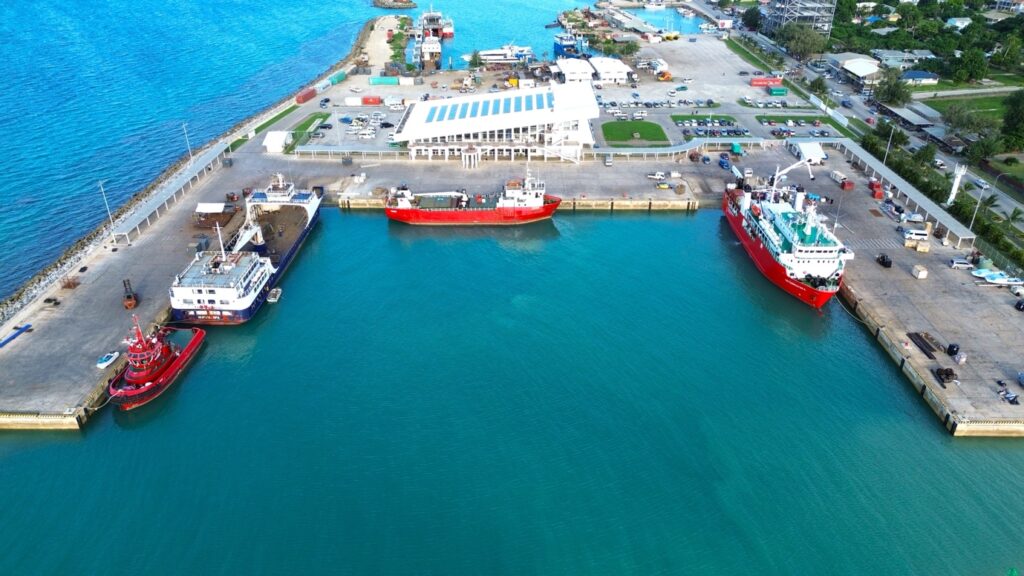
The new Taufa’ahau Domestic Terminal/Port, a critical piece of infrastructure connecting Tongatapu to its sister islands, stands as a testament to engineering ambition—and a shocking monument to environmental oversight. Tonga Independent surveillance and analysis has revealed a potential for instability and inoperability of the wharf basin, erosion the adjacent sediment walls, collapse of the nearby foreshore wavebreaks, and the reef structures along the waterfront.
In constructing the deep-water wharf, the Ports Authority and government relied on two drastic steps: breaching the natural fringing reef and aggressively dredging the inner sedimentary lagoon. While the immediate wharf apron is finished in concrete, a fatal flaw was engineered into the project: the immense bank of dredged, loose sediment adjacent to the wharf channel mouth and side banks, has been left unreinforced and exposed.
This is not a minor oversight; it is an infrastructural and environmental catastrophe waiting to happen, threatening to choke the port and destabilise the very coastline, and the entire reef ecosystem it serves.
The Fatal Flaw: Ignoring Coastal Geomorphology
The Tongatapu reef system is a delicate, self-sustaining barrier. The dredging operation disrupted the natural angle of repose—the steepest angle at which unconsolidated material remains stable—of the lagoon floor. The material pulled from the lagoon bottom to create the deep channel is unconsolidated silt, sand, and fine coral rubble. This material is inherently prone to erosion.
Because the sedimentary face is unprotected, it is highly vulnerable to the constant, relentless forces of the marine environment:
Tides and Currents: Daily tidal shifts and strong longshore currents continuously undercut the base of the slope.
Wind and Waves: Even minor wave action and wake from domestic vessels relentlessly wash away the fine particles, exacerbating the problem.
Cyclonic Events: During the next major tropical cyclone or storm surge, the hydraulic energy will mobilise massive quantities of sediment, likely causing the entire unsupported face to slump and collapse into the deep, newly dredged basin.
Without a stabilising structure—such as a riprap, gabion baskets, or a concrete bulkhead—this loose sediment will inevitably seek its natural, shallower resting depth, effectively refilling the man-made channel.
The Infrastructural and Economic Collapse
The predicted collapse and infilling of the port basin represents an unacceptable risk to the nation’s domestic shipping and economy. The consequences are direct and severe:
Firstly, the deep channel, designed to accommodate inter-island ferries and supply vessels, will suffer rapid siltation. The accumulated sediment will quickly reduce the operational depth, making the port inaccessible or severely restricting vessel size and cargo capacity. This will halt or severely cripple domestic transport, isolating island communities that rely on Nuku’alofa for goods, fuel, and medical supplies. Several close calls of this have been reported through sources.
Secondly, correcting the failure will be exponentially more expensive than preventing it. The government and Ports Authority will be forced to engage in costly and recurring maintenance dredging. This high operational cost—paid for by the taxpayer—will continue indefinitely until a permanent coastal defence structure is erected. This short-sighted initial saving guarantees a crippling long-term fiscal burden.

Environmental Catastrophe and Coastal Degradation
The disaster is equally devastating from an environmental perspective, impacting the very resources Tongans depend on. The dredging has already compromised the natural reef, but the subsequent erosion accelerates the damage:
The continual collapse of the sedimentary slope generates massive sediment plumes. These plumes do not stay localised; currents carry the fine silt across the inner lagoon, smothering the few remaining healthy patches of coral and seagrass. These habitats are critical nurseries for fish and shellfish, meaning the collapse of the artificial bank translates directly into fisheries decline and reduced food security.
Furthermore, the failure to reinforce the sediment leaves the adjacent coastline vulnerable to flanking erosion, destabilising nearby public and private land. The initial failure to protect the dredged area essentially guarantees a domino effect, undermining the natural coastal resilience that the fringing reef once provided.
Urgent Call for Remediation
The construction of the Taufa’ahau Domestic Terminal was a major national investment. To allow this facility to fail due to a lack of simple coastal protection measures is irresponsible stewardship. The initial cost of installing a revetment, rock armour, or retaining wall would have been minor compared to the projected cost of continuous dredging and the catastrophic economic loss of a non-functional port.
We urge the Ports Authority, the government, and international partners to immediately halt all other works and prioritise the stabilisation of the exposed sedimentary bank. Failure to act swiftly, especially before the next cyclone season arrives, ensures that this structural oversight will evolve into a costly national disaster, transforming the Taufa’ahau Domestic Terminal from an asset into an enduring liability.
Project Details: Taufaʻāhau Domestic Wharf
The construction of the domestic wharf was part of the Project for Upgrade of Wharf for Domestic Transport in the Kingdom of Tonga.
- Contractors and Consultants
The project was executed through a Grant Aid assistance from the Japanese Government, which typically involves Japanese firms for design and construction management.
- Primary Funding Source:Government of Japan (Japanese Grant Aid). The project cost was approximately ¥3,320 million (around T$66 million Pa‘anga/USD$30 million at the time).
- Consultant / Engineering Firm:Oriental Consultants Global (part of Oriental Consultants Holdings Co., Ltd.) undertook the feasibility study, engineering design, bid support, and construction supervision.
- Contractor:Toa Corporation (a Japanese marine civil engineering firm) was the main construction contractor for the wharf and associated facilities.
- Implementing Agency (Tonga):The Ministry of Infrastructure (MOI) and Ports Authority Tonga (PAT) in coordination with the Japanese government and consultants.
The project reached completion and was officially commissioned in June 2018.