How China’s Governance Model is Inspiring Young Tongans
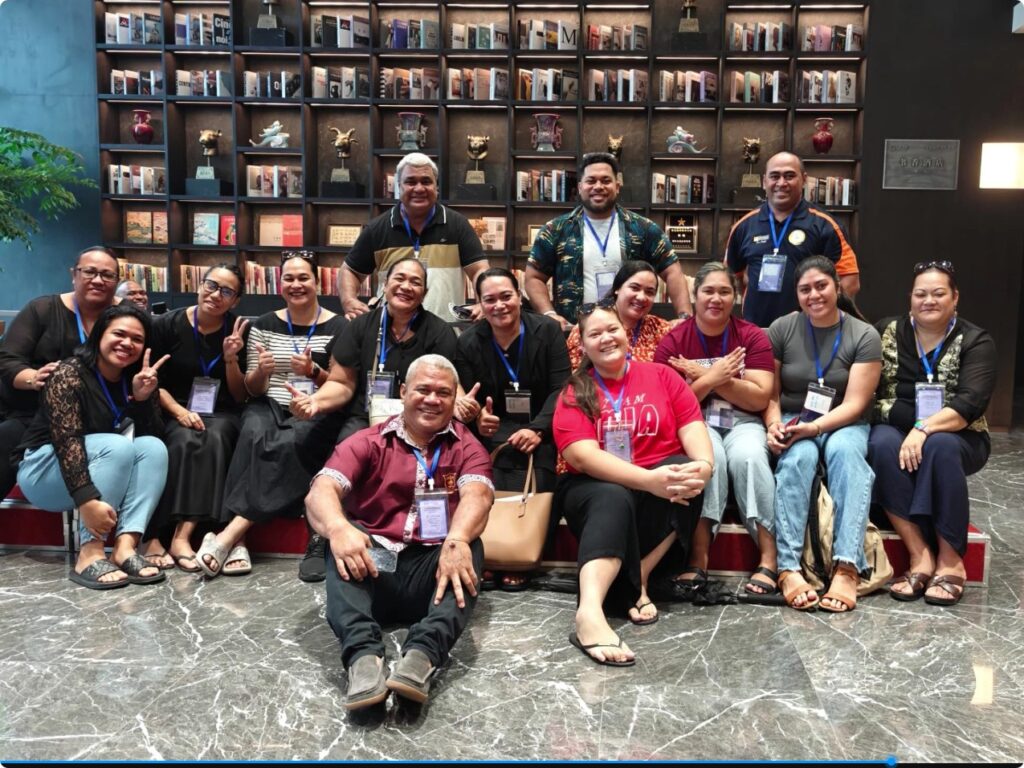
How does a nation lift 800 million people out of poverty in just a few decades? That question framed the reflections of 15 Tongan public servants who travelled to Beijing for the Seminar on Governance for Pacific Island Countries, hosted by China’s National Development and Reform Commission (NDRC) from 28 May to 6 June, 2025.
The delegation came from the Prime Minister’s Office, the Public Service Commission, the Ministry of Trade and Economic Development, the Ministry of Lands and Natural Resources, and the Ministry of Internal Affairs. They were seeking practical lessons, and China’s model of state-led development provided much to consider. According to Mesuilame Vea, Chief Economist in the Prime Minister’s Office, China’s defining strength is its ability to mobilise resources towards national priorities and sustain them over decades. “China has institutional advantages that enable it to concentrate resources on major undertakings and implement long-term strategic planning. The country has achieved the goal of eradicating extreme poverty as part of its strategic development.”
For Tonga, where political cycles often disrupt continuity and projects are vulnerable to shifting priorities, this capacity for long-term vision is worth studying. The challenge is reconciling such centralised planning with Tonga’s democratic structures and limited fiscal base. China’s poverty eradication story is not only about financial investment but about systems: precise targeting, strong leadership, measurable exit strategies, and rigorous monitoring. Tonga’s social safety nets could adopt this discipline, ensuring that vulnerable communities are not left dependent but instead guided towards resilience.
Equally striking is China’s approach to social innovation. With nearly 900,000 registered NGOs, millions of employees, and hundreds of millions of volunteers, collective action has become a cornerstone of development. Tonga’s civil society is smaller, but it is deeply rooted in churches, villages, and community organisations. The lesson here is that government does not need to carry the entire burden. Partnerships with grassroots groups could become the backbone of national development, blending state policy with local initiative.

Environmental management provided another point of reflection. China enforces strict limits on resource use, applies rigorous environmental access criteria, and maintains baseline quality standards. These practices challenge small island nations to think more ambitiously about ecological protection. Tonga, whose economy depends heavily on natural resources, faces the question of whether it can apply similarly uncompromising safeguards. Even small-scale initiatives inspired by China’s urban experiments, such as alternative transport solutions in Nuku‘alofa, could help reduce reliance on imported fuel and improve public health.
The seminar also highlighted China’s ability to modernise while protecting its cultural identity. For Tonga, this reinforced the need to ensure that economic growth strengthens rather than weakens language, faith, and tradition. At the same time, China’s Belt and Road Initiative illustrated how openness to global markets and infrastructure partnerships can accelerate development. Tonga, geographically isolated and economically constrained, cannot afford to turn inward. Strategic openness may provide the external resources needed to sustain national growth.
Underlying all of these lessons was a broader point: sustainable governance requires balance. China has demonstrated that stability and growth do not come from unrestrained markets or unchecked state control, but from coordination between the two. Infrastructure, policy discipline, and people-to-people connections provide the foundation for resilience.
For Tonga, the Beijing seminar was not an exercise in copying another system but in holding a mirror to our own institutions. Can we build governance structures that think beyond election cycles? Can poverty reduction become systematic rather than episodic? Can government unlock the power of civil society? And can we modernise without losing the culture that defines us?
These are not abstract questions. They are the real test of governance in Tonga. Our public servants returned with more than briefing notes and photographs. They returned with a challenge to translate international lessons into homegrown solutions. China’s governance model cannot simply be transplanted into the Pacific. But it does remind us that clarity of vision and consistency of action are the engines of transformative change. If Tonga can adapt that spirit to our own context, even the smallest nation can chart a course to lasting progress.