China’s Global Governance Initiative Highlighted at SCO Tianjin Summit
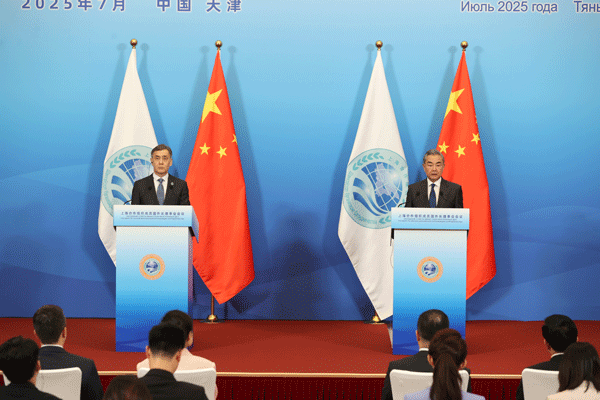
At the close of the Shanghai Cooperation Organization (SCO) Tianjin Summit on 1 September 2025, Chinese Foreign Minister Wang Yi described President Xi Jinping’s newly proposed Global Governance Initiative (GGI) as a timely response to the world’s most pressing challenges.
Speaking alongside SCO Secretary-General Nurlan Yermekbayev at the summit’s media centre, Wang said the initiative comes during what he called a “big year” for global governance — the 80th anniversary of both the victory in the Second World War and the founding of the United Nations. Against this backdrop, Xi’s proposal was presented as China’s contribution to shaping a system more suited to modern realities.
Wang emphasised that the GGI has already drawn positive responses from leaders of other countries and international organisations. He argued that its principles — sovereign equality, adherence to international law, multilateralism, a people-centred approach, and practical action — provide a roadmap for reforming international governance structures.
“All countries, regardless of size, strength or wealth, have the equal right to participate in international affairs,” Wang said, noting that monopolisation of global governance by a few states “should no longer continue.” He added that international law must be upheld universally, while multilateralism should replace unilateralism and “bullying.”

The initiative, according to Wang, is intended to reinforce the United Nations’ central role and encourage countries to engage within multilateral frameworks. By aligning with the UN Charter, he said, the GGI seeks to ensure that the system of global governance evolves in step with the times.
Wang also framed the GGI as part of a broader pattern in China’s international diplomacy. He linked it to earlier initiatives announced by Xi — the Belt and Road Initiative, the Global Development Initiative, the Global Security Initiative, and the Global Civilization Initiative — describing them as mutually reinforcing and as contributions of “global public goods.”
Together, these efforts, Wang argued, aim to foster “an open, inclusive, clean and beautiful world of lasting peace, universal security and shared prosperity.” He said China would continue to work with the United Nations and other parties to implement the GGI and to push for a “more just and equitable” international order.
“Facing a world of changes and chaos, China will continue to stand on the right side of history, on the side of human progress, and on the side of multilateralism,” Wang said.