
Australia’s climate diplomacy in the Pacific enters a critical phase
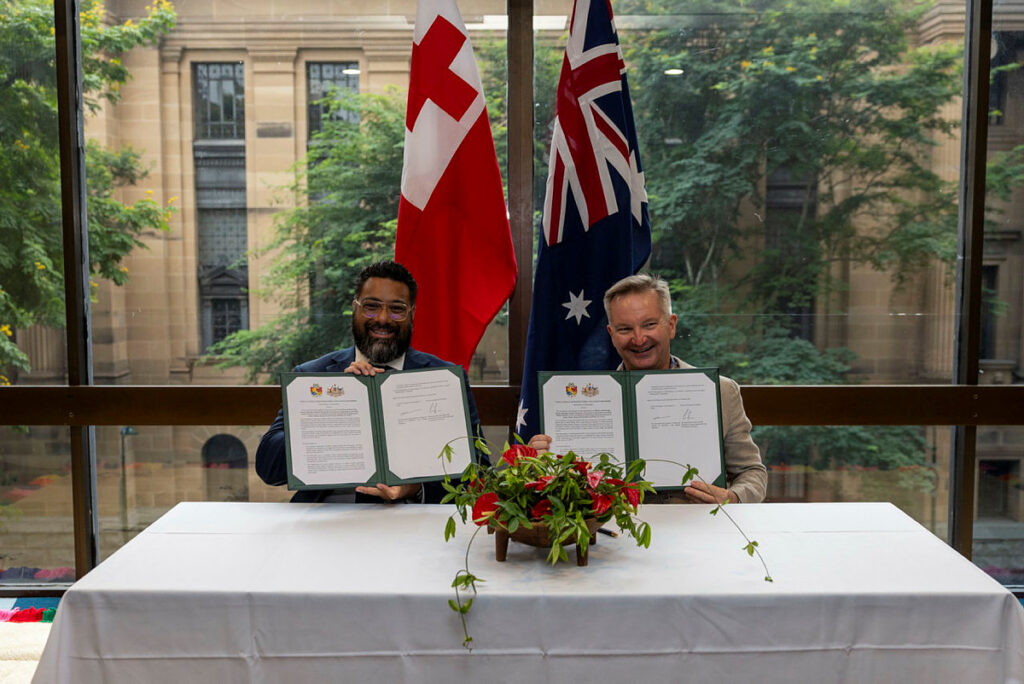
Australia’s latest round of climate and energy diplomacy in the Pacific underscores a clear strategic intent to position Canberra as a reliable, long-term partner on climate action, while anchoring its influence in a region increasingly shaped by climate vulnerability and geopolitical competition.
At the centre of this effort is the signing of a Renewable Energy and Climate Partnership Memorandum of Understanding with Tonga, reinforcing support for Tonga’s ambition to reach 100 per cent renewable electricity by 2035. The agreement was formalised during a Pacific Islands Forum (PIF) Troika meeting in Brisbane involving Australian Foreign Minister Penny Wong, Climate Change and Energy Minister Chris Bowen, and regional leaders including Tongan Prime Minister Lord Fakafanua, Solomon Islands Prime Minister Jeremiah Manele, and Palau President Surangel Whipps Jr.
Alongside the MoU, Australia announced an additional $550 million injection into the Australian Infrastructure Financing Facility for the Pacific (AIFFP), strengthening its role as the Pacific’s largest external infrastructure financier. The funding targets renewable energy, digital infrastructure, ports, airports and undersea cables, sectors that carry both development and strategic value.
Climate leadership or climate optics?
While the announcements were welcomed by Pacific governments, they also revived a familiar criticism that Australia’s regional climate leadership sits uneasily alongside its continued expansion of fossil fuel production and exports.
Critics argue that Australia’s credibility in the Pacific is undermined when strong diplomatic messaging on climate action coincides with new or expanded fossil fuel projects at home. For low-lying island states facing existential climate risks, the concern is not rhetorical consistency, but whether major partners are genuinely aligned with limiting global warming to survivable levels.
This tension has become increasingly central to Australia’s Pacific relationships, where climate change is viewed not as a policy sector but as a core security threat.
Australia defends a transition rather than denial
In response to these concerns, staff from the Australian High Commission defended Canberra’s climate record, framing Australia’s approach as a managed transition rather than abrupt disengagement from fossil fuels.
They pointed to several key indicators:
- Australia’s emissions fell 13 per cent between 2005 and 2018, outpacing average reductions across G7, G20 and OECD countries.
- Between 2017 and 2020, Australia invested nearly $30 billion in renewable energy.
- In 2019, renewable energy deployment occurred at ten times the global per-capita rate, and four times faster than in Europe, China, Japan or the United States.
- Australia now has the highest household solar uptake globally, with one in four homes fitted with solar panels.
- Renewables are projected to supply 47 per cent of national electricity by 2025, rising to 55 per cent by 2030.
The High Commission also linked climate action directly to lived experience, pointing to ongoing bushfires as evidence that climate impacts are already reshaping Australia itself.

What this means for Tonga
For Tonga, the credibility of this partnership will ultimately be tested not at signing ceremonies, but in how quickly renewable projects translate into lower household power costs, reduced diesel dependence, and greater energy resilience across the outer islands.
If delivered effectively, the MoU offers more than climate symbolism. It provides a pathway toward energy sovereignty in a country where imported fuel remains both a financial and strategic vulnerability.
The strategic calculation
Australia’s expanding climate and infrastructure footprint in the Pacific reflects a broader strategic calculation. Climate action has become inseparable from diplomacy, development and regional influence.
The challenge for Canberra is ensuring that its Pacific climate narrative is reinforced, not weakened, by its actions at home. For Pacific countries, the test is equally clear. Partnerships are welcome, but credibility will increasingly be measured not by pledges alone, but by alignment between words, investments and emissions trajectories.