Analysis: The Tonga Travel Ban: A Pointless Fracture in U.S. Pacific Strategy
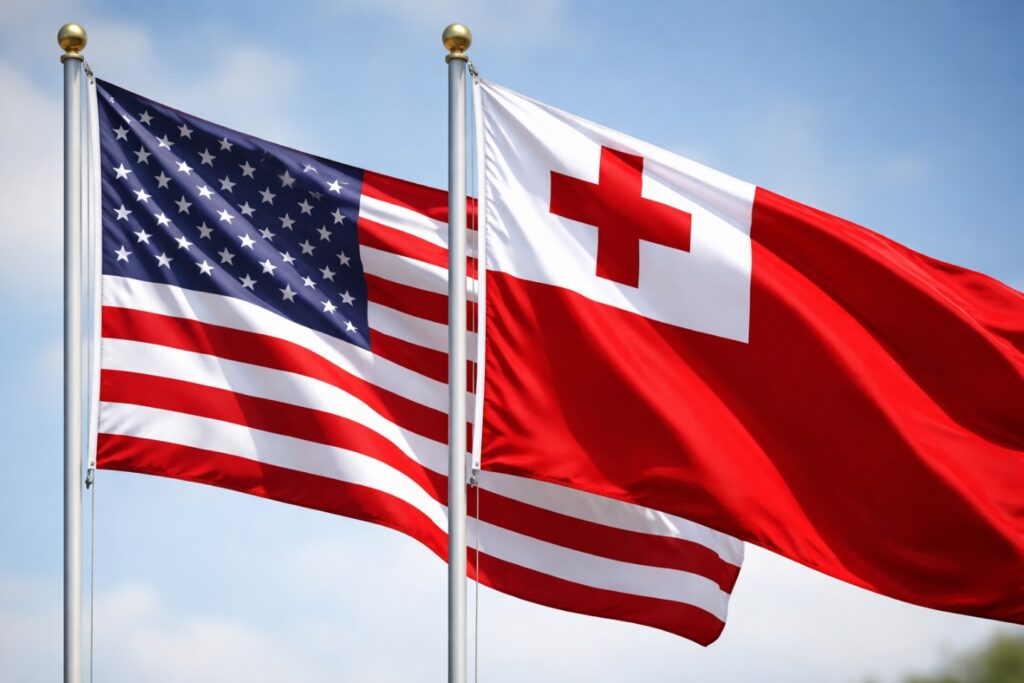
Tucked within the broader architecture of U.S. travel restrictions, a new and perplexing entry has emerged: the Kingdom of Tonga. Effective January 1, 2026, the United States is set to impose severe limitations on student and short-term visas for the roughly 100,000 citizens of this small Pacific island nation. On its face, categorising Tonga—a country in which an estimated 65 per cent of the population belongs to The Church of Jesus Christ of Latter-day Saints—as a national security concern is a proposition that demands scrutiny. If the threat framework now extends to religious exchange, educational mobility, and extended family ties, then the framework itself warrants re-examination.
The implications extend well beyond visa processing. The policy strikes at the core of Tonga’s social and economic resilience, tests the coherence of U.S. values-based diplomacy, and exposes the risks of governing by blunt geopolitical reflex. In a region where American influence is already contested, it represents a strategic unforced error.
Immediate Fallout: Severing Lifelines
The consequences are neither abstract nor remote. Two pillars of Tonga’s transnational life—education and family connectivity—are directly affected.
Institutions such as Brigham Young University–Hawaii have long been embedded in the Pacific Islander educational ecosystem. For decades, this pathway has produced graduates who either return home as educators, administrators, and professionals, or contribute to diasporic communities across the United States. Restricting access to this channel does not enhance U.S. security; it weakens a proven instrument of soft power and long-term regional partnership.
Equally damaging are restrictions on short-term travel. For Tongan communities in Utah, California, and Hawai‘i, mobility for weddings, funerals, church events, and cultural obligations is not discretionary—it is foundational. Curtailing these movements institutionalises family separation and sends a stark message that kinship, faith, and community continuity are subordinate to an undifferentiated exclusionary policy.
Geostrategic Myopia and the Pacific
The timing of the ban sits uneasily alongside Washington’s stated commitment to renewed engagement in the Pacific Islands. At a moment when the United States is seeking to counter China’s growing regional presence, constraining educational and cultural exchange with a long-standing partner undercuts the very relationships that sustain influence over time.
America’s comparative advantage in the Pacific has never rested on coercion, but on access—to universities, labour mobility, and partnership. A policy that labels a friendly state a security risk erodes trust and creates openings for alternative powers willing to offer educational pathways without stigma.
Diplomatically, inclusion on a travel restriction list is not a technical slight; it is a symbolic one. It risks signalling that Pacific partners are viewed not as sovereign equals but as peripheral variables in domestic political signalling.
A Cynical Rationale?
One possible, if unspoken, rationale merits examination: concern that Chinese nationals may acquire Tongan passports and exploit visa access. Tonga, like several Pacific nations, has previously experimented with economic citizenship schemes. If this is the underlying anxiety in Washington, the policy response is both disproportionate and ineffective.
A blanket restriction punishes an entire population for a regulatory issue better addressed through targeted vetting, information-sharing, and bilateral cooperation. More paradoxically, it accelerates the very outcome it may seek to avoid. By narrowing U.S. educational and cultural access, the policy incentivises deeper engagement with alternative partners ready to fill the gap.

Political and Moral Contradictions
Domestically, the policy also exposes uncomfortable contradictions. Political actors who draw heavily on LDS constituencies have been notably restrained in their response, despite the disproportionate impact on one of the most LDS-affiliated nations globally. For lawmakers who routinely invoke family unity and religious liberty, this silence is striking.
Latter-day Saint theology places strong emphasis on gathering, mutual obligation, and global fellowship. A policy that systematically restricts engagement with a co-religious community abroad sits uneasily alongside those principles. In this context, inaction functions less as neutrality than as acquiescence.
Governance by Blunt Instrument
Ultimately, the Tonga restriction exemplifies the hazards of policy driven by optics rather than calibrated risk. If the objective is security, resources are misdirected. If the objective is strategic competition, the effect is counterproductive. If the objective is resolve, the signal is misaligned with the target.
The result is a policy that imposes tangible human costs while delivering little strategic gain.
A Call for Coherence
A course correction is still possible. Lawmakers with strong Pacific and faith-based constituencies—particularly in Utah—have both standing and responsibility to seek transparency, exemptions for students and family travel, and a more proportionate approach.
More broadly, U.S. immigration and security policy should return to first principles: individualised assessment, allied cooperation, and respect for long-term partners. Where concerns exist about document integrity or third-country exploitation, the remedy lies in engagement, not exclusion.
The Tonga travel ban is more than an administrative measure. It is a symbolic rupture that diminishes U.S. credibility in a region where credibility matters. Reversing or refining it would signal that American power remains capable of discernment—and that strength is better expressed through partnership than through indiscriminate closure.
By Melino Maka