Amazon’s Knockout Blow: How Jeff Bezos Delivered an Uppercut Trump Never Saw Coming
By Melino Maka – Political and Economic Commentator
Tonga Independent News
When Donald Trump launched his self-styled “Patriotic Trade Revolution” in 2025, he envisioned a revival of American industry through brute economic force. Tariffs would punish foreign competitors, protect U.S. jobs, and reaffirm American dominance. But what Trump and his economic team failed to consider was that in the age of global e-commerce, the battlefield isn’t factories—it’s algorithms, logistics, and digital command centres.
And no company understands that battlefield better than Amazon.
In a move that stunned Washington and reshaped global commerce, Amazon delivered a knockout blow to Trump’s trade agenda by announcing the relocation of its entire global headquarters out of the United States. Not just a token office or a satellite campus—but its full executive core, logistics, finance, and innovation operations. The message was unmistakable: if the U.S. was going to sabotage global trade in the name of nationalism, Amazon would become post-national.
This wasn’t just a business decision. It was a corporate declaration of independence.
The Tariffs That Triggered a Tectonic Shift
The beginning of the end came in January 2025, when Trump’s administration imposed sweeping tariffs on imports from China, Europe, Canada, and beyond. A key change was the elimination of the de minimis rule—an obscure but vital policy that allowed low-value items to enter the U.S. duty-free. For Amazon, which thrived on a vast global network of third-party sellers offering cheap, fast-moving products, this was a fatal blow.
Overnight, thousands of items became uncompetitive. Profit margins vanished. Logistics models collapsed. Amazon was essentially being punished for operating the very ecosystem that had helped democratize global trade.
Behind the scenes, Amazon executives ran the numbers. The math was brutal: projected losses of $13 billion over three years if they stayed the course. So they didn’t. Instead, they launched Project Silver Compass—a covert initiative to find a new country to call home.
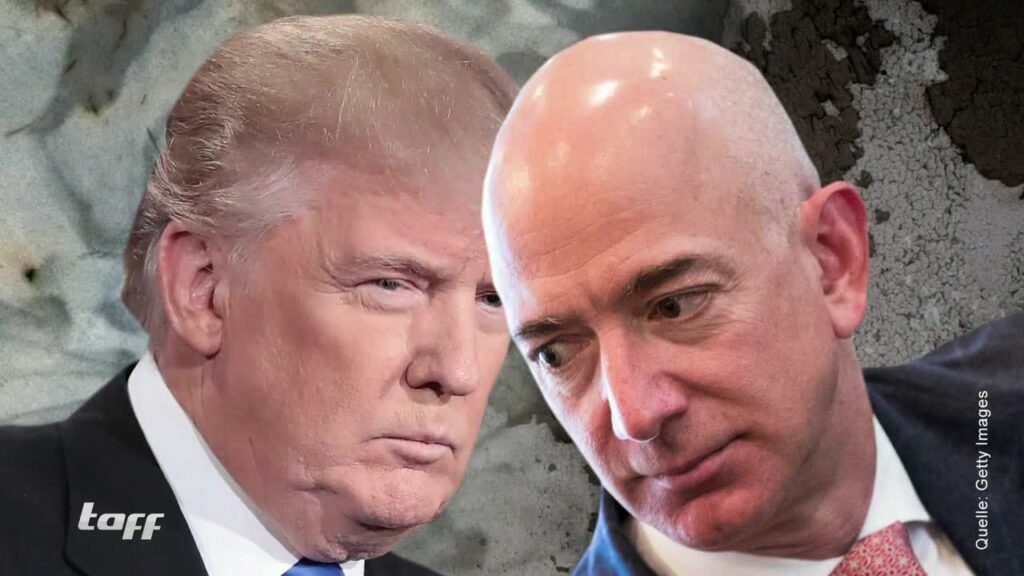
Bezos vs. Trump: The Final Round
What followed was a masterclass in strategic repositioning. While Trump ranted about reciprocity and economic patriotism, Amazon negotiated quietly with Singapore, Ireland, Canada, and the UAE. In the end, Dubai won the bid—offering zero corporate tax for a decade, a bespoke logistics hub, expedited visas for 40,000 Amazon employees, and sovereign data protection.
As Trump’s White House fumed, rumours swirled that Amazon was planning to display tariff costs directly on its product pages, letting U.S. consumers see the true price of political brinkmanship. In a heated phone call, Trump allegedly warned Jeff Bezos against further escalation. Bezos replied, “If you make it impossible to operate here, we will operate elsewhere.”
And that’s exactly what happened.

The Fallout: Economic, Political, Symbolic
On May 6, 2025, Amazon confirmed what insiders already knew: its global headquarters was leaving the U.S.
Seattle plunged into economic turmoil. Thousands of high-paying jobs vanished. The housing market collapsed. Local businesses, once thriving off Amazon’s presence, shut down. City officials were left scrambling to patch gaping holes in tax revenue.
Meanwhile, Amazon was already breaking ground in the UAE. New data centres rose in Abu Dhabi. Fulfilment centres in Oman and Bahrain received automation upgrades. Engineers were retrained in Islamic finance and Gulf compliance. A new digital special economic zone was emerging, and with it, a fresh pipeline of talent from Asia, Africa, and Europe.
Amazon wasn’t downsizing. It was recalibrating—away from American constraints and toward a global future.
A Wake-Up Call America Chose to Ignore
Predictably, Washington exploded in outrage. Senators demanded investigations. Labor unions cried betrayal. Consumer advocacy groups accused Amazon of exploiting the system.
But the deeper question wasn’t about Amazon’s loyalty. It was about America’s attractiveness as a place to innovate, build, and grow.
If the world’s most advanced e-commerce company concluded that U.S. policy had become too erratic and hostile to operate under, what message does that send to others? Apple, Tesla, and Walmart quickly began rethinking their supply chains and lobbying for exemptions. The dominos were wobbling.
The Lesson from the Pacific
From the vantage point of the Pacific—places like Tonga, where we often look to the U.S. as a model of economic power and democratic integrity—this moment demands reflection.
We are reminded that power without wisdom, like policy without foresight, leads to self-sabotage. Amazon’s exit is not just a story of corporate strategy. It’s a warning that in an interconnected world, isolationist policies have real consequences.
And as Amazon builds a new global nerve centre outside American borders, the U.S. must come to grips with a hard truth: it’s no longer the only game in town.
In trying to punish the world, Trump may have just taught it how to play without him.