Supreme Court blocks Lavulavu press exclusion pending constitutional challenge
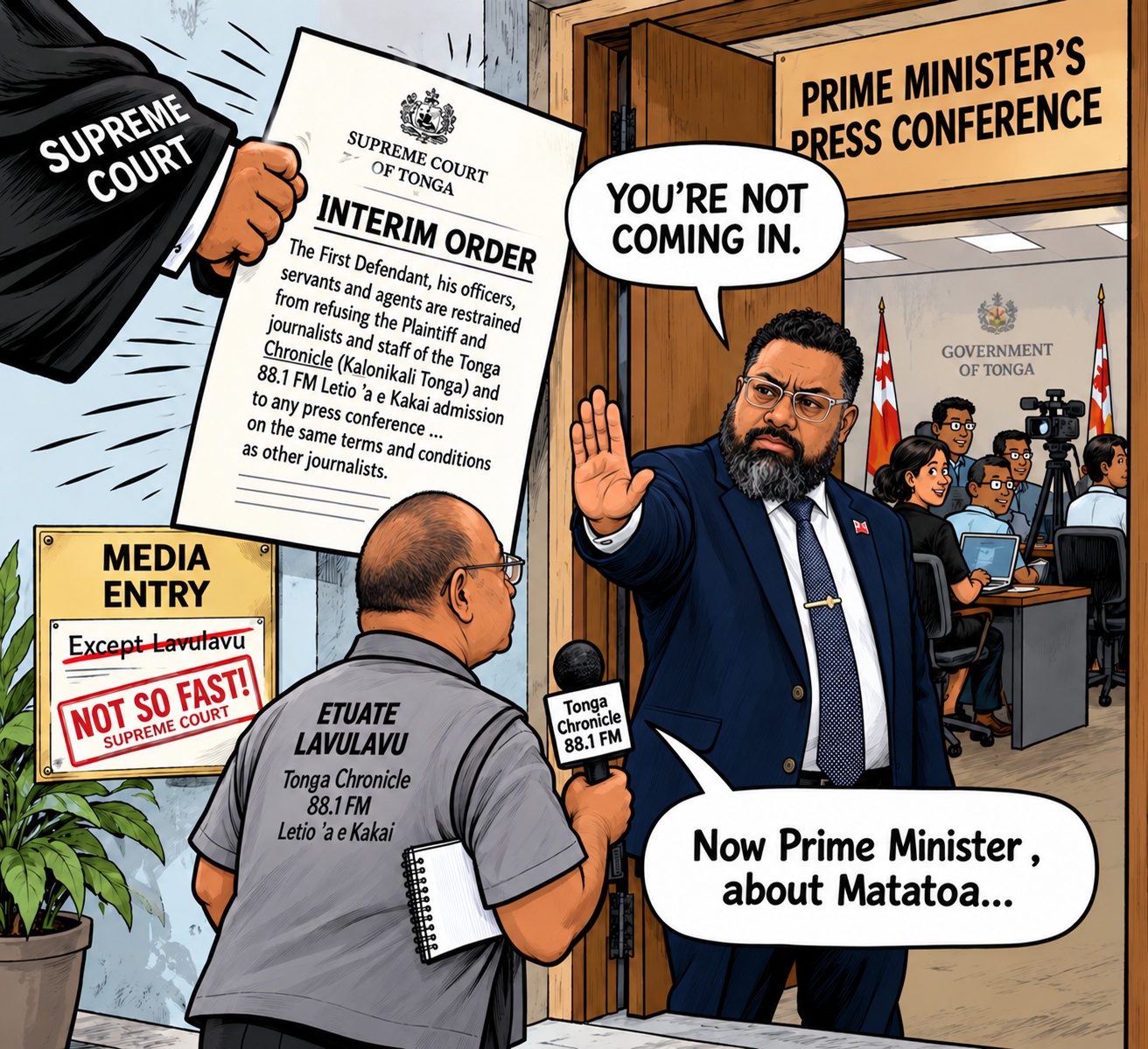
The Supreme Court has temporarily stopped Prime Minister Lord Fakafanua from excluding ‘Etuate Lavulavu and his journalists from Government press conferences, setting up an important test of the limits of a Prime Minister’s power over media access.
The Supreme Court of Tonga has intervened in the dispute between Prime Minister Lord Fakafanua and broadcaster and newspaper executive ‘Etuate Lavulavu, issuing interim orders preventing the Prime Minister and Government officials from refusing Lavulavu and journalists from the Tonga Chronicle and 88.1 FM access to Government press conferences.
The orders, made by Lord Chief Justice Malcolm Bishop KC on 4 September, require Lavulavu and his journalists to be admitted to press conferences “on the same terms and conditions” as journalists from other news organisations.
They must also be permitted to enter the St George Government Building on the same terms as other members of the public and news media.
The intervention is significant because the controversy had produced sharply differing views within Tonga’s media community over whether the Prime Minister was entitled to decide who could attend his press conferences.
Pacific Islands News Association president Kalafi Moala had publicly argued that the dispute was “not a media problem” and that the Prime Minister was entitled to decide who attended his press conferences. Moala said Lavulavu had personally attacked the Prime Minister and characterised attendance as ultimately the Prime Minister’s prerogative.
Closer to home, Tonga’s own media association has remained publicly silent on the exclusion, despite 88.1 FM being a financial member of the organisation.
TIN questioned that position at the time, drawing a distinction between a Prime Minister refusing a private interview and the Government excluding a recognised media organisation from an official Government press conference.
Until now, much of the debate had centred on whether the Prime Minister was simply entitled to decide who attended his press conferences.
The Supreme Court proceedings have shifted that debate.
The question is now whether that discretion exists at all in the circumstances alleged and, if it does, how far it can be exercised consistently with Tonga’s Constitution.
Importantly, the interim order does not mean Lavulavu has won the substantive case, nor has the Court ruled that the Prime Minister acted unconstitutionally.
It means the Court considered the matter sufficiently urgent to make interim orders preserving Lavulavu’s access while his challenge proceeds. The substantive application is listed for hearing on 11 September 2026.
Lavulavu’s Statement of Claim alleges that he was refused entry to the St George Government Building on 14 August when he attended to cover a press conference. It says he was told the refusal was on the Prime Minister’s orders.
It further alleges that Tonga Chronicle and 88.1 FM journalist Amanda Vaipulu was refused entry on 17 August because of her media affiliation, while journalists from other media organisations were admitted.

On 19 August, according to the claim, Lavulavu returned to the Government building seeking an appointment with the Prime Minister about the exclusion and was again refused entry.
Lavulavu is asking the Supreme Court to examine the Government’s actions against several provisions of Tonga’s Constitution.
His case relies on Clause 7, concerning freedom of speech and the press; Clause 4, requiring the same law for all; and Clause 17, requiring the Kingdom to be governed without partiality. He also argues that there was no lawful power authorising his exclusion.
These remain allegations and legal arguments to be determined by the Court.
The constitutional issue is particularly important because these are not private interviews or private meetings. They are official Government press conferences through which ministers announce Government decisions and answer questions from the news media.
That distinction goes to the heart of the case.
A Prime Minister may choose whether to grant an individual journalist a private interview. Whether a Government can selectively exclude a recognised media organisation from an official press conference while admitting others is a very different question.
The Supreme Court will now have an opportunity to examine where that boundary lies under Tonga’s Constitution.
For Tonga’s media, the eventual decision could establish an important precedent extending well beyond Lavulavu, the Tonga Chronicle or 88.1 FM.
Whatever the Court ultimately decides, the dispute has already moved beyond personalities. It is now about the constitutional boundary between executive power and the freedom of journalists to question the Government on behalf of the public.