Part One of Tonga Independent News’ examination of the Government’s 2024 Financial and Compliance Audits
By: Tuífua Vailena
The warning has been issued before.
In 2023, Tonga’s Auditor General found that the Government’s financial statements could not be fully relied upon. Recommendations were made. Responses were noted. The year passed.
In 2024, the Auditor General found the same thing.
The formal term for what has now happened two years in a row is a qualified audit opinion — a declaration by Tonga’s most senior independent financial officer that material issues remain in parts of the Government’s financial statements that could not be fully verified or resolved. It is among the most serious findings an auditor can make. When it recurs, it raises a question that goes beyond accounting.
Who is acting on the Auditor Generals findings?
The letter containing that finding runs to 121 pages. It describes a government that cannot fully account for $737 million in assets it claims to own. It identifies a $4.54 million gap in the fund that receives Tonga’s foreign aid. It documents tens of millions of dollars in accounting errors that the Government’s own financial system failed to prevent. And it concludes, for the second year in a row, with a qualified audit opinion on the Government’s financial statements.
The letter has been delivered. The findings are on the record.
What happens next is a different question — and one that Tonga has struggled to answer.
To understand why that question matters, it helps to understand what the Auditor General’s report is and what it is supposed to set in motion.
Every year, Tonga’s Auditor General produces one of the most important documents in government.
The report examines how public money has been collected, spent, recorded and managed across ministries, agencies and public entities. It identifies weaknesses, highlights risks and recommends corrective action.
Yet a more fundamental question often goes unanswered.
What happens after the report is tabled?
The question has gained renewed attention following discussions about accountability systems in Australia, where parliamentary Senate Estimates committees routinely summon ministers and public officials to explain government spending decisions, procurement processes and administrative failures. Recent scrutiny surrounding the resignation of the head of Australia’s National Anti-Corruption Commission has again demonstrated the role independent oversight bodies play in holding governments accountable.
Tonga has its own accountability framework.
The Auditor General reports to Parliament. Parliament’s Public Accounts Committee is responsible for examining public expenditure and reviewing matters arising from audit reports. In theory, the system provides a mechanism to ensure concerns identified by auditors are followed up and addressed.
In a small island state like Tonga, personal, political and professional relationships often overlap. The risk is that the system can end up asking those with a stake in the outcome to investigate themselves. That is why stronger, more independent oversight mechanisms, similar to Australia’s Senate Estimates Committees, deserve consideration.
However, questions remain over whether the committee has sufficient powers, resources and institutional support to effectively pursue serious findings once they are identified.
One senior Member of Parliament recently told Tonga Independent News that while Tonga’s Public Accounts Committee performs an important function, it requires stronger legal authority to conduct investigations into possible misuse of public funds identified through Auditor General reports and other official sources.
That observation is directly relevant to the findings contained in the Auditor General’s 2024 Financial and Compliance Audits report — a document that deserves close public attention.
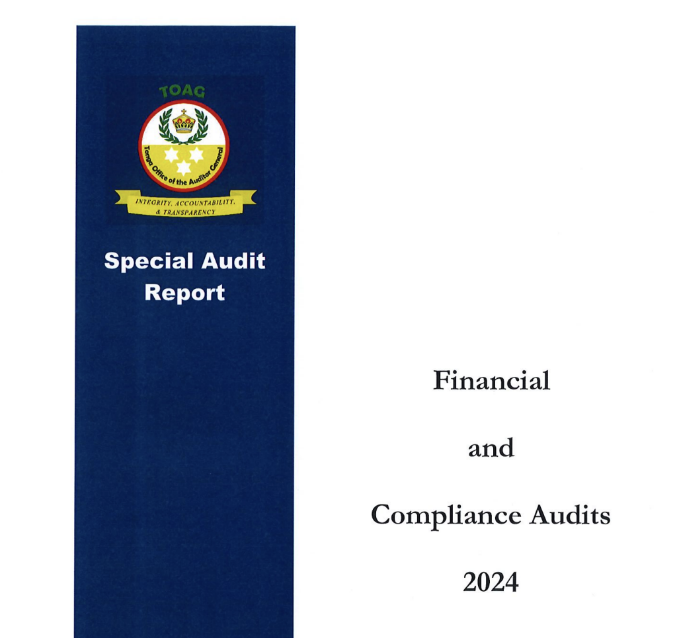
The report, signed by Auditor General Sefita Tangi and submitted to the Lord Speaker on 16 June 2025, covers the financial year ended 30 June 2024. Its central finding is serious: for the second consecutive year, the Auditor General has issued a qualified audit opinion on the Government’s financial statements.
A qualified opinion is not a routine administrative notation. It is a formal declaration by Tonga’s most senior independent financial officer that material issues remain in the Government’s financial statements which could not be fully verified or resolved during the audit.

When the same declaration is made two years in a row, it signals that the concerns identified in the previous audit were not sufficiently addressed before the next one began.
The 2024 qualification was triggered by material problems in two specific areas — the Development Fund cash balance and the valuation of Government assets — both of which will be examined in detail in this series.
But the qualified opinion is not the only concern the report raises.
Among the issues identified were more than $25.16 million in unpresented cheques recorded among bank reconciliation items, including long-outstanding cheques in outer-island government accounts. The Auditor General also questioned a $292.1 million revaluation of government assets and reported that the Government still does not maintain a complete fixed asset register or a formal depreciation policy for all government assets.
Several of these findings have appeared in previous audit reports. Some are now years old. Yet the pattern persists: identified, noted, and left to reappear the following year.
What is clear is that the Auditor General’s Office has done its part. The findings are documented. The recommendations are on the record. The report has been delivered to Parliament.
What is less clear is what happens next — and whether the institutions designed to answer that question are willing and able to do so.
Good governance starts at the top. Audit reports can identify problems and recommend solutions, but they cannot compel action. If the same issues continue to appear year after year, despite repeated warnings, it is reasonable to ask whether accountability is being driven strongly enough from the centre of government. That is one of the questions this series will examine in the weeks ahead.
In the articles ahead, Tonga Independent News will examine each of the major findings in the 2024 report in detail. We will be seeking responses from the Ministry of Finance, the Auditor General’s Office, the Public Accounts Committee and the Prime Minister’s Office regarding the status of these issues and what steps are now being taken to address them.