
Reimagining Pacific Sovereignty in a New Great Game
By Tevita Motulalo
MSc Geopolitics and International Relations
As global power shifts from rules to raw capacity, Pacific island nations face a stark reality: sovereignty in the 21st century may depend less on flags and more on collective strength. If the world is moving toward hard power and strategic control, the Pacific must decide whether to stand alone — or stand together.
The Inheritance of Empire
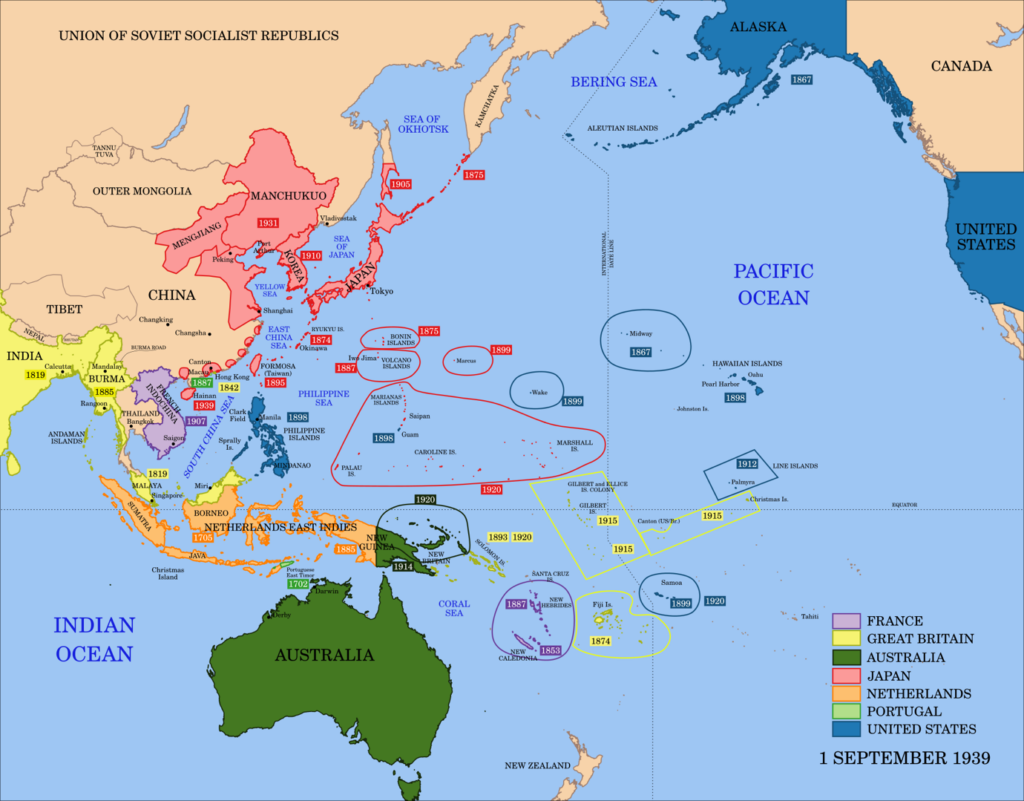
The modern map of the Pacific was largely drawn in the cabins of 19th-century European ships. Borders were not shaped organically by the peoples of the ocean, but formalised through imperial negotiations and colonial administration. These lines reflected the logic of empire and trade, not indigenous political imagination.
There were attempts to think differently. The proposed Confederation of Polynesia envisioned an archipelagic state stretching from Hawai‘i to Tahiti, from Fiji to the Solomons — a unified oceanic political entity rather than fragmented colonial territories. Later, the formation of the Pacific Islands Forum echoed elements of that ambition. Yet even that effort operated within the geopolitical constraints of its time, with Australia and New Zealand eventually seated within the very structure designed to balance outside influence.
For decades after World War II, the Pacific existed within the stabilising framework of the Anglo-American-led order. Colonial borders were preserved under international law, and sovereignty was treated as settled. But as that global order weakens, an uncomfortable question emerges:
Why should the next phase of world politics continue to respect boundaries created by empires that no longer exist?
The Myth of Permanent Sovereignty
One of the quiet assumptions of the modern era is that sovereignty, once granted, is permanent. History suggests otherwise. Major geopolitical transitions — from the Treaty of Westphalia to the collapse of empires — do not merely redraw borders; they redefine the meaning of statehood itself.
We are moving from a rules-based order toward a more openly realist one. In this environment, sovereignty is less a legal entitlement and more a capacity. It depends on economic resilience, technological infrastructure, military reach, and strategic leverage.
For small island states, this shift presents an existential challenge. Many lack the demographic scale or industrial base to influence great powers on equal terms. If international norms weaken and raw capability becomes decisive, fragmentation becomes vulnerability.
Today’s global leadership — whether in Beijing, Moscow, Washington or elsewhere — increasingly views the world through strategic calculations of depth, access, supply chains and resources. In such a context, colonial-era borders are historical facts, not sacred guarantees.
The Death of Distance and the Rise of Digital Dependence
For centuries, the Pacific’s greatest defence was distance. Isolation acted as a moat. That moat no longer exists.
Technology has collapsed geography. Satellite constellations, undersea cables, digital platforms and cloud infrastructure now form the backbone of governance, finance, communication and national security. When critical systems are owned or controlled externally, sovereignty becomes more complicated than a flag and a seat at the United Nations.
A small island state may retain formal independence, yet rely entirely on foreign-owned digital infrastructure. In such conditions, power does not require territorial conquest. Influence flows through systems, contracts and connectivity.
The commodities of the modern era are not spices and plantations, but data, rare earth minerals, energy corridors and strategic sea lanes. Control over these networks shapes the next phase of global competition.
Fragmentation or Consolidation
The Pacific now faces a defining choice.
The current model is fragmentation. Individual states negotiate bilateral security arrangements, infrastructure loans or resource deals independently. While often necessary, such arrangements can create asymmetries and strategic tensions between neighbours. When states negotiate alone, they negotiate from weakness.
The alternative is deeper regional consolidation — not simply dialogue forums, but structural alignment. This does not require the erasure of national identity. It requires coordinated sovereignty.
If the Blue Pacific were treated as a unified strategic space — a “liquid continent” rather than scattered dots — the region could aggregate its maritime zones, economic leverage and diplomatic weight. A collective framework could negotiate with major powers from a position of scale rather than isolation.
This is not about dissolving states. It is about amplifying them.

The Australia–Pacific Question
Any serious reorganisation of Pacific strategy inevitably includes Australia.
For decades, debate has framed the relationship as a binary: will Australia dominate the Pacific, or will the Pacific resist Australia?
That framing may now be outdated.
Australia increasingly recognises that its security is inseparable from the stability and strategic alignment of its northern and eastern neighbours. At the same time, Pacific states understand that standing entirely alone in a harsher geopolitical climate may invite pressure from larger powers.
The emerging possibility is not absorption, but structured interdependence: a Pacific community in which Australian capital and security capabilities align with Pacific geography and sovereign decision-making. Such an arrangement would need to be negotiated carefully, transparently and on equal terms. But the logic of collective resilience is becoming harder to ignore.
An Imaginative Challenge
The deeper challenge is conceptual.
Can Pacific leaders imagine sovereignty not merely as inherited independence, but as shared strategic power?
For centuries before European contact, Pacific societies navigated and governed vast ocean spaces through networks rather than rigid territorial lines. The recent period of state-centric globalisation may prove to be an anomaly in longer human history. Regional power blocs, not isolated micro-states, may once again become the norm.
If that is the direction of travel, the Pacific must decide whose orbit it will enter — or whether it will create one of its own.
Remaining fragmented risks long-term dependency and external competition played out across island states. Coordinated consolidation offers the possibility of redefining sovereignty for the 21st century — not as isolation, but as structured strength.
The New Phase of the Game
The emerging global order is colder and more transactional. Strategic requirements increasingly shape policy decisions. The Pacific Islands, despite small landmasses, occupy vast maritime territories that are central to future energy routes, resource access and military positioning.
The political question is no longer simply about independence. It is about interdependence — on whose terms and under what structure.
The Pacific can continue as a collection of individually sovereign but strategically exposed states. Or it can build a durable regional architecture that converts geography into collective power.
The choice is stark: consolidate and shape the next era — or remain divided within it.